Get Full Government Meeting Transcripts, Videos, & Alerts Forever!
Get email alerts on the Council Reduction Act topic
No spam. Unsubscribe anytime.
Metro committee hears legal update on 2023 Council Reduction Act; court argument docketed for Feb. 12
Summary
Metro’s Director of Law, Wally Dietz, told a council committee that Metro has filed briefs in its challenge to the 2023 Council Reduction Act, that a preliminary injunction was granted on April 10, and that the case is currently docketed for argument on Feb. 12 with a reply brief due Jan. 16.
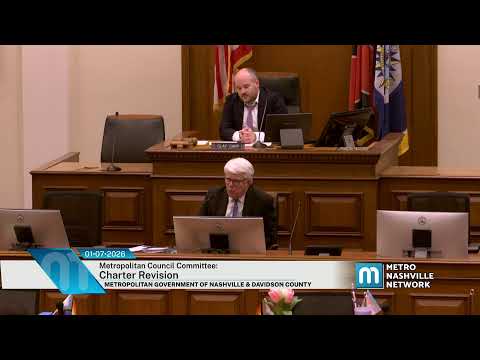
Chair Sharon Capp convened a committee meeting to brief council members and the public on ongoing litigation over the 2023 Council Reduction Act and to hear questions from council members. Metro Director of Law Wally Dietz, who is leading the legal team, delivered the update and laid out likely next steps.
Dietz told the committee that Metro sued over four 2023 measures affecting local governance and that Metro prevailed at the trial court on all four claims; the fairgrounds-related measure was not appealed. He said Metro filed a challenge to the council‑reduction provision and obtained a preliminary injunction on April 10. “We filed suit within a week. We asked for a preliminary injunction, and we won that injunction on April 10,” Dietz said.
Dietz described what he called “extraordinary” provisions in the 2023 act: a mandatory reduction of metropolitan councils larger than 20 to a 20‑member body; statutory requirements directing the planning commission to draw district boundaries on a tight timetable with no council discretion; and a provision that could have extended current council members’ terms by one year if the council did not complete required legislative steps before an election deadline. Dietz said those provisions were central to Metro’s claims that the law was an overreach of state authority.
On procedure, Dietz summarized the appellate posture: Metro filed its opening brief in November, the state filed its brief on Dec. 19, and Metro’s reply brief was due Jan. 16. The clerk has indicated the case is docketed for oral argument on Feb. 12, though Dietz emphasized the court had not yet issued a formal calendar order. “We will have a month, to prepare the argument, 3 and a half weeks to prepare the argument,” he told the committee.
Dietz said Metro’s leading legal argument is based on the Tennessee Constitution’s Home Rule Amendment and the constitutional exemption for consolidated (metropolitan) governments from the general 25‑member county cap. He described that constitutional argument as Metro’s strongest claim. He also said Metro has raised alternative arguments, including mootness for parts of the statute whose deadlines have expired.
Dietz outlined two broad outcomes: if Metro wins, the litigation ends and the council would proceed with the 2027 election on the existing 40‑member structure; if Metro loses, there are multiple procedural paths the courts could take and many implementation questions that would follow. “We win, case over. We have an election in 2027 with 40 council seats at play,” Dietz said. He urged the body to wait for the court’s guidance before taking legislative steps.
Council members pressed practical questions about implementation if the law were upheld, including whether the council would present one configuration or several options to the planning commission and whether any new map would go to voters. Dietz said state law would guide post‑census mapping procedures but that the present situation is atypical; he offered to research the state statutes about maps and follow up with the committee. He also told members that, in Metro’s prior guidance, two‑term limits would remain applicable to incumbents even if districts were redrawn, though staff would revisit that question in detail.
Several council members stressed public engagement if changes became necessary. Council member Benedict told the committee she hoped Metro would win but said, “I think in preparation of the scenario of if we don't, that we need to be clear with the voters ... we need them to create any new government that would be required.” Chair Capp said she was committed to a consultative, community‑driven process if the council must consider structural changes.
No formal motions or votes were taken during the session. The committee agreed to plan a follow‑up update after the Supreme Court argument timeline becomes clearer and to coordinate meeting dates through the council office. The meeting concluded with thanks to Director Dietz; the committee adjourned.