Housing Division outlines Round 16 Barnes Fund rules, eligibility and application process
Loading...
Summary
The Housing Division held a webinar to present draft Round 16 Barnes Fund grant policies, including eligibility thresholds, scoring criteria, a $750,000-per-project cap, and a new prohibition on applicant-staff communications during the application window; final policy text and funding totals will be published later.
Angie Hubbard, Director of the Housing Division, led a public webinar explaining draft Round 16 Barnes Fund grant policies and the application process. She said the RFA "is to solicit applications from qualified nonprofit organizations looking to apply for grant funds to create and preserve affordable rental and limited-equity cooperative housing," and emphasized the agency’s goal of equitable and transparent evaluation.
Hubbard told attendees that final funding totals had not been released and that staff would publish the final figures with the RFA. On awards, she said the proposed maximum grant per project is $750,000. She described a small-organization set-aside and said some project types (notably rental limited-equity cooperatives) may be eligible for bonus points under the draft scoring matrix.
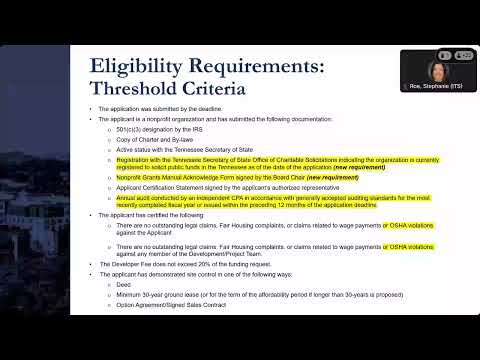
On eligibility, Hubbard explained key threshold requirements. Applicants must be registered to solicit charitable funds (as shown by the Secretary of State / office of charitable solicitation documentation), acknowledge the nonprofit grants manual, and — if requesting more than $50,000 in Metro funds — submit a most-recent annual audit. "If you don't submit the audit, you don't pass threshold," she said. The team will clarify how out-of-state nonprofits document good standing in their charter state.
Hubbard described the types of projects eligible for Barnes Fund money in Round 16: new buildings or homes that have not previously received a Barnes Fund award, scattered-site rental, conversions (for example, motel-to-housing), and a range of housing typologies from single-family to multifamily. Eligible costs listed include acquisition (including improvements), soft costs, and construction (with up to 30% of a grant required for construction costs). She clarified that developer fee is separate from soft costs and must be documented in application materials.
The webinar also outlined ineligible uses: Barnes funds cannot be used for homeownership or owner-occupied rehab work in this round, relocation costs for tenants, rental assistance, operating subsidies, or general nonprofit operating payroll unconnected to project management. Hubbard said that the grant is reimbursable for documented costs except in the case of acquisition where escrow procedures would be used.
Hubbard described new and clarified evaluation elements. The draft scoring matrix is divided into housing security criteria, project approach, underwriting, and (for rental) a bonus-points category; applicants may only claim the maximum points for a single target within certain subcategories rather than combining overlapping point allocations. She said staff will provide ranges and clearer guidance for items such as affordability-term scoring and universal-design checklists to reduce subjectivity.
On submission and process, Hubbard announced a prohibition on communications between applicants (or anyone on an applicant team) and Housing Division staff, members of the Housing Trust Fund Commission, or evaluation committee members once the official RFA is released and until the commission votes on recommended awards; violation of that rule could bar an application from consideration. The team also plans to use the Neighborly application portal, will publish a required checklist and cure period for missing documents (not to enable completing an application after the deadline), and noted that all awards must be approved by Metro Council before becoming effective.
Hubbard concluded by inviting written comments (BarnesFund@Nashville.gov), saying the commission will receive red-line revisions and compiled comments ahead of its January meeting, and confirming a later public comment opportunity during the commission meeting.