
Surry County leaders defend creation of countywide fire service district as residents plead to save Franklin and Banner Town departments
Get AI-powered insights, summaries, and transcripts
Subscribe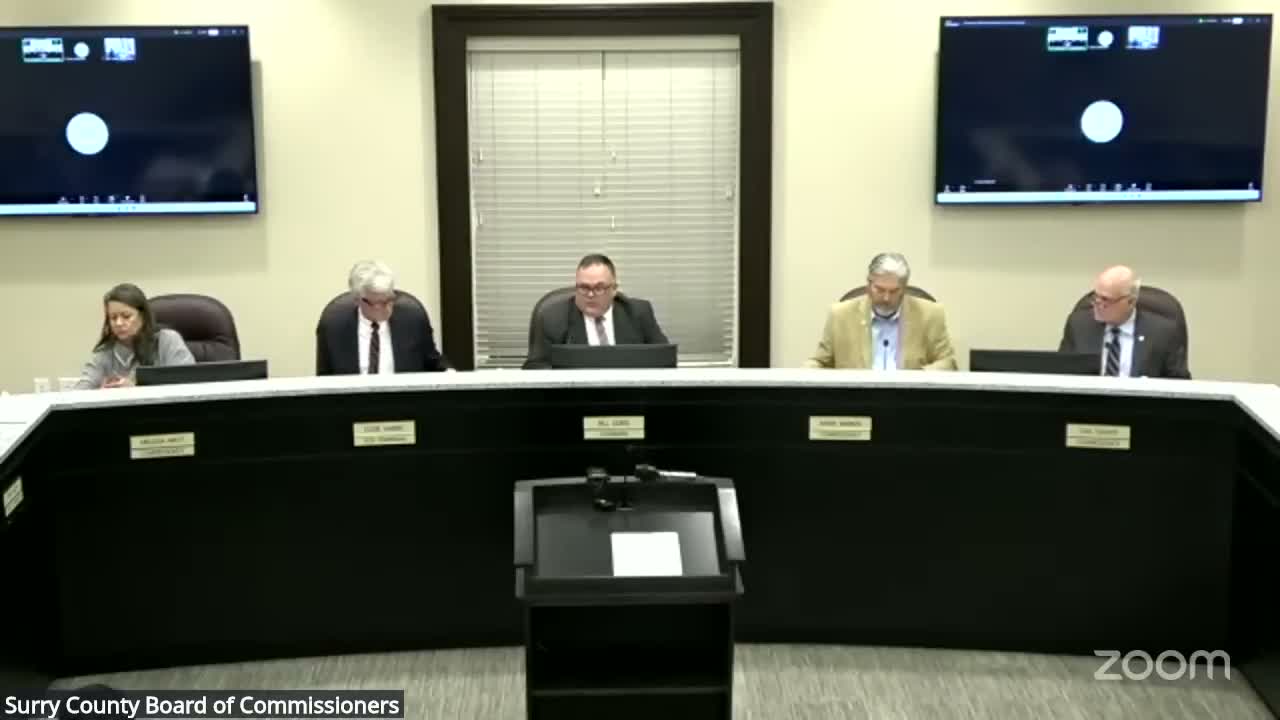
Summary
Surry County commissioners defended a newly adopted countywide fire service district, a funding matrix and a fire commission, citing consultant findings on uneven funding and departmental nonresponse. Dozens of residents gave emotional testimony urging the board not to withdraw contracts for Franklin and Banner Town departments.
Surry County commissioners spent the bulk of their Jan. 5 meeting defending a recently adopted countywide fire service district and new funding rules and listening to hours of public comment from residents who said the changes would undermine local emergency response.
The chair of the meeting (identified in the transcript only as the chairman) told residents the board adopted three changes after review: a countywide fire service district (excluding Mount Airy and Elkin) with a uniform tax rate, a funding matrix intended to allocate funds by need rather than by historic allocations, and an independent fire commission to assess department needs and advise the board. “Please listen closely to the numbers we share with you. They speak for themselves,” the chairman said during his presentation.
Why the change, the board said The county’s presentation cited a consultant, North Carolina Fire Chief Consulting, and consultations with the state fire marshal. The presenter said long-standing disparities left a few departments receiving a much larger share of property-tax disbursements for fire protection. The slides shown to the board, the presenter said, listed fiscal-year 2024–25 disbursements that ranged from $841,557.83 (listed for Better/Banner Town on the slide) down to $112,030.21 for Shoals, totaling $4,475,660.68 across the county. The presenter told the meeting that equalizing every department to the largest recipient would require more than $7.5 million in additional funding.
The presenter also cited department performance data from the consultant’s six‑year review, saying some stations had high "no‑response" rates. As an example, he pointed to station-level figures in the consultant’s report and singled out a station listed as Station 71 (Franklin) where the report showed a high no‑response figure; the presenter also contrasted Franklin’s FY2025 funding ($550,262.10) with Pine Ridge’s ($248,516.51) and said Franklin recorded 942 calls and 386 no‑responses in the consultant’s dataset.
County: actions were public and staff will help if needed The presenter said those changes and the funding matrix were adopted in open session, after public notice, and after a public hearing. He also said the county would work with affected departments if assets or stations required transfer or if assistance was needed, and denied that the county intends to shut down volunteer firefighters themselves.
Public comment: dozens oppose contract changes When the chair opened a three‑minute open-forum period, dozens of residents spoke, many with personal or long volunteer histories. Speakers described life‑saving responses by local volunteer departments, gave near‑miss personal accounts and argued the county had not communicated clearly. Examples: - A longtime volunteer said, “I myself was a volunteer firefighter for 28 years” and urged commissioners to remember what volunteering requires. - Multiple residents described specific rescues they credited to Franklin or Banner Town first responders, including a 911 call that reached Franklin before EMS and a child who was stabilized by Bannertown personnel. - Chris Baker, identified in public comment as a Bannertown chief, said his private business is unrelated to county decisions and said he had tried to meet with commissioners and the county manager before the dispute escalated.
Concerns raised included perceived secrecy (closed-session meetings were cited by commenters), the wording of a county press release that said some services "will no longer be needed after 07/01/2026," the risk of increased response times and higher homeowner insurance premiums, and the potential loss of volunteers if local stations lose contracts or funding.
Board response and next steps After public comment the chair said the board would take the testimony “under advisement” and would not make a decision that night; he said the board intended to continue working on the issue and expected to take action in the coming month. A county attorney also told the audience that existing resolutions could be changed by the board and that “nothing is set in stone.”
Why it matters The board framed the changes as a response to fiscal inequities and operational performance differences identified by a consultant and reviewed with the state fire marshal. Residents countered that the consultant’s data and the board’s communications had not translated into an adequate public engagement process and that closing or defunding locally based departments could risk lives on the margins of response time.
What’s next The commissioners said they would continue to review the matter and consider petitions and additional public input before a final decision. No new contracts or station closures were enacted at the Jan. 5 meeting; commissioners said they expect further deliberation in the next month.