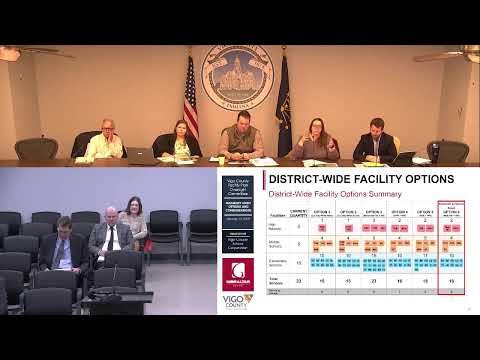
Vigo County presenters outline plan for new countywide high school, repurposing up to eight elementary sites
Loading...
Summary
Consultants presented a feasibility study to the Vigo County School Board proposing Option 6: a new high school east of the Wabash River, renovation of West Vigo, conversion of North/South to middle schools and repurposing or closure of several elementary sites; presenters cited a $14M annual maintenance shortfall and said updated cost estimates will follow.
Consultants working with Vigo County schools presented a feasibility study and a recommended reorganization plan that would put a new countywide high school east of the Wabash River at the center of a larger plan to modernize facilities.
At a presentation to the school board, a lead presenter said the district’s maintenance math is driving the discussion: “On average, we need about $23,000,000 per year just to do annual maintenance, and there’s only $9,000,000 available,” creating a recurring shortfall that leaves the district unable to sustain the current 23‑school footprint without major changes. The consultant said the study focused on building function, future‑readiness, operational affordability and return on investment when comparing options.
The study groups options into several models: keep both existing high schools and renovate (two‑high‑school model); build one new high school on a new site and convert North and South into middle schools (the one‑high‑school model); or renovate an existing campus to serve countywide enrollment. The consultants told the board a new high school sized for roughly 3,200 students would typically be designed to operate at about 85% capacity to allow for modest growth and scheduling needs.
Presenters emphasized tradeoffs. Building a new high school would allow North and South to be vacated and renovated off‑site without students present, which consultants said can roughly halve construction time versus phased work while occupied. But a countywide site raises transportation and access questions: presenters noted limited bridge crossings of the Wabash River and asked the board to consider how bridge maintenance or closures could affect students from the West Side.
Site requirements and costs were discussed but not finalized. Consultants estimated a new high‑school site could require roughly 80–100 acres depending on access and water‑mitigation needs; they also reported that modern electrical, plumbing and code upgrades add complexity and cost when retrofitting older campuses. Individual modernization costs, the presenters said, vary widely — some repurposed buildings could cost more than $10,000,000 to modernize and a few projects approach $30,000,000 — and district staff will update those figures to reflect recent inflation.
The consultants identified several community and program priorities that shaped recommendations: preserving smaller elementary‑school options where affordable, adding alternative‑education and career‑center capacity, providing outdoor/FFA learning space and partnering with local institutions (Ivy Tech, Union Hospital, Boys & Girls Club, Purdue 4‑H). They said a centralized career center or stronger Ivy Tech partnership would reduce peak building enrollment and specialized classroom duplication.
Board members pressed on logistics, asking whether existing campuses could absorb larger populations and how construction would proceed with students on site. A Gibraltar consultant answered that some campuses (for example, Terre Haute North) could not sustain the plumbing and underground infrastructure demands of hosting all students without major replacement work. The presenters also said the district’s current bonding capacity could support a 20‑year bond to address one of the high‑school projects without raising rates; doing both high‑school projects at once would likely require a tax increase or additional county partnership.
Public comment focused on early‑learning and special‑education placements. A local resident, Debbie Constantine, asked whether a proposed early‑learning center (pre‑K) at Sugar Grove would remove pre‑K from existing schools and how special‑education classes currently housed at Farrington Grove and other sites would be accommodated; board members said pre‑K and special‑education placement remain under consideration and that special‑education space would be included in planning.
Next steps: presenters said updated, inflation‑adjusted cost and savings numbers would be prepared and shared — staff aimed to have revised figures available around Martin Luther King Day or shortly after. The study team also noted county finance officials will be asked to provide an independent analysis of potential county partnership and bonding capacity before the board moves to any referendum or final decisions.
Votes at a glance: the board approved the meeting minutes at the start of the session (motion by Speaker 2, second by Speaker 3) and later recessed to public comment and adjourned after the meeting (motion to adjourn by Speaker 5, seconded).