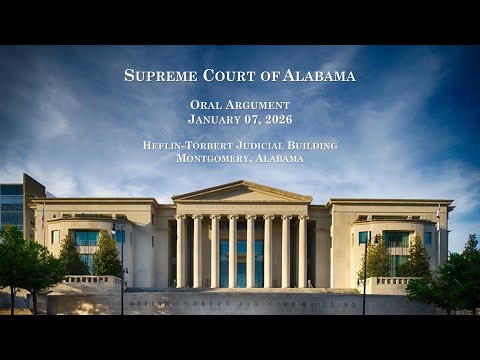
Alabama Supreme Court Hears Question on Whether Officers May Demand Physical ID During a Terry Stop
Loading...
Summary
The Alabama Supreme Court heard argument on a certified question whether Ala. Code §15-5-30 allows officers during a valid Terry investigatory stop to demand physical identification (such as a driver's license) and whether refusal can support arrest for obstruction. Counsel for the appellant urged a limited reading; respondent counsel cited Heibel and urged a verification-based, reasonable-officer test.
MONTGOMERY, Ala. — The Supreme Court of Alabama heard oral argument on a certified question about the scope of Ala. Code §15-5-30 and whether a police officer who has made a valid Terry investigatory stop may demand a suspect's physical identification, such as a driver's license, and arrest the person for obstruction if they refuse.
Harry Daniels, representing appellant Michael Jerome Jennings, told the court that reading the statute to permit compelled production of physical identification would "fundamentally distort" Fourth Amendment protections and risk arbitrary enforcement. "Freedom cannot thrive under the capricious demand of the state," Daniels argued, saying the statute authorizes requests for name, address and an explanation of conduct but does not authorize the officer to compel a document.
Daniels acknowledged the stop in the underlying incident was a valid Terry stop but emphasized context: the individual gave a name and explained he lived across the street, and Daniels said officers did not take steps to verify the oral information by asking follow-up questions before seeking a license. He told the court the Eleventh Circuit's approach — which in the lower courts favored a broader reading — should not bind the Alabama Supreme Court's interpretation of state law.
Ed Hadden, counsel for officers Smith, Gable and Brooks and the City of Childersburg, countered that federal precedent and the statutory text support allowing officers to use documents to verify identity. He cited Heibel, a U.S. Supreme Court decision noting that a suspect may communicate a name "by other means," and said a driver's license is one common and reliable means of verification. "The statute says 'demand,'" Hadden told the justices, arguing that demand contemplates the officer's ability to obtain documentary verification when a reasonable officer, under the totality of the circumstances, takes reasonable steps to determine a suspect's true name, address and explanation.
Justices pressed both parties on where the line should be drawn between permissible follow-up questioning and a compelled production of documents. Several justices asked whether the statute's "demand" language requires an officer to accept a verbal answer, or instead permits verification through documents when an officer reasonably suspects a false name or incomplete information. Counsel for the respondents argued for an objective reasonable-officer standard focused on the totality of the circumstances; counsel for the appellant urged a narrower reading to avoid creating a de facto requirement that citizens carry identification at all times.
The court also discussed whether refusal to produce identification could support an arrest for obstruction under Alabama law. Counsel and the bench queried whether obstruction requires intentional interference or physical force, and whether failure to comply with a demand under §15-5-30 can constitute an independent unlawful act.
Neither side argued that the Fourth Amendment question resolved the case; instead, they asked the state high court to answer a certified state-law question sent up by the federal district court. The justices took the matter under submission and said they would issue a ruling in due course.
The case was styled Michael Jerome Jennings v. Christopher Smith, Justin Gable, Jeremy Brooks and the City of Childersburg, No. SC20250372. The court adjourned after taking the certified question under submission.