
Metro Nashville outlines $10.8 million CDBG-DR plan to rebuild homes, prioritizes 24th Avenue site
Get AI-powered insights, summaries, and transcripts
Subscribe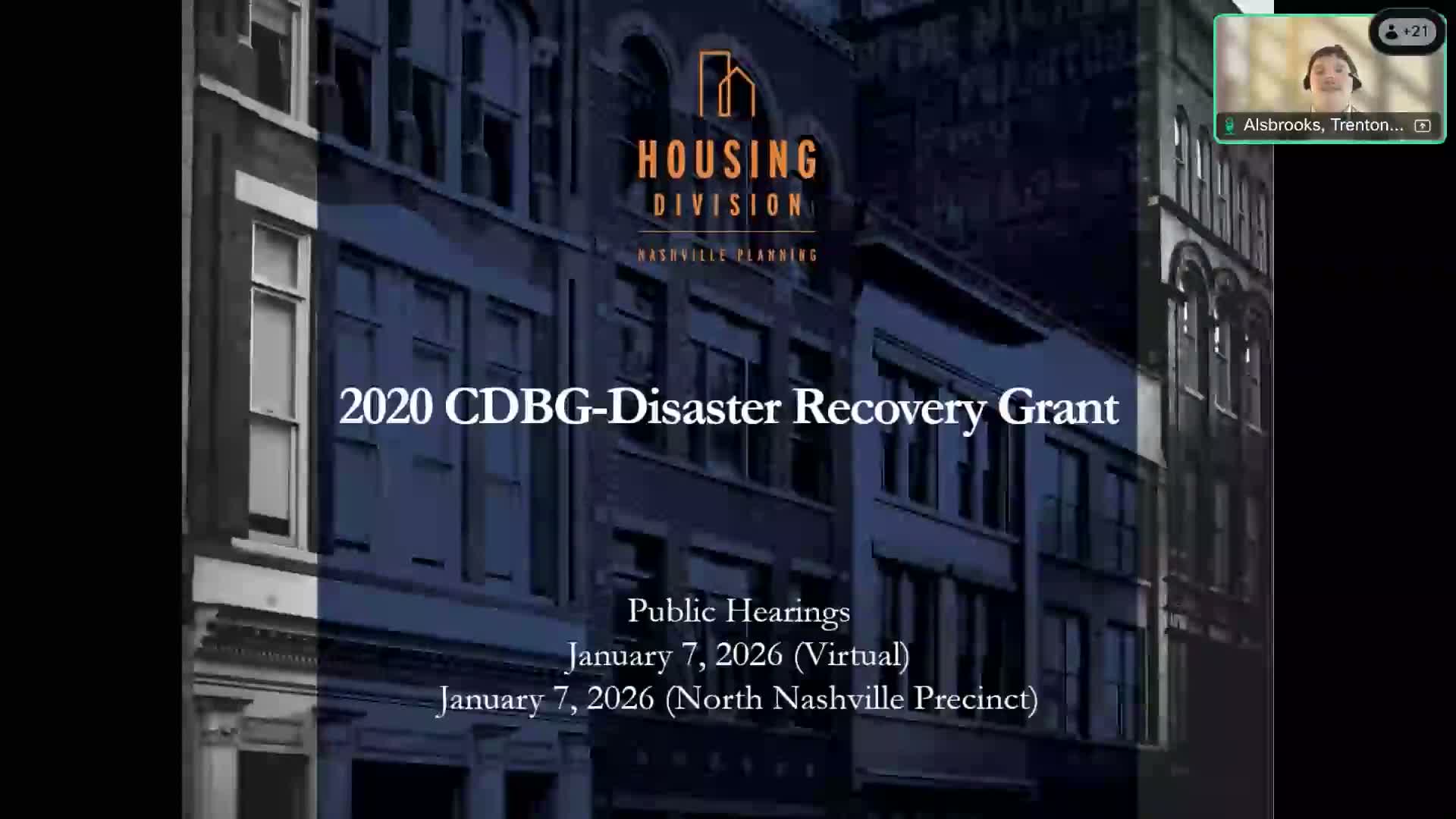
Summary
Metro Nashville Planning presented a draft CDBG-DR action plan proposing about $10.8 million for acquisition/rehab, new construction, mitigation and administration targeted to tornado-impacted ZIP codes; the first new-construction RFP will be paired with a Metro site at 2119 24th Avenue North, with comments due Jan. 12, 2026.
Metro Nashville’s Housing Division on Wednesday laid out a draft Community Development Block Grant–Disaster Recovery (CDBG-DR) action plan that would channel about $10.83 million into four activities: acquisition and rehabilitation of vacant tornado-impacted homes, construction of new for-sale homes, mitigation work on at‑risk owner-occupied properties, and grant administration.
Trenton Allsbrooks, housing program specialist with Metro Planning, told a virtual public hearing that the funds respond to the March 3, 2020, tornado and are intended for long-term recovery and neighborhood stabilization, not immediate repair work. “This grant is meant to address unmet housing needs, to further long-term recovery and neighborhood stabilization,” Allsbrooks said.
The plan divides funds roughly among rehabilitation/reconstruction (about $1.6 million), new construction (about $7.06 million), mitigation ($1.624 million) and administration (about $515,593), Allsbrooks said. He emphasized all activities are subject to approval by the State of Tennessee Economic and Community Development (TNECD) and the U.S. Department of Housing and Urban Development (HUD).
Why it matters: Metro staff said the programs aim to return affordable homeownership to neighborhoods hit by the tornado, preserve housing stock and reduce future disaster risk. Most activities will be targeted to a set of ZIP codes identified in the action plan as “most impacted and distressed.” The plan ties long-term affordability to 30‑year deed restrictions and resale requirements so units remain available to households at or below 80% of area median income (AMI).
Key program details
Rehab and reconstruction: Nonprofit subrecipients would be competitively procured to acquire vacant homes through voluntary acquisition in priority ZIP codes, then rehabilitate or reconstruct to HUD green retrofit standards. Costs for acquired homes must not exceed 10% of current appraised value for the acquisition-related funding category, and rehabilitated homes will be sold to income‑eligible households at or below 80% AMI under a 30‑year deed-restricted covenant.
New construction: About $7.06 million is earmarked for new homes to be built by nonprofit partners in the priority ZIP codes. Metro said it will make a Metro-owned parcel at 2119 24th Avenue North available and the first request for proposals (RFP) for new-construction funding will be paired with that site. The parcel requires rezoning, and developers must work with the council member and the community. For single‑family detached units the income limit is 80% AMI; for multifamily projects 75% of units must be affordable at ≤80% AMI and 25% at ≤120% AMI; all homes must be comparable in size and finishes and will carry 30‑year affordability restrictions.
Mitigation: Per the Federal Register rules governing CDBG‑DR, 15% of the grant is set aside for mitigation activities (approximately $1.624 million). Metro said these funds will support rehab of owner‑occupied substandard homes across the county (priority given to areas at high displacement risk). Work must comply with the green retrofit checklist and cannot fund repairs already completed with other public or private disaster recovery dollars; liens and cost‑recapture agreements will protect the public investment.
Administration and federal requirements: Administration is capped at 5% (roughly $515,593) to support grant administration, federal procurement and the HUD environmental review process; MDHA may assist with procurement and environmental review. Projects will be subject to NEPA/environmental review, Davis‑Bacon wage rules where applicable (new construction), Section 3, civil‑rights and fair‑housing rules, and duplication‑of‑benefits analysis.
Public questions and clarifications
At the hearing, community participants asked whether faith‑based or community nonprofits could partner with qualified developers rather than serve as sole developers. Angie Hubbard, Metro’s housing director, said federal rules apply and Metro will clarify eligible applicants and lead‑partner requirements in the RFP. “With these being federal dollars, we will need to consult with HUD on their requirements,” Hubbard said.
Several participants asked whether acquisition of vacant or tornado‑impacted lots and homes would be reimbursable when paired with new construction. Hubbard clarified that acquisition of vacant homes for rehab/reconstruction is a separate activity from new construction, and acquisition and rehab/reconstruction costs listed in the action plan are eligible for reimbursement after HUD environmental review and release of funds. She noted the activity covers vacant homes (not simply vacant lots) and that environmental review must clear any property before contract or construction begins.
A caller asked whether the CDBG‑DR dollars can be layered with other subsidies; Hubbard said layering is possible but cautioned that HUD environmental review or other funding‑source restrictions could pause construction and that Davis‑Bacon requirements apply to new construction.
Next steps
Metro expects to submit the action plan to TNECD in February 2026 and aims for state approval and Metro Council appropriation in the spring; the RFPs and program development are planned for spring and summer 2026. Public comments on the draft action plan are due by 12:00 p.m. Central on Jan. 12, 2026, and can be submitted via the online comment form, email (metrohousing@nashville.gov), mail, or hand delivery. The webinar recording and materials will be posted on the housing division’s disaster recovery website.
The Housing Division will summarize comments received and indicate whether recommendations were incorporated into the final action plan submitted to the state. Allsbrooks closed by reminding participants there would be a separate in‑person meeting that evening at the North Nashville Precinct at 5:00 p.m.