
Judicial branch outlines treatment-court grant process and local match ask for Fremont County
Get AI-powered insights, summaries, and transcripts
Subscribe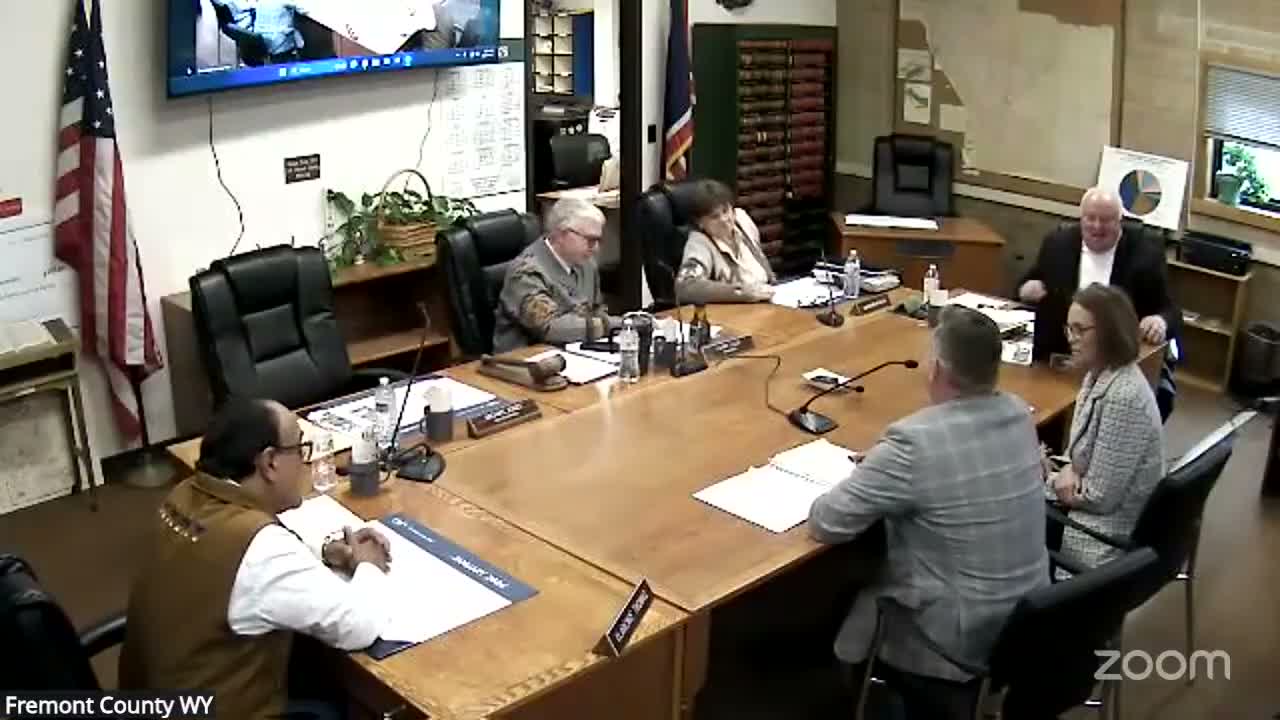
Summary
Judicial-branch officials told Fremont County Commissioners that the grant process for adult and juvenile treatment courts requires a 25% local match but that effective programs often rely on larger contributions; the county was asked to consider $149,449.05 for the adult CAST program and $95,563.04 for juvenile JTC funding ahead of a behavioral health committee review.
Victor Payne, the chief court services officer for the administrative office at the judicial branch, told the Fremont County Commissioners that the branch’s treatment-court grant cycle for 2027–28 is underway and that applications are being reviewed.
Payne said the behavioral health committee will screen applications on Jan. 29 and forward funding recommendations to the judicial council, which is scheduled to decide in March; award letters and subsequent county contracts would follow in late spring or early summer. “They will meet … and we’ll make a recommendation, for the amount of funding each program gets,” Payne said.
Why it matters: the judicial branch requires a 25% local match for grant eligibility, a carryover from Department of Health rules the branch continued when responsibility moved to the courts. Payne cautioned that many programs report needing more than the minimum to operate effectively; after removing a high outlier, he said the statewide average reported match across 16 treatment courts is about 63%.
The commission discussed the specific figures Director Goff submitted for Fremont County. Payne identified the county figures in the current application as $149,449.05 for the adult CAST program and $95,563.04 for the juvenile JTC program. He also said earlier county reporting showed a larger local contribution (about $238,002.71) that, if used, would alter Fremont County’s relative ranking among counties.
Payne highlighted permitted uses of optional surcharge revenue — a statutory surcharge up to $50 judges may impose for drug and alcohol crimes — noting surcharge funds may be requested in grant budgets for training or pilot activities. “Any program can ask for whatever amount they would like of surcharge money,” he said.
Commissioners raised concerns about the potential scale of local contributions if state funding tightens and asked what the county should prepare now. Payne recommended the commission decide whether to endorse the application figures so the behavioral health committee would have accurate county-requested match amounts when making recommendations.
Next steps: the behavioral health committee review is scheduled for Jan. 29 and the judicial council will act in March; commissioners discussed preparing a revised county funding letter and, if necessary, exploring supplemental local or settlement funding if awards fall short.
Ending: Commissioners agreed to prepare figures and follow up with staff on whether opioid-settlement or other locally controlled funds could mitigate a shortfall if the judicial-branch award or state appropriation changes.