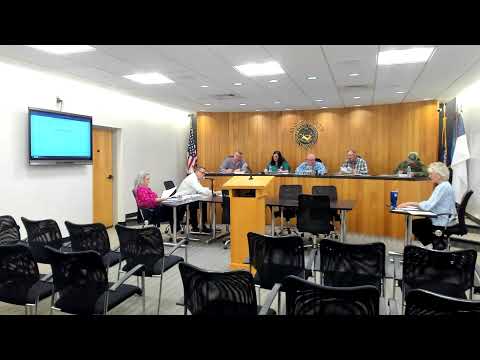
Grayson County supervisors elect leaders, adopt remote participation policy and code of ethics
Loading...
Summary
At its Jan. 8 organizational meeting, the Grayson County Board of Supervisors elected chair and vice chair, appointed Jenny as clerk and a deputy clerk, and adopted 2026 rules including a remote participation policy and a code of conduct and ethics. A closed session was added to tonight’s agenda.
Grayson County’s Board of Supervisors held its organizational meeting Thursday evening, electing leadership, appointing clerks and adopting governance policies. The meeting, convened at about 7:05 p.m., included approval of the agenda, the board’s 2026 rules and a new remote participation policy, and concluded with plans for a closed session later in the meeting.
Board members nominated and approved a chair and a vice chair by voice vote after brief nominations and seconds. The board also moved to appoint Jenny, identified in the meeting as county administrator services and the clerk, and to appoint a deputy clerk; both appointments were approved by voice votes with no roll-call tallies recorded in the transcript.
Members reviewed and adopted the remote participation policy, which the meeting record describes as allowing remote attendance for emergencies such as illness, with procedural limits including what was discussed as "two" remote participations or a 25% threshold for remote members. Board members asked for clarification on notice and technical arrangements for remote callers before approving the policy.
The board adopted its 2026 rules and procedures with no substantive changes, and discussed public comment procedures: the default limit is three minutes per speaker for general public comment, with an option for a group to designate a single representative (the group representative may speak for up to six minutes total).
Officials also discussed regular meeting scheduling (second Thursday of each month at 6:00 p.m.) and noted potential scheduling overlap with other local authorities, such as the public service/water authority and a communications infrastructure project that staff said will place towers on the West End. The tower project was raised as context for scheduling but no substantive action on the project was recorded.
The board reviewed a code of conduct and a code of ethics, agreed that each member would sign the documents, and adopted both by voice vote. The presiding officer told members the board expects to use statutory authority under the Code of Virginia when holding closed sessions and explained that, after any closed session, the board must certify publicly that only authorized topics were discussed.
The meeting concluded with a motion to adjourn after the organizational business was completed. The transcript records voice votes and verbal approvals throughout but does not include a roll-call vote record or numeric tallies.
Quotes in the record were procedural and brief; for example, the presiding officer summarized closed-session practice, saying the closed sessions are for matters such as "personnel, legal matter[s]," and that the board "will certify that that's all we talked about" after returning to open session.