
Arlington County board member urges local response to raids, prioritizes economy, housing, AI and childcare
Get AI-powered insights, summaries, and transcripts
Sign Up Free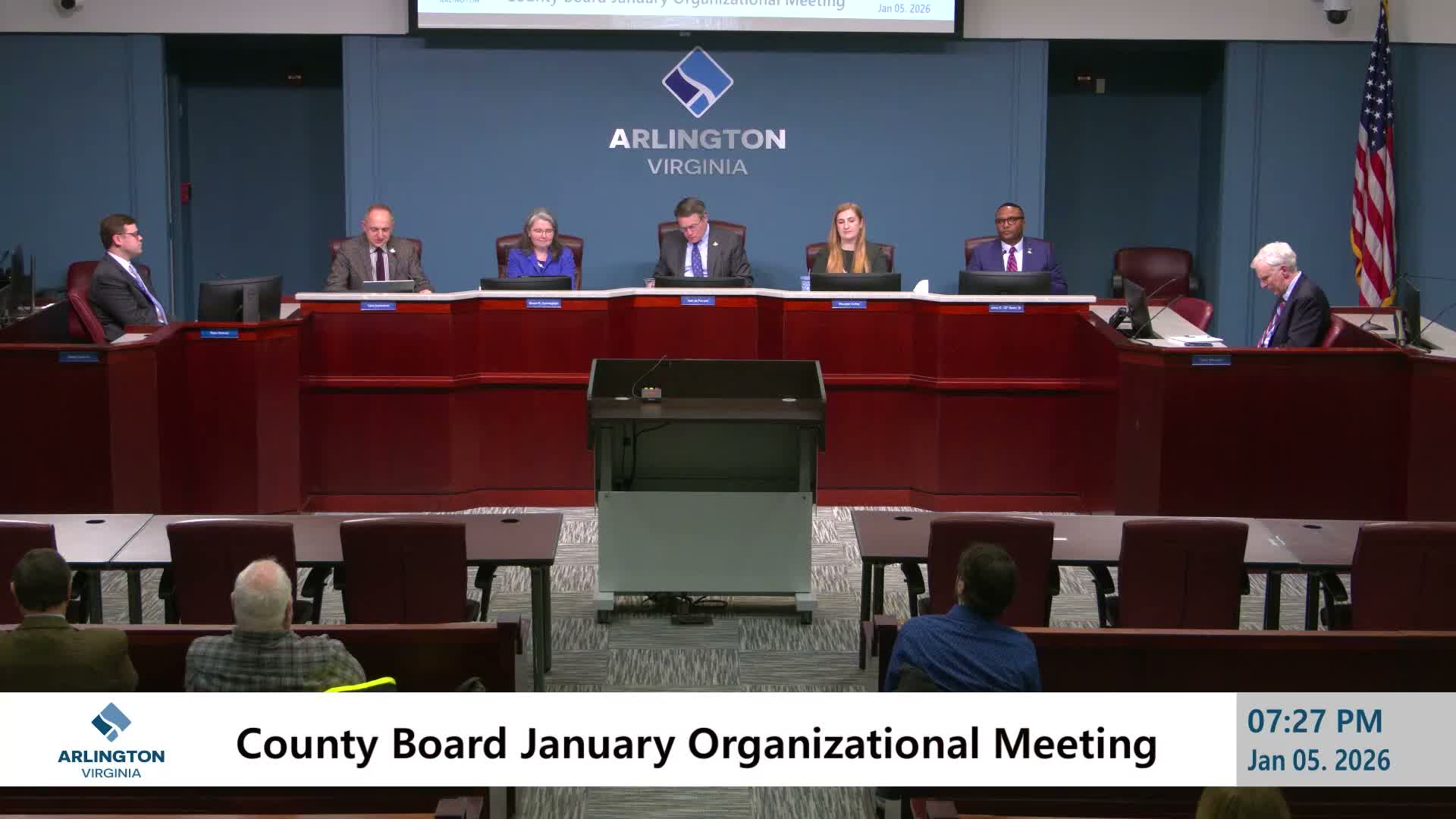
Summary
At a county meeting, an unidentified Arlington County board member recapped 2025 and laid out 2026 priorities, highlighting local response to reported federal raids, economic resiliency and small-business support, housing affordability and adaptive reuse, emerging AI risks, and childcare and senior poverty concerns.
An unidentified Arlington County board member opened remarks by thanking the chair and vice chair and outlining a set of priorities the county will pursue in 2026, including local support after recent federal enforcement actions, economic resiliency, housing affordability, regulation of artificial intelligence and expanded public engagement.
The speaker described distributing a small red "know your rights" card as a practical response to what they said were law-enforcement raids in Arlington. "This is this card... this is a red card that is a know your rights card that contains all essential information for one's constitutional rights," the speaker said, and added that residents and federal employees alike had turned to local government for help after the incidents. The speaker also said, "the secretary of the Department of Homeland Security was in one of these raids," and called the events "an insult." No formal action or vote on those incidents was recorded in the remarks.
Why it matters: the speaker framed the county as a first line of response when residents seek guidance and resources, praising Arlington County staff for their frontline work. That framing sets the board's tone for constituent services and signals a focus on local readiness and supports for people affected by federal enforcement.
Economic resiliency was presented as a top policy priority. "Economic resiliency is for me absolutely paramount," the speaker said, urging support for employers, entrepreneurs and small businesses and citing the claim that "1 out of 3 Arlingtonians works in a small business." The remarks called for integrated investments across housing, transportation (including Metro funding), education (Arlington Public Schools) and the arts to sustain the local workforce and attract investment.
On housing, the speaker said decisions this year will involve trade-offs and highlighted forthcoming technical work, including recommendations from "low residential studies" and completion of phase one of the county's comprehensive plan update. The speaker urged using plantable acres to help with stormwater and tree canopy while enabling housing creation and proposed that adaptive reuse projects (conversions from commercial to residential) be structured to secure public benefits.
Emerging technology was another stated concern. The speaker called artificial intelligence "era-defining," warning of impacts on privacy, cybersecurity, employment and education and saying regulation has not kept pace. "We need to focus more on that," the speaker said, noting ongoing work and plans to continue efforts on AI-related issues.
The speaker also highlighted social services and equity issues, calling the child-care situation a crisis—saying Arlington had earned "a very doubtful first in the nation for cost of childcare"—and warned of rising senior poverty and related food and housing insecurity. Education and youth mental health, including after-school programs, were cited as implementation priorities.
On transportation and climate, the speaker said they looked forward to results from the transportation master plan update and described the county's safety focus—referencing "Vision 0"—and urged making the climate action plan tangible, measurable and inclusive to reach communities that cannot afford technologies like rooftop solar.
The talk closed with a call to rethink service delivery amid fiscal pressure, a plea to apply an equity lens when prioritizing services, and announcements of new town halls and in-person "open door Mondays" for constituent engagement. The speaker ended by expressing optimism about Arlington's resilience and extended holiday greetings.
No formal motions or votes were recorded during the remarks; the statements in this article are based on the speaker's description of priorities and claimed facts, some of which (for example, the participation of the DHS secretary in a raid and specific statistical claims) were asserted in the remarks rather than established through board action.