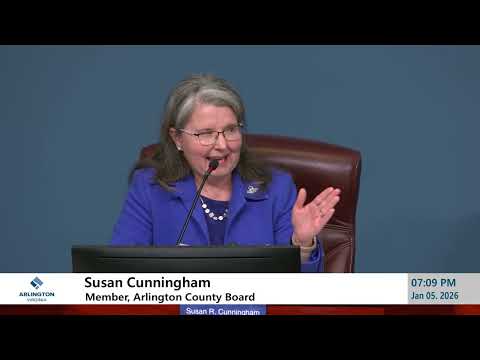
Arlington board member urges 'reboot' of housing strategy, seeks court clarity on EHO appeals
Loading...
Summary
In a year‑start address, an Arlington County board member called for a major housing push in 2026: clarifying appeals over Expanded Housing Options (EHO), demystifying community benefits, reimagining permitting, and targeting more family‑sized and owner‑occupied homes.
Unidentified Speaker, a county board member, outlined a broad housing agenda for 2026 on behalf of Arlington County, saying the county has more homes than households but lacks for‑sale housing and deeply affordable rentals.
"We have more homes than households, which is a gift really, but we have far from enough for‑sale homes and deeply affordable rentals," the Unidentified Speaker said, summarizing why the board intends to shift focus to new housing strategies.
The speaker reviewed 2025 accomplishments — including approval of about 4,500 new homes and an emergency‑housing expansion — and cited statistics the county will address in 2026: 58% of new homes are rentals, only 11% of homes are larger than two bedrooms, and 12.8% of rental homes are classified as affordable. The speaker also said the county restarted fair‑housing testing.
On policy and process, the speaker criticized the Expanded Housing Options program (EHO) as having "few net homes created" and described it as a source of division. They said they are "looking forward" to courts deciding appeals so the county can move from litigation to revising policy and rebuilding relationships.
Planned steps for 2026 include demystifying the community benefits process to clarify trade‑offs and preserve long‑term commitments; considering adding a preamble to the comprehensive plan in consultation with Vice Chair Coffey; reimagining permitting and enforcement; and studying large, generational development sites such as the Key Bridge Marriott and East Falls Church Metro for future housing development and financing options.
The speaker said the county will engage real‑estate professionals to encourage more owner‑occupied homes, explore real‑estate tax relief for seniors, revisit the definition of household to allow more legal shared housing, and make workforce housing an explicit priority.
Next steps: the speaker asked the county manager and staff to continue action on permitting and community benefits work in 2026 and urged courts to resolve appeals so policy reforms can proceed.