County shifts justice-reinvestment funds and moves pre-treatment dorm staffing to sheriff’s budget
Loading...
Summary
Multnomah County approved a justice-reinvestment budget modification that adjusts county partners’ CJC awards, increases victim-services funding, and transfers roughly $237,000 to the sheriff’s office to staff a pre-treatment dorm with two corrections counselors.
Sarah Mullen and county partners presented a Multnomah County justice-reinvestment program (JRP) budget modification Jan. 13 that reconciles county partner budgets with final Criminal Justice Commission awards for the 2025–27 biennium. The modification spans multiple county partners and funding streams including formula, evaluation, competitive and victim services funds.
Mullen said the countywide JRP adjustment includes a modest $29,086 increase for victim-services funding that will be distributed to existing community providers. Tiara Hubbard (DCJ) said the county removed some pass-through support related to the treatment readiness dorm operations and reduced wrap-around supports where the estimated number of qualified clients declined; the county covered some shortfalls with general-fund supplies as an interim step.
John Harms Milant of the sheriff’s office said the approved modification transfers roughly $237,000 to the sheriff’s budget to pay for two corrections-counselor FTE to staff the pre-treatment dorm at Inverness Jail. Steve Ciccatelli of MCSO described the operational transition and said VOA counselors who previously provided services continued in similar roles through onboarding, and that documentation and evaluation templates are being formalized to maintain services through the operational shift.
Caroline Wong of the DA’s office said MCDA maintained a high level of diversion work and that TASK and other units would preserve core services, noting carryforward funding helps maintain staff levels. Commissioners asked about impact on individuals in the dorm and transitional coordination to community treatment; presenters said they are prioritizing warm handoffs and coordinating with housing and community providers, but acknowledged gaps in residential treatment capacity.
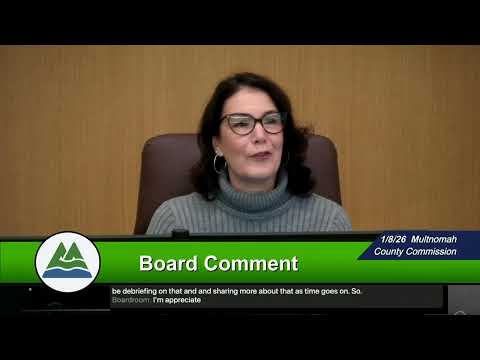
Motion and vote: The board approved the JRP budget modification by roll-call vote. Staff will continue to coordinate across DCJ, the sheriff’s office and the DA’s office to track outcomes and minimize service interruptions during transitions.
Next steps: County staff will formalize evaluation templates and continue monthly transition-planning meetings; commissioners requested future reports on outcomes and on the effect of shifting operations from community providers to a county-run model.