
Board hears first reading of policy tying senior remediation to ISAT proficiency; members ask for more planning
Get AI-powered insights, summaries, and transcripts
Subscribe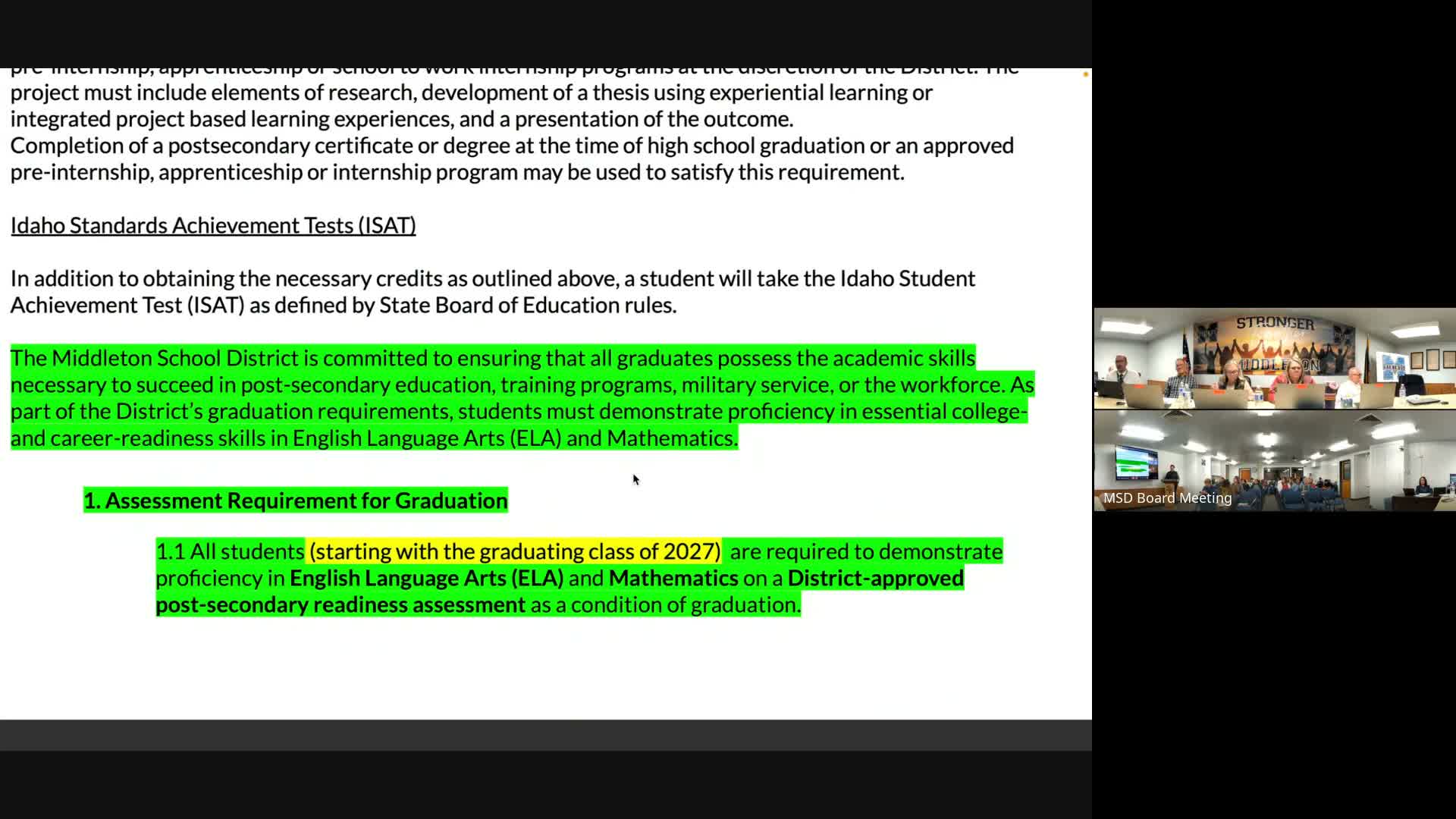
Summary
Superintendent and staff presented a first reading of a proposed policy that would require seniors who are not proficient on their junior‑year ISATs to take remedial semester courses; board members asked for clearer appeals language, accommodations for opt‑outs and IEPs, and stronger early‑grade interventions before adopting the policy.
At a first reading the Middleton District board reviewed a draft policy that would add a remedial senior‑year course requirement for students who are not proficient on the ISAT at the end of their junior year.
Johnny (district staff) framed the proposal as an additional step to support students, not a punitive measure, noting the district’s high graduation rate (about 96%) but lower ISAT proficiency rates (roughly 70% English, about 50% math). Under the draft, juniors who test below proficiency would be required to take one or two semester remediation courses during their senior year (English, math or both, as needed). The district would grade those courses pass/fail; passing the course would satisfy the requirement and the district would not, as written in the draft, require students to retake the ISAT to graduate.
Board members raised multiple concerns during discussion: several asked that students be identified and supported earlier (K–3 and middle grades) so the district is not relying on a “last‑ditch” senior‑year fix; others asked for a clear appeals and alternate‑assessment process for parents who opt their children out of state testing and for accommodations under IEPs. Staff said that parents may continue to opt out of the ISAT, but students who opt out would take an alternate comprehensive assessment; successful performance on that alternate assessment would exempt a student from the remedial course.
Members asked staff to work with the district’s attorneys to tighten the language, to model staffing/FTE needs and scheduling impacts, and to return with a second reading addressing appeals, exemptions and operations. No final action was taken; the policy remains at first reading.