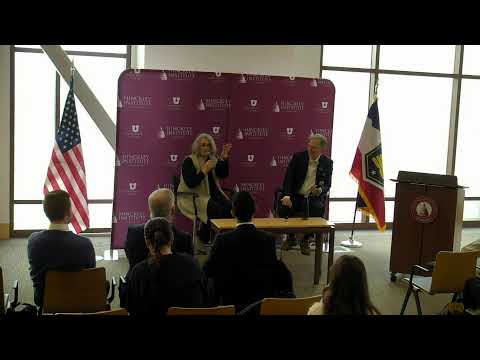
Former U.S. Ambassador George Kent: Support for Ukraine Is a U.S. National Interest
Loading...
Summary
At a Hinckley Institute forum at the University of Utah, former U.S. diplomat George Kent argued that backing Ukraine defends the international order, warned that rhetoric about taking Greenland strains alliances, and highlighted battlefield-driven innovation in drone and defense production as lessons for U.S. and European policy.
Former U.S. Ambassador George Kent told a University of Utah Hinckley Institute forum that U.S. support for Ukraine is a matter of national interest and a defense of the international order.
"The support for Ukraine is in U.S. national interest," Kent said in opening remarks, arguing that Ukraine is fighting to preserve the principle that states may defend their borders. He said Russia’s campaigns since 2014 reflect an effort by President Vladimir Putin to expand Russian influence and that Moscow uses a mix of conventional force and hybrid "active measures"—including disinformation and covert operations—to weaken Western alliances.
Kent recounted his diplomatic career and described recent events and rhetoric as risks to the transatlantic relationship. He warned that public talk about the United States "taking" Greenland is "incredibly damaging to the U.S.–European relationship," saying such rhetoric plays into Russian narratives and undermines trust with treaty allies.
Velida Kent, who described grassroots humanitarian work and fundraising after Russia's 2022 invasion, recounted arriving in Ukraine hours before the invasion and evacuating refugees to Poland. "Our daughter ... refused to leave the country. And then she said, 24 years old, if I die, I die," she said, describing why she became involved in relief efforts at the border.
The forum shifted to audience questions on U.S. policy, NATO, and defense technology. Kent said NATO accession for Ukraine is a political question that requires unanimity among member states; he noted that in the recent period the United States, Germany and Hungary were not prepared to support immediate accession. On the broader question of U.S. engagement, Kent said the recent pattern of actions and public statements by U.S. officials leaves allies uncertain but argued American behavior has not been purely isolationist, citing recent strikes and special operations.
Kent emphasized lessons from the battlefield: modern warfare in Ukraine has spurred rapid, iterative innovation in relatively low-cost defense platforms and supply chains. He described how fiber-optic–controlled drones and other systems change front-line dynamics and said Western prime contractors’ multiyear, high-cost procurement models risk lagging behind mass-produced, quickly iterated systems used in Ukraine. "Whatever's in [a warehouse] older than a month is out of date," Kent said, arguing that co-production agreements and near-term innovation could better meet defensive needs.
He pointed to concrete contrasts in allied defense postures: "Estonia this year is gonna spend 5% of their GDP on defense," he said, while saying U.S. defense spending was about 3.4 percent of GDP. Kent argued that several European countries are shifting toward more agile, locally produced defense capabilities to counter drone incursions and other hybrid threats.
Audience members also pressed whether the United States would commit troops to defend Taiwan in a hypothetical Chinese attack. Kent said decisions to deploy U.S. forces are presidential and that recent public statements by senior U.S. officials have introduced uncertainty about future commitments. He urged attention to the two factors he described as central to Taiwan's strategic importance to the West: advanced microchip production and critical maritime shipping lanes that move global trade.
The forum concluded after roughly an hour of questions and remarks; moderators thanked Kent and Velida and invited attendees to continue conversations informally outside the event.
The Hinckley Institute of Politics hosted the event at the University of Utah. Kent is a retired U.S. foreign service officer with postings that included Ukraine and Estonia; Velida Kent described volunteer and humanitarian activity at the Ukrainian–Polish border after Russia's 2022 invasion.