
ZBA approves most variances for proposed Kalamazoo County youth sports facility; woodland reduction fails
Get AI-powered insights, summaries, and transcripts
Subscribe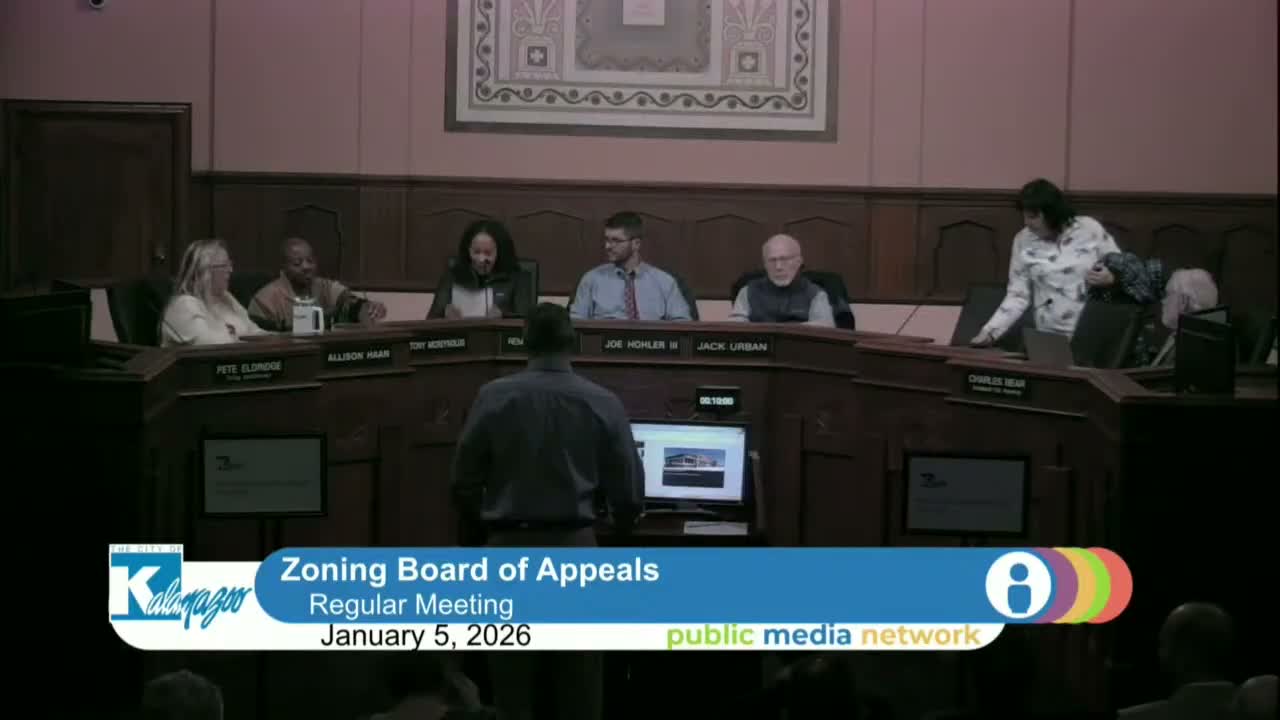
Summary
Discover Kalamazoo sought five variances for a proposed 150,000 sq ft youth sports complex at 1619 N. Drake Rd.; the board approved four variances (slope encroachment with NFP conditions, building height, impervious coverage, reduced bike parking) and denied the request to reduce woodland preservation from 25% to 13.5% after extended public comment and debate.
The City of Kalamazoo Zoning Board of Appeals heard a multi‑hour public hearing and decided on a package of variances for a proposed Kalamazoo County youth sports facility at 1619 North Drake Road.
Discover Kalamazoo presented the project as a 150,000‑square‑foot regional sports complex intended to host tournaments and generate hotel stays. Jane Ghosh, president and CEO of Discover Kalamazoo, said the project would be financed through the Event Center Financing Act — an incremental 4% assessment on accommodations approved by hotel owners — and cited an estimate of up to 36,000 incremental hotel room nights per year. "Once that passed, well, what that means then is that local youth are gonna benefit from the visitor economy," Ghosh said.
The applicant requested five variances: (1) to encroach into protected slopes under the Natural Features Protection (NFP) ordinance, (2) to reduce woodland preservation to 13.5% (from 25%), (3) to allow a 56‑foot building height where 35 feet is the maximum, (4) to allow up to 56% impervious coverage where 45% is allowed in RS‑5, and (5) to reduce calculated bike parking from 170 spaces to 20.
City staff and the Natural Features Protection Review Board recommended approval of the NFP‑related variances with a condition requiring dense replanting of native trees in green/undeveloped areas where possible. Staff cited practical constraints: the facility requires flat, single‑floor court space with minimum clearance and spectator sight lines, no shared parking is available on site, and county roads adjacent to the property do not permit on‑street parking. Kurt Artema, representing the development team, described multiple design iterations to reduce footprint and parking and to place the tallest portion on the lower (western) portion of the site to reduce visual impact on residences.
Speakers for and against the project addressed economic, recreational and environmental trade‑offs. Supporters — including hotel managers, chamber leaders, university staff, youth coaches and local athletes — emphasized tourism revenue and youth access. Opponents and some planning volunteers warned that granting a large woodland‑preservation reduction would undermine the intent of the NFP overlay and set a precedent; they urged either denial or additional work such as a visual impact assessment or acquisition of adjacent acreage to reduce woodland loss.
The board’s votes produced a mixed result: the two NFP variances were considered separately. The board approved the slope‑encroachment variance (request #1) with the NFP board’s replanting condition (vote 4–1). The woodland‑preservation reduction (request #2) failed to secure the necessary four affirmative votes and was denied. The height variance (request #3) was approved unanimously (5–0); the impervious‑coverage variance (request #4) passed 4–1; and the bike‑parking variance (request #5) passed unanimously (5–0).
Board members spent substantial time weighing the ordinance standards for variances, the degree to which site constraints are "special circumstances," and the potential for setting precedents that could weaken the Natural Features Protection overlay. Attorney/staff counsel reminded the board that denial would bar consideration of a similar application for one year unless the board granted a waiver, and that the board could also choose to table the applications to request additional information.
Next steps: because the woodland‑preservation relief was denied, the applicant will either revise the plan to comply with the 25% preservation requirement or consider alternative parcels or acreage arrangements. Approved variances that remain in effect will carry conditions (for example, the NFP replanting requirement) and the project will still require detailed site plan review and coordination with Oshtemo Township for access and infrastructure.