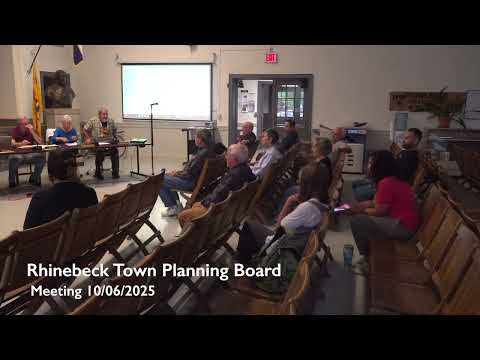
Rhinebeck Villas project continued after engineering, wastewater and neighbor concerns
Loading...
Summary
Developers for the Rhinebeck Villas presented revised technical responses and a tree survey but the Planning Board continued the application to Nov. 3, asking for additional engineer review, a neighborhood meeting, and clarified plans for wastewater location, screening and archeological impacts.
Sean Kemp, counsel for Rhinebeck Villas LLC, updated the Town of Rhinebeck Planning Board on October 6, saying the project team had completed a second site visit, delivered a tree survey (final report pending) and submitted technical responses to town engineering comments. Kemp said the project team expected to supply the outstanding materials to the board before the next meeting and asked to keep the review moving forward.
Neighbors and board members focused on the proposed wastewater treatment location, visibility of new buildings from Route 9G and the need for additional screening. One nearby resident, Christopher Kennan, told the board he had raised eight points about the sewage‑treatment plan and asked when those concerns would be addressed; the board confirmed that the town engineer and project engineers would review and respond as part of the technical record. "I raised 8 points related to the sewage treatment plan which in my opinion seem to be either in conflict or at least in irritant to some of the code," Kennan said during public comment.
Project architect Rob Ponte and the applicant's engineer explained that the proposed wastewater treatment location was chosen to minimize wetland impacts and because the discharge point and utility routing make that site the most practical. Board members and neighbors pressed whether the treatment plant might be moved or reconfigured; the applicant said topography, buffer limits and proximity to discharge points constrained alternative locations. The project team acknowledged the need for more detailed renderings and a landscape screening plan to show how proposed earth‑tone materials and plantings would reduce visibility from 9G and neighboring properties.
Board members also raised potential archeological issues. Consultants noted a New York State Museum‑listed site on a nearby property; the board asked the applicant's archaeologist to expand or better contextualize the field report so the planners and engineers could evaluate whether sewer alignments or grading would affect any sensitive areas.
Several planning board members and the town's consultant (CPL) asked the applicant's engineers to confer directly with the town engineer to resolve outstanding technical comments. The board set a continuation to the November 3 meeting to allow the project team to post the revised materials, for CPL and the applicant's engineers to confer, and for the applicant to hold a neighbor meeting with property owners and nearby stakeholders. The board said it expected renderings and a finalized screening/landscape plan and reaffirmed that any final action would be conditional on receipt of the town engineer's clean letter and responses to the technical comments.
The continuation preserves the Planning Board's authority to require additional mitigation measures, including screening and plantings, further buffering of the wastewater installation, and any adjustments necessary to avoid or reduce archeological impacts. Board members repeatedly framed the next steps as technical rather than policy decisions: engineering and CPL reviews, additional materials posted publicly, and a neighbor meeting before the board can finish SEQR Part 2 and make a local determination.
The Planning Board will revisit Rhinebeck Villas at its November 3 meeting; in the meantime, the project team is to submit the final tree‑survey report, the engineer responses to CDL/CPL comments, and a draft landscape/screening plan for review.