
CNRWA legislative working group previews 2027 water bills and debates data‑center water policy
Get AI-powered insights, summaries, and transcripts
Subscribe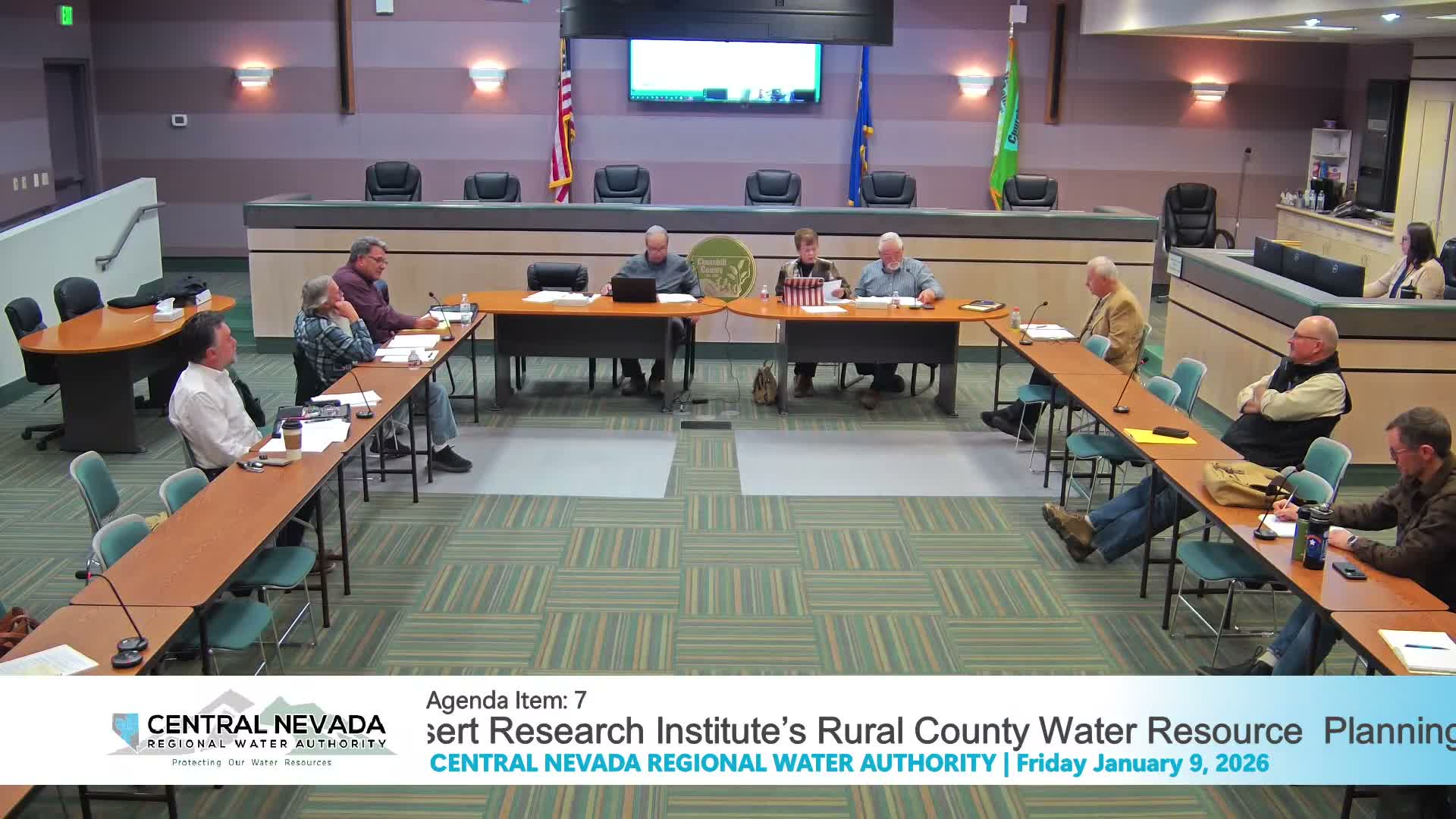
Summary
CNRWA leaders reviewed likely 2027 water issues — including AB009 (temporary environmental conversions), AB109 (non‑consumptive uses review), administrative reforms and SB31 (vested‑rights filings) — and discussed a draft policy urging counties and utilities to limit evaporative cooling and require disclosure of data‑center water use.
At the Central Nevada Regional Water Authority meeting on Jan. 9, board leaders outlined legislative priorities and opened a discussion about water use by data centers, urging member counties to prepare policy tools ahead of the 2027 Nevada legislative session.
Norm Frey, chair of CNRWA's legislative working group, and Executive Director Jeff summarized interim work and stakeholder engagement that led to unanimous passage of some 2025 measures and identified likely 2027 priorities: AB009 (proposed expansion of temporary environmental conversion of agricultural rights from three to five years and potential expansion beyond ag rights), AB109 (closer Division of Water Resources review of non‑consumptive uses, including closed‑loop geothermal and lithium brine exploration), AB419 (administrative procedures and state‑engineer process reforms, pared back because of fiscal impacts), and SB31 and other measures concerning filing deadlines for vested water‑rights claims ahead of the 2027 statutory deadline.
On data centers, Jeff presented a draft CNRWA policy to guide county action. He told the board data centers range from small facilities to hyperscale campuses and have two main cooling approaches: air/power‑intensive cooling or water‑using evaporative cooling. Southern Nevada has already prohibited evaporative cooling for data centers; Jeff urged counties to require prospective operators to disclose projected consumptive and non‑consumptive water use and to consider requiring the use of treated effluent or non‑potable sources where feasible. He suggested tracking a "water usage effectiveness" metric and ensuring infrastructure costs for large water users are not unfairly spread among other ratepayers.
Board members discussed potential county actions, including adopting policy language in local water plans or ordinances, engaging developers early, and protecting ratepayers. Norm cautioned that proprietary claims by data‑center applicants can become a negotiation tactic and advised boards to ask rigorous technical questions.
The board also discussed 3‑M (monitoring, management, mitigation) plans used in NEPA and state‑engineer proceedings. Jeff said 3‑M plans can be required by the state engineer to address unanticipated impacts, but they cannot be used to cure known conflicts; counties should be cooperating agencies on NEPA where possible, seek access to models and monitoring networks, and avoid waiving protest rights without careful negotiation.
On water‑rights administration, Jeff reminded the board that claims for vested water rights must be filed by Dec. 31, 2027, and encouraged early outreach and filings to avoid a late rush. The board later authorized the executive director to withdraw CNRWA protests to three specific applications (93949–93951) contingent on Esmeralda County withdrawing its protest and legal counsel signoff; the motion passed with no opposition.
The legislative and policy discussion leaves several items for follow‑up: drafting recommended county ordinance language on data‑center water use, refining a template for 3‑M plans, and tracking bills through the interim committee process.