
Greenville County committee pauses car-wash ordinance after owner, residents raise noise and cost concerns
Get AI-powered insights, summaries, and transcripts
Sign Up Free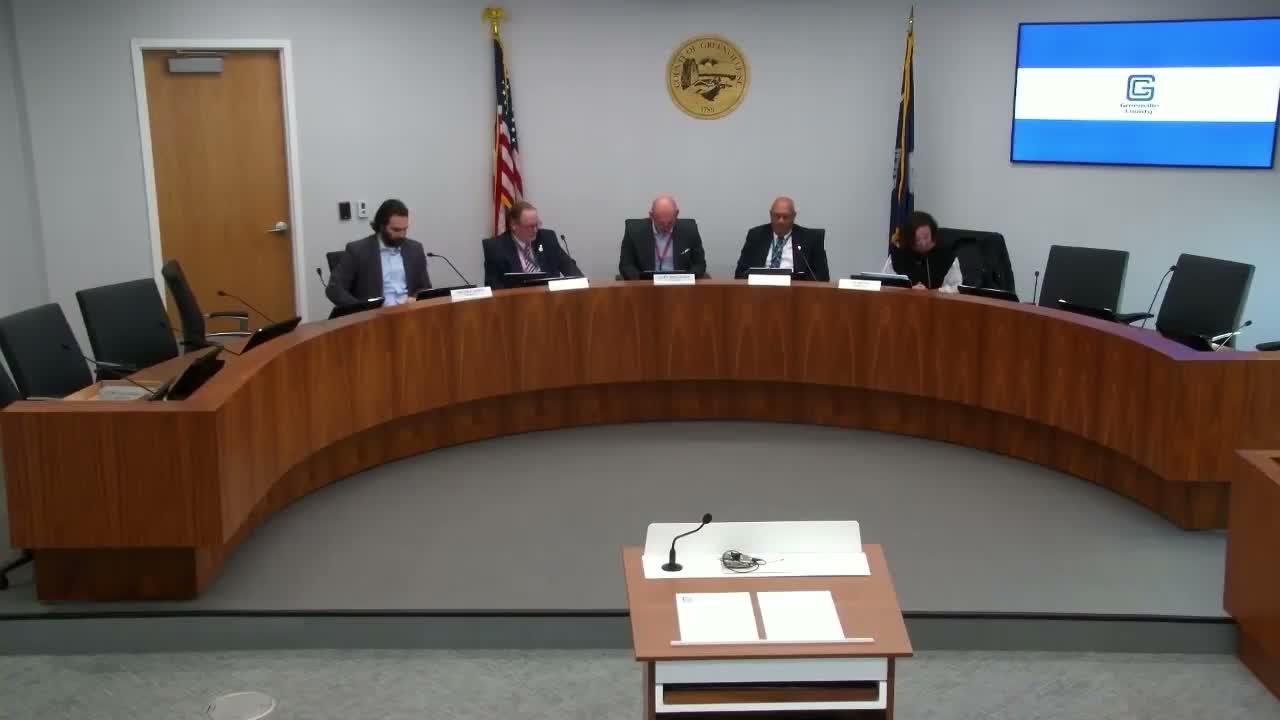
Summary
Greenville County’s Roads, Infrastructure and Public Works Committee paused consideration of proposed car-wash facility standards after the owner of Sonic Sitz and residents raised objections about a proposed 1,000-foot setback, recurring testing costs and potential retroactive compliance. Staff will post decibel readings; the committee set a follow-up meeting in February.
The Greenville County Roads, Infrastructure and Public Works Committee on Jan. 6 paused action on a proposed ordinance establishing car-wash facility standards after business owners, residents and committee members raised technical, financial and fairness concerns.
Legal staff presented a newly redlined draft that, according to the county attorney, aims to address committee requests by focusing on meeting decibel limits rather than forcing structural changes to existing buildings. The attorney warned that applying setbacks to existing car washes could ‘‘deprive the economic value of the property’’ or render a property unusable if it forced modifications.
The item drew sustained public comment from the owner of Sonic Sitz Car Wash, who identified himself as Theliopolis. He told the committee the draft ‘‘goes far beyond what is reasonable, practical, or fair’’ and cited specific provisions he said would harm local operators: a 1,000-foot setback that ‘‘effectively functions as a de facto ban on new car wash development’’ on much of Greenville County; requirements for certified acoustical studies before permitting; mandatory post-construction testing; recurring annual noise testing; equipment enclosure replacement and potential retrofitting for existing facilities. He also said a clause requiring full compliance within 12 months after replacement or repair would operate retroactively and impose significant costs on small, locally owned businesses.
Committee members stressed a need to balance business interests with neighborhood quality of life. Councilor Collins said a ‘‘quick remedy’’ at the Woodruff Road site could be a small suppression fence around vacuums and a fence along the property edge to reduce noise to about 60 decibels; he noted background/street noise measured about 59 dB and said he had seen readings as high as 70 dB during peak hours.
Staff and the chair said they would provide the committee and public with the decibel measurements taken around the affected property; the chair reported readings ranging from about 42 dB at the farthest nearby residence to about 80 dB at the property’s closest point and about 59 dB at the street. Staff agreed to add those readings to the agenda packet and to post them to the county website.
Given the technical and financial questions, and a desire to seek a site-specific fix while preserving the countywide policy discussion, Councilor Bradley moved to hold the ordinance item to the committee’s first meeting in February and to encourage a community meeting so the owner and neighbors could propose solutions. The motion carried on a voice vote. The committee also asked staff to review the redline language and to highlight substantive changes for members before further action.
Next steps: staff will post the decibel readings to the county agenda materials; the committee plans to reconvene on the first meeting in February to consider solutions developed by the owner, neighbors and staff.