Get Full Government Meeting Transcripts, Videos, & Alerts Forever!
Get email alerts on the Traffic Calming topic
No spam. Unsubscribe anytime.
Fairfax County presents Myrtle Lane traffic‑calming plan as residents weigh study, snow plowing and noise concerns
Summary
Fairfax County DOT presented a plan to install three speed tables on Myrtle Lane after a traffic study met program thresholds; residents praised safety goals but questioned single‑day study placement, plowing in winter, noise from trucks and whether less intrusive alternatives were tried. The next step is a ballot of 47 occupied properties; 24 yes votes are required to proceed.
Fairfax County Department of Transportation staff on a community call presented a traffic‑calming plan for Myrtle Lane proposing three speed tables after a county traffic study met the program's volume and speed thresholds.
Nicole Michakoy of FCDOT said the study recorded 523 vehicles in a 24‑hour period — exceeding the program's 500‑vehicle minimum — and that the southbound 80th‑percentile speed measured 37 mph on a posted 25 mph roadway, meeting the requirement that the 80th‑percentile speed be at least 10 mph over the posted limit in one direction. "Traffic calming is installation of physical devices to reduce vehicle speed," Michakoy said while explaining vertical and horizontal devices and program constraints, including that stop signs cannot be installed through this process.
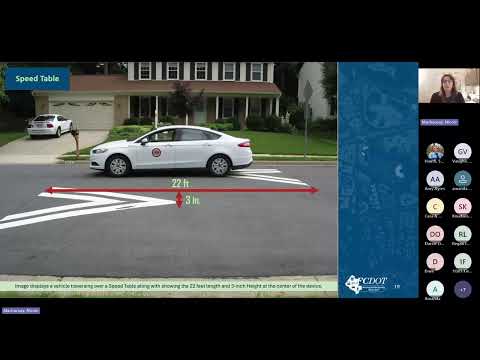
The presentation described the five‑step program (initiation, plan development, community engagement, ballot, installation), design constraints and device geometry: FCDOT proposed three speed tables, each a 22‑foot long, 3‑inch high speed table with white chevrons and a 15 mph advisory sign; vertical devices must be at least 300 feet apart and 150 feet from intersections. Staff said devices must fit existing roadway features such as driveways and utilities and that adjacent property owners directly next to a proposed device must sign to allow placement.
Residents raised several substantive concerns during the Q&A. Several speakers questioned study placement: Scott (who joined the call as Amanda's father) and others said the data were collected north of Running Cedar, a feeder location, and asked whether that single 24‑hour sample accurately reflected speeds where the devices are proposed. Michakoy said data are typically collected at one point for roads of this length and that staff developed the plan for the whole roadway after qualifying it.
Other residents asked about winter maintenance and noise. Alexandra asked whether speed tables would affect snow plowing on a no‑outlet street; Steve Knudson of FCDOT replied that VDOT designs and maintains the devices and that crews mill a smooth transition so snowplows can traverse them. Chris Lamb and others asked about noise from delivery trucks and lawn trailers; FCDOT said noise is a known issue and that adjacent property sign‑offs exist in part so nearby residents are aware of signage and striping placed immediately outside homes.
Participants also pressed whether less intrusive options had been evaluated. FCDOT and Hunter Mill District staff said pole‑mounted radar display signs exist but are rotated by police as a temporary measure; enforcement is subject to police scheduling. "They rotate around," said Hunter Mill staff Shamali, describing the short‑term nature of mounted feedback signs.
Task force lead Kara Earhart said the group originally proposed more devices but reduced the plan after discussion with county staff and neighbors. FCDOT staff said 47 occupied properties are in the ballot area; ballots will be mailed, hand‑delivered or emailed and must be returned directly to the district supervisor's office (ballots collected by the task force are not counted). The county said a majority of occupied properties must vote yes; staff calculated that 24 yes votes are needed for the plan to advance to endorsement by the Board of Supervisors and submission to VDOT for acceptance and scheduling.
FCDOT described follow‑up procedures: the county typically conducts a post‑installation study to assess effectiveness, removal can be requested after a two‑year wait period followed by another community process, and residents may request additional services (for example, a relocated speed sign) directly from VDOT. Staff closed by providing contact information for FCDOT (DOTinfo@fairfaxcounty.gov; (703) 877‑5600) and the Hunter Mill District office (huntermill@fairfaxcounty.gov; (703) 478‑0283) and advising the task force on next steps toward balloting.
The meeting transcript does not specify the calendar date of the meeting.