Get Full Government Meeting Transcripts, Videos, & Alerts Forever!
Get email alerts on the Fppc Legislative Package topic
No spam. Unsubscribe anytime.
FPPC committee reviews 10 legislative proposals including candidate training, emergency filing relief and limits on dormant committees
Summary
At its Jan. 8 Law and Policy Committee meeting, the Fair Political Practices Commission staff presented 10 draft bills ranging from a required candidate/treasurer training to expanded reporting for off‑cycle expenditures; commissioners debated emergency filing extensions, donor travel disclosure and automatic termination of dormant committees.
SACRAMENTO — The Fair Political Practices Commission’s Law and Policy Committee reviewed a package of 10 drafted legislative proposals on Jan. 8, spanning candidate and treasurer training, emergency filing relief, nonprofit travel disclosure, and automatic termination rules for dormant campaign committees.
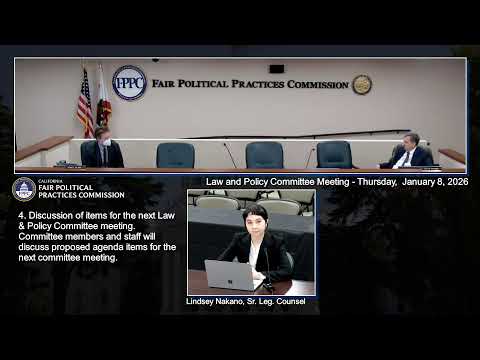
Lindsay Nacano, senior legislative counsel for the FPPC, told the committee the package includes eight items previously discussed, one proposed by a commissioner at the November meeting and one new proposal. "I will go over all of them today in the detail that we have currently developed," Nacano said, adding she would pause after each proposal for questions.
The first proposal would require candidates and treasurers to complete commission‑developed training as a condition of appearing on the ballot. Nacano said staff are considering whether the requirement would apply at the state or local level and plan to offer the coursework online. "This would require candidates and treasurers to complete training developed by the commission relating to campaign requirements," she said. Chair Silver called the training "a priority for me as chair" and emphasized the need to ensure last‑minute filers can still qualify for the ballot.
Another bill under discussion, identified in staff materials as SP401 (authored by Sen. Hurtado), would authorize the commission to extend PRA filing deadlines for people living in areas subject to an emergency declared by the governor or a local jurisdiction, if the emergency is "reasonably likely to affect the ability of the affected parties to timely file," Nacano said. Commissioners debated whether the FPPC should independently determine what qualifies as an emergency or instead rely on gubernatorial or local emergency declarations; staff said they will consult the Secretary of State and municipal stakeholders on the scope.
A separate proposal would lengthen the time period during which local filing officers may waive the late‑filing administrative fee for Statements of Economic Interests (Form 700). Nacano said common grounds include technical errors or missed notices; staff noted the current late fee is assessed at $10 per day after the deadline, capped at $100.
The committee also discussed changes recommended by the audit division to nonprofit sponsored‑travel disclosure. The draft would remove the existing one‑third Form 990 spending threshold that currently determines whether travel payments must be reported and would instead require disclosure of each travel payment and the names of affected officials, along with additional record‑keeping.
Several proposals addressed campaign finance and enforcement mechanics. One would tighten reporting when a candidate‑controlled committee makes large off‑cycle payments to a single recipient, with staff weighing whether to create a separate report or expand the existing semiannual filing. Another would expand the existing prohibition on creating a fictitious appearance of support (sometimes called astroturfing) to cover lobbyist employers and to address the potential for AI‑assisted manipulation.
Nacano described a proposal to create an automatic termination process for dormant committees that meet specified conditions, including failing to file a campaign report for the prior 12 months, holding a minimal cash balance (thresholds in the draft include $3,000 or $5,000), or owing $2,000 or more to the controlling candidate. The draft would provide notice and an opportunity to object before treasurer appointments lapse and the committee is terminated. An agency executive told the committee staff drew the thresholds from enforcement experience and Secretary of State referral data identifying thousands of inactive committees.
Another draft would transfer responsibility for lobbyist training from legislative ethics committees to the FPPC and provide on‑demand training (likely via Blackboard), while retaining the authority to charge a fee. On security, the committee considered a proposal recommended in November to require that security personnel paid with campaign funds be licensed by the Bureau of Security and Investigative Services (BSIS), a change commissioners said would help ensure professionals are used for protective details.
No formal committee votes on sponsorship were taken at the meeting; Nacano said the committee may make recommendations to the full commission at the commission meeting the following week, and staff will report verbally unless members request a written memorialization. Chair Silver said he plans to raise the final sponsorship decisions with the full commission.
The committee invited public comment on the package; none was offered. After discussing items for future Law and Policy meetings, the committee adjourned.
What’s next: Staff will continue drafting bill language, consult affected stakeholders including the Secretary of State’s office and nonprofits, and the committee may vote on sponsorship recommendations at the FPPC’s full commission meeting next week.