
St. Croix County plans recycling ordinance update to meet state rules, add materials and reporting
Get AI-powered insights, summaries, and transcripts
Subscribe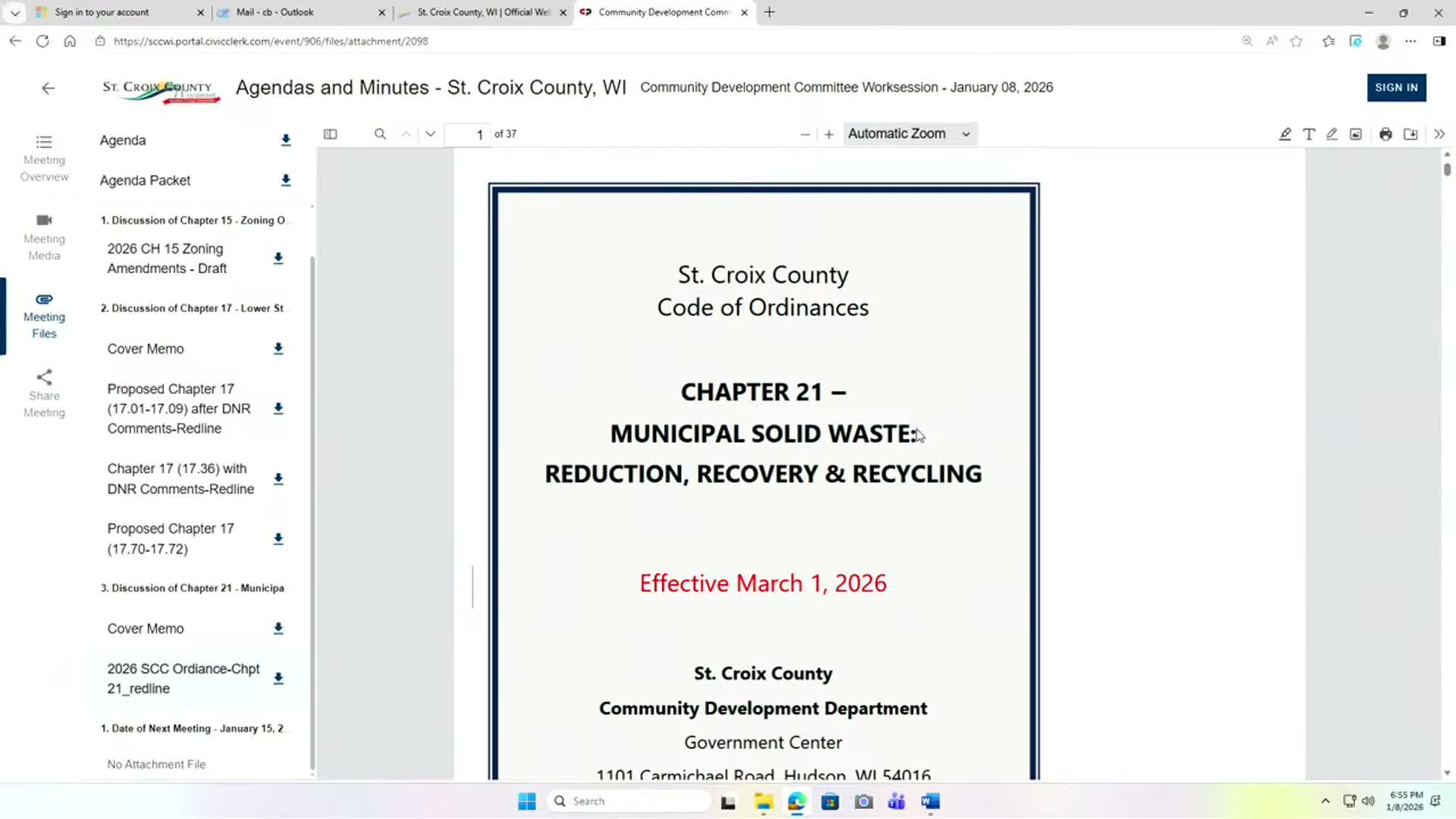
Summary
County staff told the Community Development Committee that Chapter 21 needs amendment by April so the county can apply for a state recycling grant. Draft changes align the ordinance to NR 544 sample language, add required materials reporting, and move to require municipal reporting and clearer hauler education; committee asked to add lithium‑ion batteries and hazardous‑waste clarifications.
Speaker 4, the county's community development staff presenter, told the committee the recycling ordinance (Chapter 21) is dated and "we really need to get amended by April so that we're able to take and apply for our recycling grant this year." The draft aligns local language with the state administrative code sample (NR 544), streamlines repeated provisions and adds specific reporting and separation requirements the DNR requires for responsible units.
Key changes and compliance: Speaker 4 said the draft adds plastics and other post‑consumer materials required by the DNR, clarifies residential (1–4 dwelling) vs. nonresidential definitions, and asks municipalities over 5,000 population to provide curbside collection options at least once per month for single‑family and 2–4 unit residences as required by state law. The draft also strengthens hauler reporting obligations so the county can compile annual tonnage and contamination data for state reporting.
Hazardous and special materials: Committee members asked staff to explicitly address medical sharps, mercury/fluorescent bulbs, waste oil and tires. Speaker 2 asked that lithium‑ion batteries be added to the list of materials and collection guidance; Speaker 4 agreed to add clarifying text and to reuse language from Chapter 11 where appropriate for hazardous or biohazard prohibitions.
Enforcement and outreach: Staff noted enforcement of container placement and contamination can be difficult in practice and said the ordinance language is intended partly as a basis for education and for hauler obligations to notify customers about proper recycling. The draft updates definitions for containers and recyclable categories and adds notification and reporting procedures for municipal responsible units.
Next steps: Speaker 4 said staff will incorporate DNR edits and file the petition to amend so the county can meet the April timeline for grant eligibility; the committee will review updated language at its Jan. 15 meeting before public notice.