City manager outlines 2025 performance and 2026 priorities, including $10M water contract and housing initiatives
Loading...
Summary
City Manager Aaron Descentz reviewed 2025 service benchmarks and presented 2026 goals, highlighting a roughly $10 million DWSRF Phase 1 water project, continued conversion to cellular/satellite water meters (about 1,000 meters installed in 2025), Franklin Street reconstruction, housing site planning and a food-waste receiving station as priority projects.
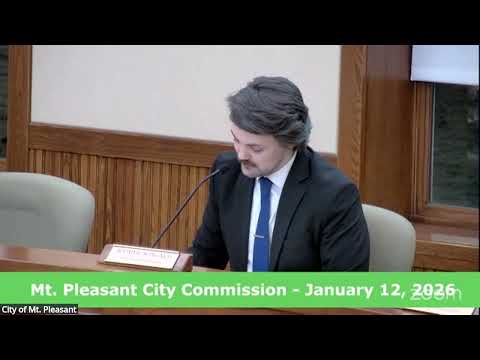
City Manager Aaron Descentz presented a summary of 2025 performance metrics and outlined the city's goals and objectives for 2026 during the January commission meeting.
Descentz said public safety average emergency response hovered around 4.5 minutes in 2025. He reported nearly 1,000 satellite-read water meters were installed in 2025 as part of a multi-year transition to cellular-read meters. In utilities, he noted chemical costs per million gallons treated ranged roughly from $327 to $409 across quarters and outlined ongoing attention to kilowatt hours per million gallons treated at the water plant.
Looking to 2026, Descentz identified two major capital priorities: construction under the DWSRF Phase 1 program (described in the presentation as about a $10,000,000 contract) at the water treatment plant, and Franklin Street reconstruction. Staff will also continue the meter-conversion program, roll out more asset-management work (including cemetery software migration to Pontem), pursue a shared-use pathway grant for Mission Street, advance missing-middle housing strategies and pursue grants for a food-waste receiving station and combined heat-and-power infrastructure.
Descentz said the city had pivoted on an asset-management tool and adopted Pontem for cemetery records; he summarized workforce and training initiatives (a Mount Pleasant Learning Center with ten skill-development courses and 21 users to date) and flagged an RFP to sample and assess the condition of aging AC water mains to inform replacement plans.
Commissioners asked detailed follow-up questions about utility chemical costs, housing strategies, economic-development outreach and grant opportunities. Descentz acknowledged a significant state grant opportunity (described in the presentation as $1.5 million) that could help infrastructure costs for housing projects if awarded. No formal decisions were made; the presentation was received and staff were asked to return with follow-up details on specific projects and grant timelines.