
Board briefs committee on Act 250 basics, digitization and Act 181 implementation timeline
Get AI-powered insights, summaries, and transcripts
Subscribe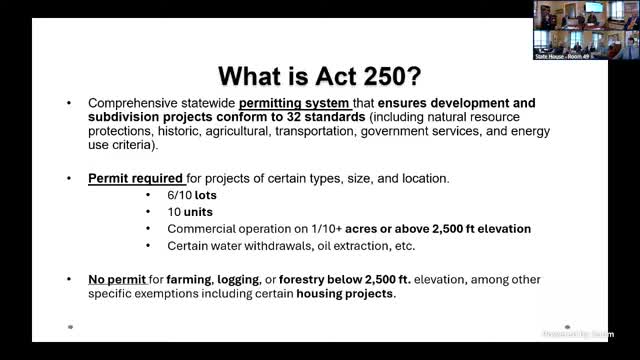
Summary
Board staff summarized Act 250 triggers, exemptions, district coordination, digitization of records, new application form, and Act 181 implementation tasks including regional plan reviews, a new road‑construction trigger, and an EJ community engagement plan.
Board staff briefed a legislative committee on Act 250 fundamentals, program improvements and the Land Use Review Board’s early Act 181 implementation work. Pete Gill, executive director of the board, outlined what requires an Act 250 permit and said the program reviews projects against 32 sub‑criteria covering transportation, energy, prime farmland, natural resources and other factors.
Gill described common triggers for Act 250 review—subdivisions (6–10 lots), commercial projects of 1–10 acres and a 10‑unit housing threshold—and stressed that some logging, farming and forestry activities under 2,500 feet remain exempt. He said the board issues about 350–400 permits per year, that denial is rare (around 0.2%), and that majors (applications requiring hearings) make up roughly 5% of matters.
Program improvements highlighted included a digitization effort (about 540 boxes of files processed) to make historical permits and amendments searchable and a new electronic application form launched January 15 intended to clarify upfront documentation requirements. Gill said additional permanent district coordinators—previously ARPA‑funded roving coordinators—have been hired to expand capacity for jurisdictional determinations and applicant assistance.
Janet Hurley, chair of the Land Use Review Board, reviewed Act 181 implementation work: since the board began on 01/27/2025 it has adopted guidance for tier 1a municipal applications, started pre‑application reviews for regional plans and will perform quasi‑judicial reviews of final plans; several regional planning commissions aim to adopt Act 181‑compliant plans by year‑end. Hurley also noted the board must develop a community engagement plan to satisfy environmental‑justice requirements and that a new road‑construction jurisdiction trigger will go into effect in July.
Committee members asked about state and municipal projects; staff said state projects may trigger review when disturbance thresholds are met but many municipal projects are below those thresholds. Members asked follow‑up questions about jurisdictional determination procedures and cross‑agency coordination; staff invited municipalities and applicants to contact district coordinators for project‑specific advice.
Hurley told the committee the board will seek limited extensions for some deliverables but that the tiered structure implementation remains on the board’s work plan; the board is scheduled to report back to the legislature in 2029 on implementation outcomes.
The committee requested a follow‑up meeting and the board agreed to return with draft statutory language and further updates as requested.