
Land Use Review Board recommends 10 measures to ease Act 250 permitting for wood-products manufacturers
Get AI-powered insights, summaries, and transcripts
Subscribe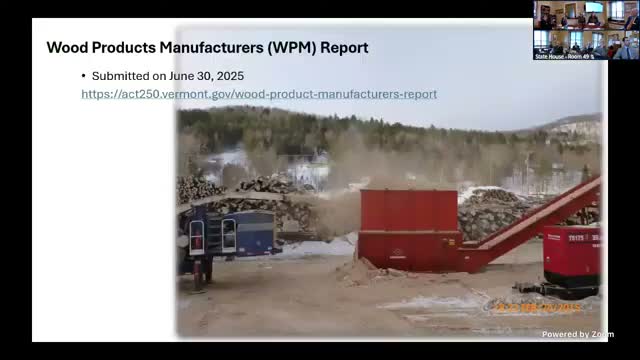
Summary
The Land Use Review Board filed a report with 10 recommendations to help wood-products manufacturers navigate Act 250, including sector-specific fact sheets, training, permit-coordination with ANR, rule updates, a proposed ombudsperson, and a statutory fix to exclude log yards from the wood‑products‑manufacturer definition.
The Land Use Review Board on Tuesday told a legislative committee it has submitted a report containing 10 recommendations aimed at reducing permitting friction for wood‑products manufacturers under Vermont’s Act 250 land‑use permitting system. Board member Kirsten Soltan, who led the review, said the board gathered stakeholder input, reviewed permit files and surveyed applicants before filing the report in June after receiving an extension.
The recommendations center on clearer guidance and faster coordination. "We came up with 10 specific recommendations," Soltan said, and the board proposes publishing sector‑specific fact sheets and supplemental guidance to make applicants aware of existing statutory benefits (hours‑of‑operation allowances and prime‑soils mitigation defaults) and to explain a precedent called Stony Brook that lets commissions limit permit conditions to a subset of a larger tract.
Why it matters: the board found a small but steady caseload for the sector and evidence that interagency timing slows decisions. Between 2018 and early 2025 the board identified 14 wood‑products manufacturing Act 250 applications (about two per year); roughly two‑thirds were processed as minor applications and about one‑third as majors. The board reported an average in‑house processing time of about 130 days (after removing an outlier) and noted that 6 of the 14 cases (43%) were delayed while the commission awaited ancillary permits—most commonly Agency of Natural Resources stormwater or related ANR permits—for an average wait of about 89–90 days.
Key recommendations described to the committee include: publishing targeted guidance and fact sheets for the sector; expanding internal and public training for commissioners and applicants; documenting ANR permit coordination options for complex projects; reviewing Act 250 rules to improve efficiency (for example, clearer permit names and possibly broader use of administrative amendments); advocating for an ombudsperson or permit specialist to provide hands‑on assistance; and making a statutory clarification to align forestry/logging exemptions with agricultural exemptions below 2,500 feet.
On the statutory definition of "wood products manufacturer," Soltan said a 2021 definition unintentionally captured log yards as manufacturing facilities, changing long‑standing practice. The board recommends revising that definition so log yards would be treated as part of logging operations rather than commercial manufacturing in the statute.
Board members told the committee they had limited direct survey response from primary applicants in the sector and therefore supplemented record reviews with evening outreach sessions and stakeholder meetings. Soltan said the board will finalize its fact sheet and guidance in coordination with ANR and make those materials publicly available on the board’s website.
Committee members pressed on prioritization and potential impacts. Soltan said the recommendations were not listed strictly in priority order but that publishing guidance and improving coordination could materially reduce delays—particularly where Act 250 decisions must wait for ancillary ANR permits. "For instance," Soltan said, "in 43% of the applications the Commission had everything it needed but had to wait for receipt of those other permits before the Act 250 permit process could be concluded."
Next steps: the board plans to draft targeted statutory language to address the wood‑products definition and to return to the committee with more detailed language and updates, with staff offering to come back in a follow‑up meeting to walk through the proposed statutory text and rule changes.