Washington County ratifies conditional-use permit for Vaughn Recycling after heated hearing
Loading...
Summary
After more than an hour of public testimony and extended deliberation, the Washington County Quorum Court voted to ratify a conditional-use permit allowing Vaughn Recycling to relocate a metal recycling operation to a parcel on Highway 412; opponents cited traffic, visual, and contamination concerns and a competing ordinance to deny the permit was advanced to a later hearing.
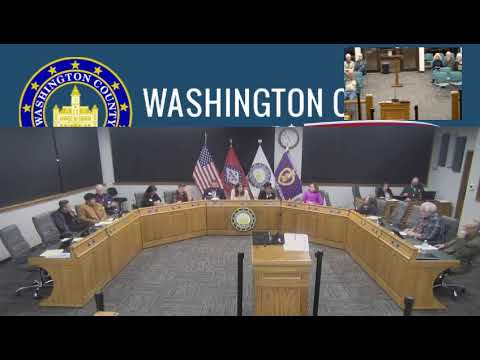
WASHINGTON COUNTY, Ark. — The Washington County Quorum Court on Jan. 8 ratified a conditional-use permit (CUP) for Vaughn Recycling to relocate a metal recycling facility to a portion of a 13.26-acre property along Highway 412, after a day of testimony from residents, staff and the applicant.
The court voted to move the ordinance ratifying the CUP (item 8.1) through the required readings and approve it on its third reading. A competing ordinance to deny the CUP (item 8.2) was advanced to a second reading and scheduled for the Quorum Court agenda on Feb. 19.
Why it matters: Residents who live near the proposed site told the court they are worried about heavy truck traffic, a steep turn and grade at the site entrance, potential visual blight from stored metal, and the risk of contaminants reaching nearby water resources. Planning staff and the applicant said the business would operate under state and federal environmental rules, use concrete pads and storage bins, and add screening and dust controls.
What the record shows: Planning staff told the court the Planning Board approved the CUP on Oct. 30 by a 5-0 vote. The staff report said the applicant provided 202 mailed notifications, and the planning record included 32 emails or letters and 553 petition signatures opposing the project; staff also recorded seven supportive comments. The CUP application would use about 6.52 acres for the facility and includes recommended conditions such as an 8-foot opaque privacy fence, dust abatement, and paving or concrete pads for material storage.
Residents' concerns: Dozens of residents spoke against the permit during two public-comment periods, citing safety concerns on Highway 412 where speakers said some drivers exceed posted speeds and where they described a downhill grade and limited sight lines into the site entrance. "It's unacceptable risk to our community's safety, health, and quality of life," said Kelly Franks, a neighbor who told the court she helped gather more than 500 petition signatures opposing the permit. Ray Estep, another nearby resident, described repeated crashes along the stretch and said the site would be visible from a steep drop, "and we're gonna be looking inside a junkyard if it's approved for the rest of our lives."
Applicant's response: Project engineer Bridal Wise of Bates & Associates and attorney Tripp Halbert presented site plans and mitigation measures. Wise said the applicant prohibits hazardous wastes, will organize outdoor material in concrete bins and designated bays, and plans dust abatement and screening. Halbert argued the site is compatible with other nearby commercial and industrial uses and noted unanimous Planning Board approval. Owner Levi (Leo) Vaughn said the company has 15 employees, processed about 20 million pounds of metal in 2025, and does not shred ferrous material on site: "We do not process the vehicles on-site. They go directly to the shredder in Rogers," Vaughn said.
Court deliberation and vote: Quorum Court members debated compatibility, enforceability of conditions and whether adjacent yards with stored vehicles are grandfathered nonconforming uses. Several justices said they trusted the Planning Board record and the ability to place enforceable conditions; others said the access (Aaron's Drive) and high-speed traffic on Highway 412 required stronger, enforceable commitments before approval. On the final roll call the motion to ratify the CUP carried (recorded votes included multiple yes and no responses; the motion passed). Separately, the denial ordinance was advanced to a second reading for the Feb. 19 meeting and will be considered further then.
What happens next: The CUP ratification ordinance (8.1) was passed at third reading. The denial ordinance (8.2) will appear for a second reading on Feb. 19, 2026; if the court takes additional actions there, the matter may return to the agenda for final disposition or further appeals per county procedures.
Reporting note: Statements in this article reflect representations made in the Jan. 8 meeting record: planning staff recounted notifications and public comments; the applicant described intended practices; a number of nearby residents expressed opposition focused on traffic safety, visual impacts and possible environmental risks. Where the record lacked specific technical studies (for example, no formal traffic study was submitted), the article reports speakers' assertions and the applicant's stated approach without independent verification.
Ending: The Quorum Court adjourned the special meeting after the vote; the item to deny the CUP will be considered at the Feb. 19 Quorum Court meeting.