State work group details 2026 data submission guide updates for APMs and primary care
Summary
OKA presented proposed technical updates to the 2026 Data Submission Guide, clarifying alternative payment model (APM) file specifications, primary care code sets and Medi-Cal reporting (in collaboration with DHCS); Oka said the changes clarify instructions but do not change methodology and a draft will go out for public comment.
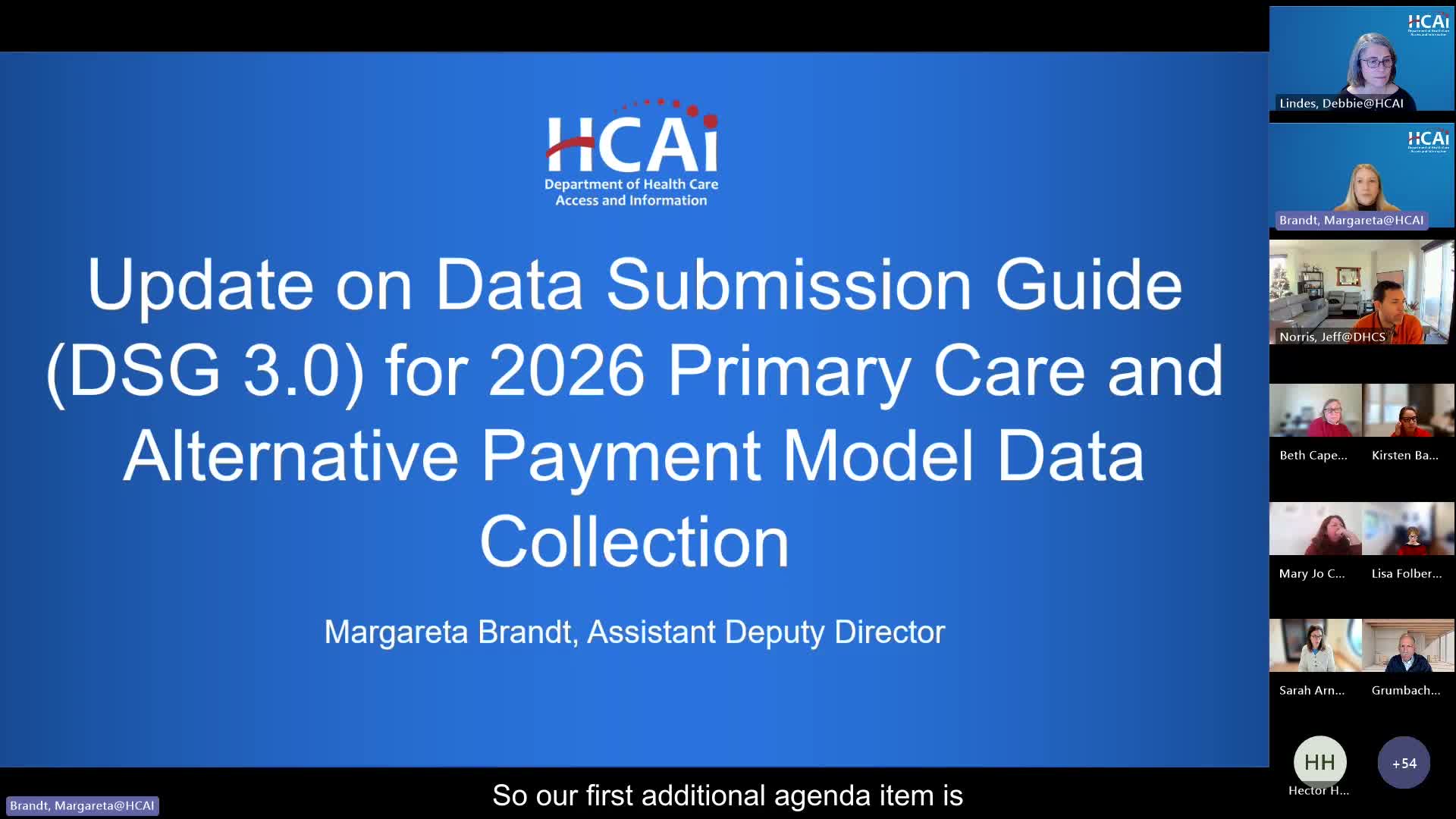
Margaretta Brandt, Assistant Deputy Director for Health System Performance at OKA, said the agency is preparing DSG 3.0 (the 2026 Data Submission Guide) to add behavioral health collection and refine APM and primary care file specifications for submitters. "It's the third version. It contains the formal written instructions for data submitters about definitions, what to include and how to configure the data that they submit to oka," Brandt said.
The most substantive clarifications described were technical and procedural. For APMs, staff proposed additional guidance for how to attribute member months, a reorganized instruction set for clarity and a new process map "to illustrate how member expenses are reported in the alternate payment model file," Brandt said. On primary care, OKA is clarifying methods for classifying non-claims primary care payment subcategories and instructing that claims-based primary care spending be measured and reported by each individual line within a claim. Brandt said OKA is also proposing adjustments to the Primary Care Code set, including adding "Physician Assistant General" and newly issued CMS "Advanced Primary Care Management Service" codes.
Brandt emphasized these updates are intended as clarifications rather than methodological changes. "There are no changes to the methodology for either the alternative payment model data collection or the primary care spending measurement," she said in response to a question.
The guide includes Medi-Cal-specific clarifications developed with the Department of Health Care Services (DHCS). Brandt said OKA added reporting guidance clarifying which DHCS payments to include or exclude in primary care spending calculations: pass-through payments will be excluded, while some program fees such as Vaccines for Children administration fees will be included. For claim-level primary care identification, OKA will instruct Medi-Cal managed care plans to use the monthly 274 network file submitted to DHCS to confirm whether a provider listed on a claim is designated as a primary care provider in the plan's network, analogous to commercial plans using Department of Managed Healthcare annual network files.
Work group participants asked whether the APM data collection can or should differentiate members by clinical severity to avoid incentives for "cherry picking." Brandt said the current APM collection does not differentiate by severity but that the team could consider that option in future standards work. She and colleagues also reiterated that for APM-adoption metrics OKA counts membership in arrangements that are linked to quality (shared savings/ capitation arrangements adjusted by quality), not solely the existence of a behavioral health capitation line.
The draft DSG (with APM, primary care and the new behavioral health file specifications) will be released for public comment this spring; OKA staff said they will post the draft and solicit feedback from submitters and stakeholders before publishing a final guide in spring in preparation for 2026 data submissions in September.
Next steps: a public comment period and outreach to data submitters before the final guide publication.