
Hundreds testify as Fairfax County School Board hears objections and support for superintendent’s boundary plan
Get AI-powered insights, summaries, and transcripts
Subscribe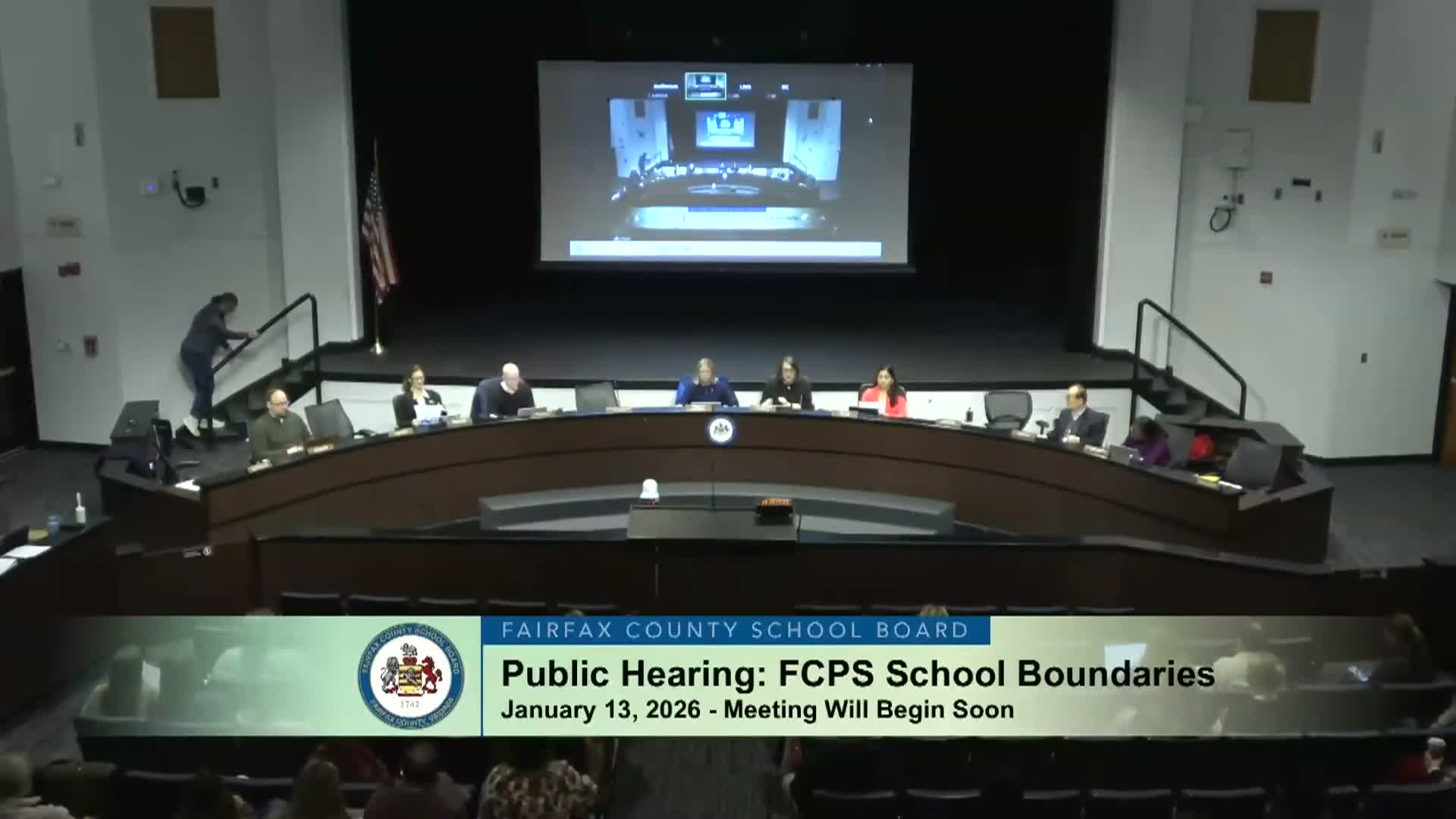
Summary
At a Jan. 10 public hearing on proposed boundary adjustments, dozens of parents, students and community representatives urged the board either to adopt the superintendent’s recommendations or to pause, citing last‑minute changes, split feeders, program continuity and transportation concerns; the board will vote Jan. 22, 2026.
Fairfax County School Board members heard more than an hour of public testimony on Jan. 10 about Superintendent Reed’s proposed school boundary adjustments, as parents and students alternately urged the board to adopt and to delay parts of the plan ahead of a board vote scheduled for Jan. 22, 2026.
The hearing opened with procedural remarks from the clerk and the presiding official, who noted that the division updated Policy 81‑30 in July 2024 to require a division‑wide boundary review at least every five years and said 86 people had preregistered to speak. Speakers were allotted two minutes each.
Many speakers pressed the board to reverse or pause late changes that they said were announced with insufficient notice. Katie Benson, a Beech Tree parent, said the community learned about changes only days before the public comment deadline and called the process “deceitful” and “undemocratic.” Michelle Sinclair, Beech Tree PTA president, said the proposal would create a new “double split feeder” and push nearby Poe Middle School over capacity, arguing that families had no adequate time to respond.
Students and families cited specific harms from sudden reassignment: Lillian Sher, a Justice student, said, “These decisions are not just data points on a map, they affect real students, real families in real lives,” and warned that transfers could disrupt IB program access and athletic eligibility if transportation is not provided.
Other speakers urged the board to keep the superintendent’s recommended alignments where they preserve neighborhoods and reduce splits. Mark Barr and other residents from the Wolf Trap and Madison areas said the recommendations generally respected community ties and program continuity. Several small neighborhoods — including Fairfax Acres and Briarwood Trace — urged the board to approve narrow reassignments that residents argued would create little operational impact while improving walkability and shortening commutes.
Speakers raised a set of recurring technical concerns: capacity projections and timing (several said the presentation relied on 2024–25 projections rather than the most current enrollment data), transportation (parents asked whether students grandfathered in their current schools would have bus service), program continuity for AAP and IB students, and safety findings for routes to school (Briarwood Trace speakers said they had only just learned of a safety assessment and were waiting for remediation options).
Several Herndon parents opposed moving 190 students into Herndon Elementary while the school is under renovation and listed as “off track” under Virginia’s school performance framework. Rebecca Shaw, a special‑needs teacher and parent, said the district must include concrete transition plans — tours, staff coordination and individualized meetings — for students with IEPs and 504 plans.
Speakers also called out process issues and compliance with Policy 81‑30’s public‑engagement requirements. Multiple presenters asked the board either to revert to the original Scenario 4 for affected neighborhoods or to pause action on areas that lacked targeted outreach (Beech Tree and parts of Region 2 were frequently cited).
The hearing featured local details as well as countywide themes: supporters pointed to reductions in some split feeders and to iterative committee work, while opponents emphasized last‑minute adjustments, incomplete outreach and potential capacity or transportation consequences. No formal motions or votes were taken at the hearing; the board said it will hear overflow testimony on Jan. 13 and vote on the superintendent’s proposal at its Jan. 22 regular meeting.
The board accepted additional written testimony via communityparticipation@fcps.edu and adjourned at 12:59 p.m.