
Commissioner outlines executive-order reforms: permitting changes, brownfields review and inventory of state land for housing
Get AI-powered insights, summaries, and transcripts
Sign Up Free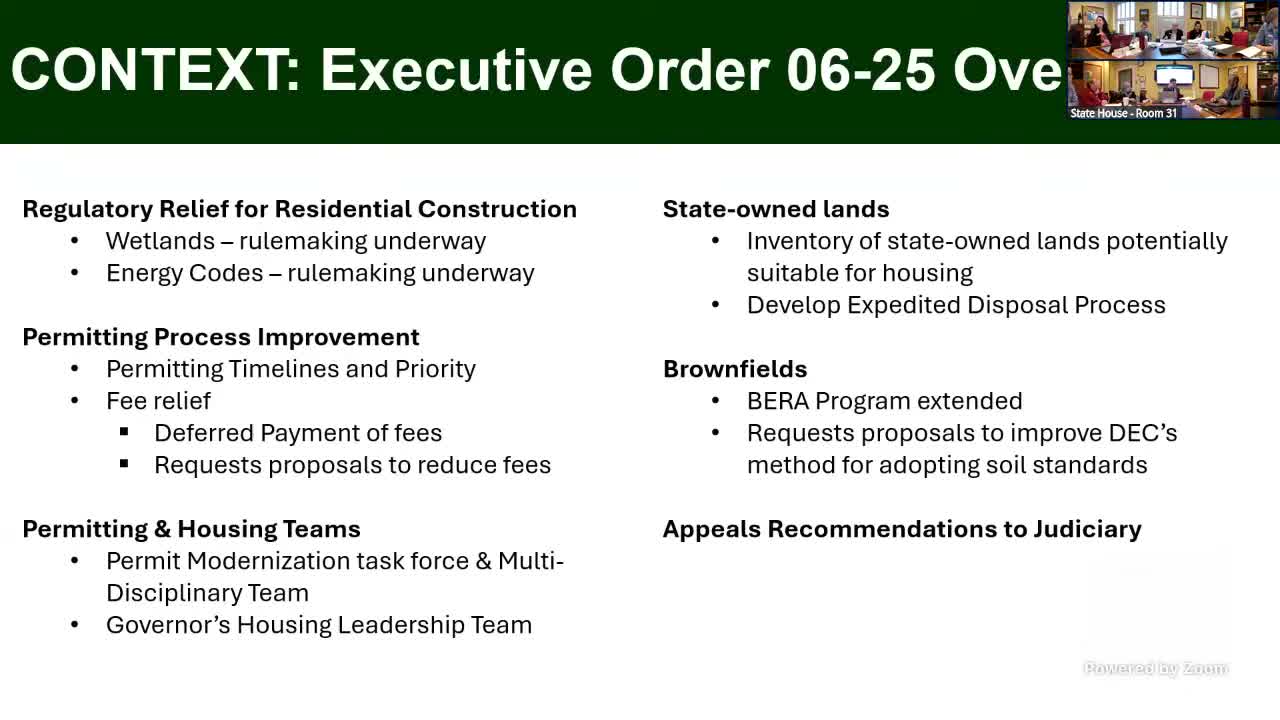
Summary
Alex Farrell briefed the committee on the administration's executive order and related work to streamline permitting, reassess environmental media standards affecting corrective action plans, and inventory state-owned parcels (BGS, VTrans) to identify developable sites and an expedited divestment process.
Alex Farrell, commissioner of the Department of Housing and Community Development, told the General & Housing Committee that an executive order signed by the governor includes energy-code alignment and wetlands buffer questions but that other elements of the order — particularly cross-agency process changes — may be more consequential for accelerating housing development.
Farrell said the administration is discussing a single-entry or plan-level approach to permitting so that state permit requirements could be addressed earlier in a project and reduce separate appealable events during construction. He told the committee such reforms are being discussed at cabinet level meetings that now occur every other Thursday and will involve DEC, VTrans, the Agency of Natural Resources and other agencies.
On brownfields and corrective-action plans, Farrell said Vermont’s environmental media standards — developed by the Department of Health and adopted by ANR — are relatively stringent and can trigger costly corrective-action timelines; the executive order calls for a review that will include health experts, economists and housing developers to inform any potential revisions to the standards.
Farrell also described an effort to inventory state-owned lands (including BGS and VTrans parcels) to identify parcels with water/wastewater access and other developability. He said the current phase is to understand and analyze opportunities, catalog constraints (easements, federal coverage, infrastructure limits) and then pursue a proof-of-concept expedited divestment or divestment process in partnership with relevant committees.
Committee members raised concerns about infrastructure studies and environmental impact analyses for large sites (one member asked about the Windsor Prison Lands in her district and whether sewer and water capacity would be sufficient). Farrell said the inventory will catalog constraints and that detailed studies would be part of subsequent analysis rather than being glossed over.
Farrell framed these items as early-stage administrative work that will produce options for the legislature and agencies to consider in upcoming sessions.