Senate debate S.220 allowable‑growth cap for school spending; counsel flags possible constitutional challenges
January 10, 2026 | Finance, SENATE, Committees, Legislative , Vermont
This article was created by AI summarizing key points discussed. AI makes mistakes, so for full details and context, please refer to the video of the full meeting. Please report any errors so we can fix them. Report an error »
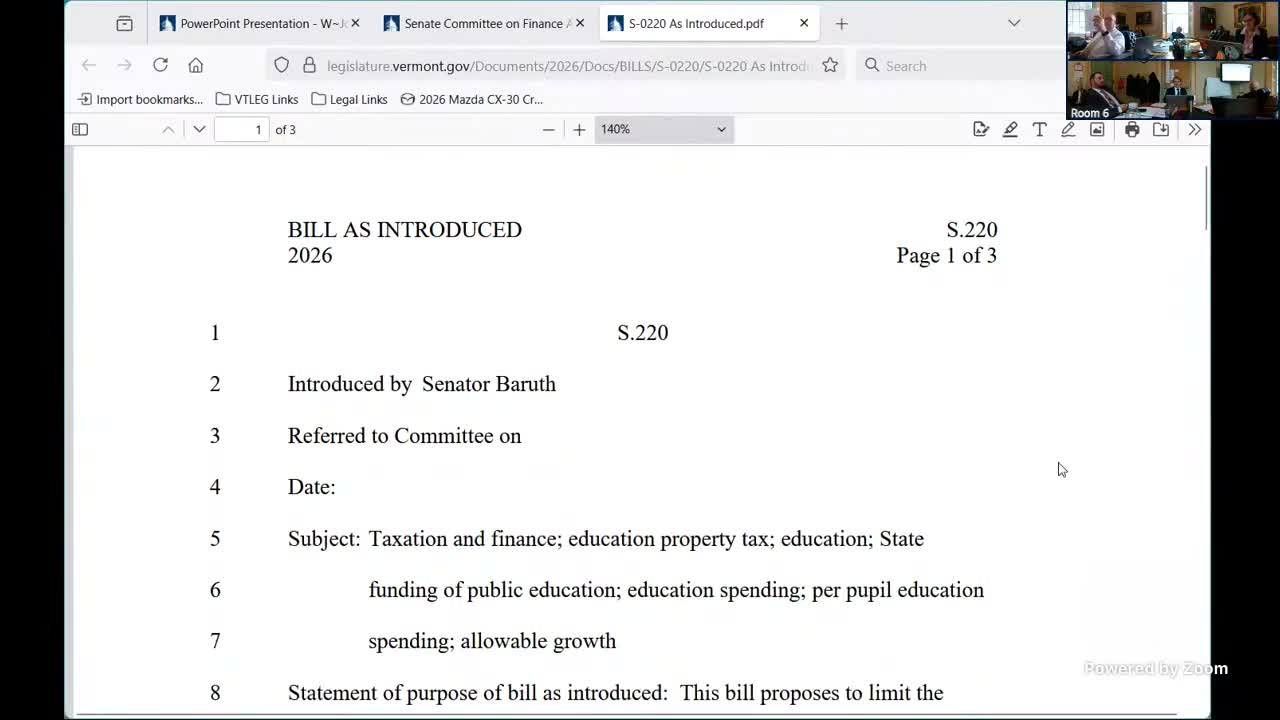
Senate Finance members discussed S.220, a bill that would cap allowable per‑pupil education spending growth for fiscal years 2028 and 2029.
Introducing the measure, committee counsel explained the bill "is a straight cap" and that "the district literally cannot spend more than the proposed allowable growth percentage," distinguishing S.220 from prior excess‑spending threshold approaches. Counsel said the bill sets the allowable growth percentage as 9% of the gap between a district's prior‑year per‑pupil spending and the highest spending district (excluding gores), expressed as a percentage of the district's own prior‑year spending, and that the statute establishes a 3% minimum allowable growth percentage.
Committee counsel also noted legal risks to consider. Counsel told members that opponents could raise challenges under Vermont’s education clause, arguing a cap might deprive students of constitutionally required education funding. He added that a Brigham‑style equal‑opportunity challenge is plausible because the cap would permit different per‑pupil spending paths across districts. "I'm not saying that that's what this does," counsel said, "just pointing out that someone can make it along these lines." The counsel suggested the temporariness of a two‑year cap might affect the analysis but cautioned the arguments are not plainly dismissible.
Members debated tradeoffs. Supporters described the bill as an immediate, short‑term mechanism to slow growth in education spending and help taxpayers while longer‑term funding proposals are developed; opponents said it does not address root cost drivers such as health‑care inflation and may force difficult local cuts. One member noted that capping per‑pupil spending does not automatically lower tax rates in every district because tax impacts depend on equalized rates and other revenue sources.
On fiscal effects, a Joint Fiscal Office presenter offered a preliminary estimate for implementation in a sample year. The transcript contains inconsistent numbers: in one line the presenter’s figure was reported as about $6,768,000,000, while elsewhere the presenter and committee discussion referenced a preliminary estimate of roughly $67,000,000 in reduced education spending for the comparison year. JFO described the method for the estimate: compare permitted spending under S.220 to projected spending and take the difference; how that translates into lower property tax rates depends on other education fund revenues and equalization mechanics.
JFO displayed a chart mapping each district’s per‑weighted‑pupil spending (blue dots) and the resulting allowable growth percentage (a line); presenters said the median allowable growth under the metric is 3% and that the 9% factor in S.220 is higher than a 5.5% factor used in prior allowable‑growth proposals.
No formal vote was taken. Committee members requested additional district‑level modeling from JFO and the Agency of Education and asked counsel to provide further analysis of possible constitutional claims before the committee advances the bill.
Introducing the measure, committee counsel explained the bill "is a straight cap" and that "the district literally cannot spend more than the proposed allowable growth percentage," distinguishing S.220 from prior excess‑spending threshold approaches. Counsel said the bill sets the allowable growth percentage as 9% of the gap between a district's prior‑year per‑pupil spending and the highest spending district (excluding gores), expressed as a percentage of the district's own prior‑year spending, and that the statute establishes a 3% minimum allowable growth percentage.
Committee counsel also noted legal risks to consider. Counsel told members that opponents could raise challenges under Vermont’s education clause, arguing a cap might deprive students of constitutionally required education funding. He added that a Brigham‑style equal‑opportunity challenge is plausible because the cap would permit different per‑pupil spending paths across districts. "I'm not saying that that's what this does," counsel said, "just pointing out that someone can make it along these lines." The counsel suggested the temporariness of a two‑year cap might affect the analysis but cautioned the arguments are not plainly dismissible.
Members debated tradeoffs. Supporters described the bill as an immediate, short‑term mechanism to slow growth in education spending and help taxpayers while longer‑term funding proposals are developed; opponents said it does not address root cost drivers such as health‑care inflation and may force difficult local cuts. One member noted that capping per‑pupil spending does not automatically lower tax rates in every district because tax impacts depend on equalized rates and other revenue sources.
On fiscal effects, a Joint Fiscal Office presenter offered a preliminary estimate for implementation in a sample year. The transcript contains inconsistent numbers: in one line the presenter’s figure was reported as about $6,768,000,000, while elsewhere the presenter and committee discussion referenced a preliminary estimate of roughly $67,000,000 in reduced education spending for the comparison year. JFO described the method for the estimate: compare permitted spending under S.220 to projected spending and take the difference; how that translates into lower property tax rates depends on other education fund revenues and equalization mechanics.
JFO displayed a chart mapping each district’s per‑weighted‑pupil spending (blue dots) and the resulting allowable growth percentage (a line); presenters said the median allowable growth under the metric is 3% and that the 9% factor in S.220 is higher than a 5.5% factor used in prior allowable‑growth proposals.
No formal vote was taken. Committee members requested additional district‑level modeling from JFO and the Agency of Education and asked counsel to provide further analysis of possible constitutional claims before the committee advances the bill.
View the Full Meeting & All Its Details
This article offers just a summary. Unlock complete video, transcripts, and insights as a Founder Member.
✓
Watch full, unedited meeting videos
✓
Search every word spoken in unlimited transcripts
✓
AI summaries & real-time alerts (all government levels)
✓
Permanent access to expanding government content
30-day money-back guarantee
