
Roseville staff outline roughly $700,000 in CDBG funds, prioritize homelessness and affordable rental housing
Get AI-powered insights, summaries, and transcripts
Subscribe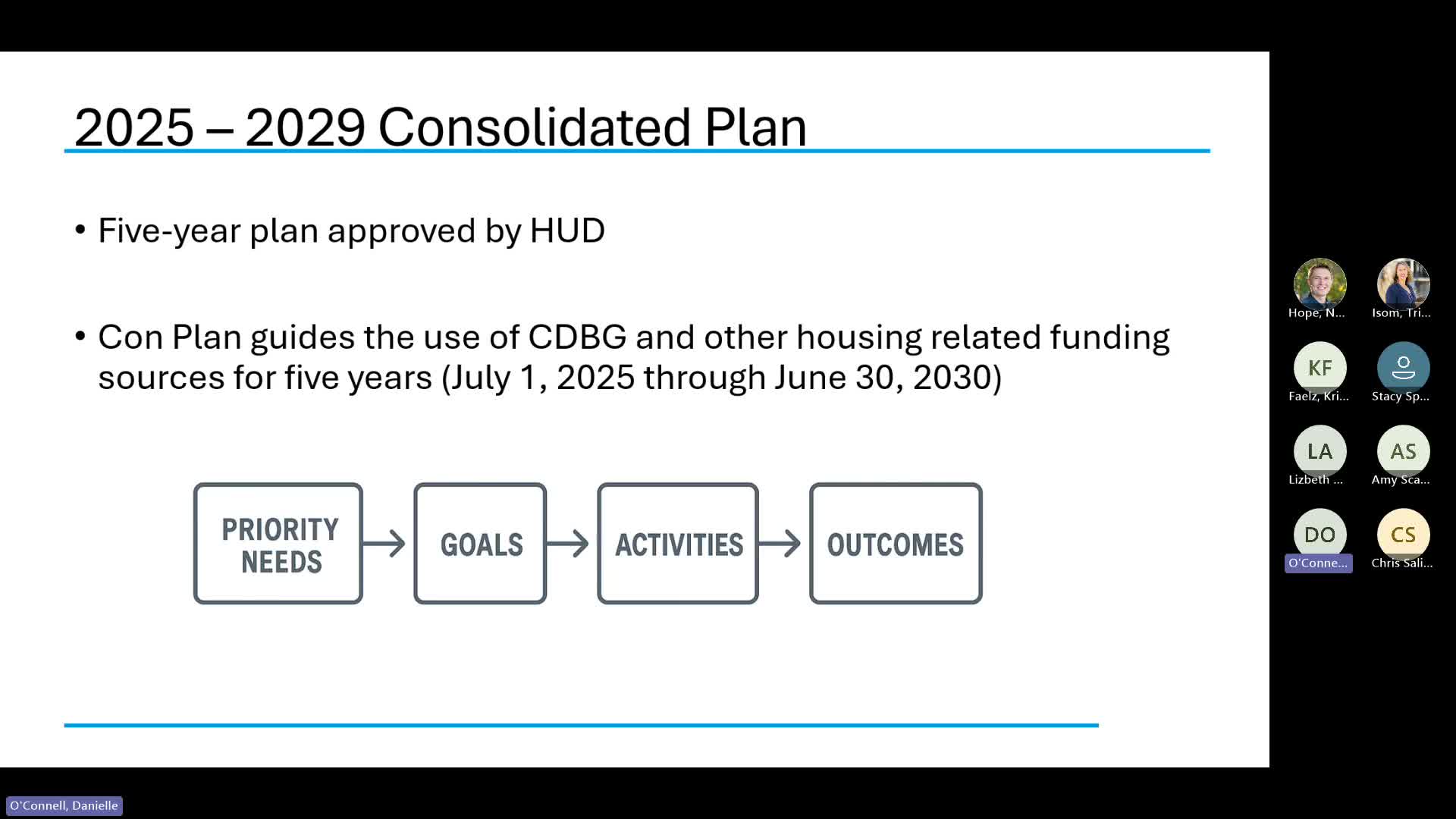
Summary
City housing staff told a public workshop the estimated 2026–2027 Community Development Block Grant (CDBG) allocation is roughly $700,000, with priorities on shelter, affordable rental housing and supportive services; staff explained eligibility, program caps, and application deadlines.
Daniel O'Connell, housing analyst for the City of Roseville, told a public workshop the city expects the 2026–2027 Community Development Block Grant (CDBG) award to be "roughly $700,000." The funds are intended to support housing programs, public facilities, accessibility improvements, planning and public services for low‑ and moderate‑income residents.
O'Connell said the city translated community input into six consolidated‑plan goals adopted in 2025, placing top priority on addressing homelessness, expanding and preserving affordable rental housing, and providing services for low‑income and special‑needs populations. "Activities that are awarded CDBG funds during the 2025–2029 consolidated planning period must be related to one of the priority needs," he said.
Under HUD rules, up to 20% of the grant may be used for administrative costs (the maximum allowed), and public‑service spending is capped at 15% of the total award. Using the staff estimate, O'Connell said about $105,000 would be available for public‑service activities and roughly $455,000 would remain for capital improvements, owner‑occupied rehabilitation and public facility projects.
Eligible activities noted at the workshop include acquisition of property for affordable rental housing, rehabilitation and construction of public facilities (water, sewer, sidewalks), limited public services that primarily serve low‑income persons, and energy conservation efforts. O'Connell reminded applicants that all projects must meet a HUD national objective and that capital projects may trigger federal labor and prevailing‑wage requirements even when CDBG covers only part of a project.
The city requires subrecipients to document beneficiary income and household characteristics via quarterly reporting through ZoomGrants; reimbursements will be paid only after required reports and supporting invoices are submitted. O'Connell also cited an illustrative HUD income limit: as of April 2025, the HUD income limit for a four‑person household in Placer County is $102,900.
Applications are handled through ZoomGrants. Staff reiterated key deadlines: pre‑applications are due by 11:59 p.m. the day after the workshop, and full applications are due Monday, Feb. 2 at 5 p.m. Applicants were invited to attend the May 6 City Council meeting in support of funding requests. Staff said they will review pre‑applications promptly and follow up with applicants as needed.