
Senate Institutions Committee reviews two‑year $100 million capital bill; JFO outlines cash fund, grants and reallocations
Get AI-powered insights, summaries, and transcripts
Subscribe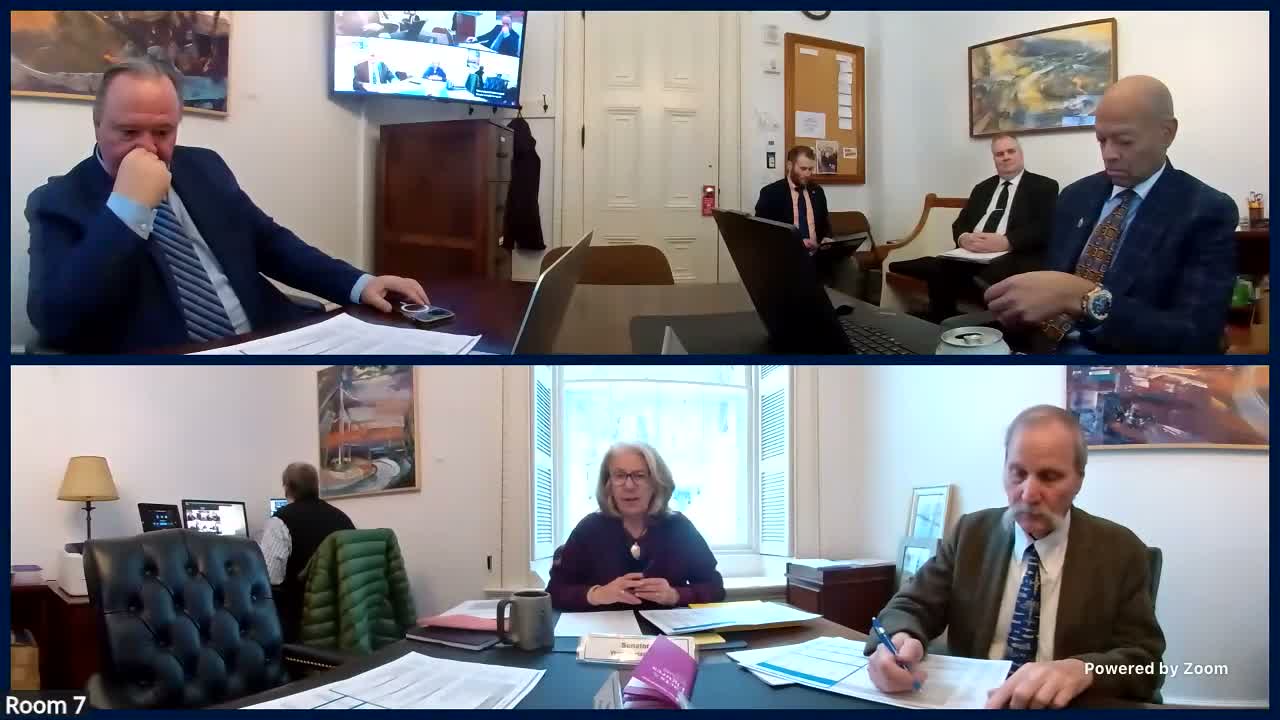
Summary
Scott Moore of the Joint Fiscal Office briefed the Senate Committee on Institutions on the proposed two‑year capital bill, describing a $100 million bonding plan ($50M/yr), the cash fund’s role for planning, key program allocations and next steps including a JFO cash‑fund report.
Madam Chair convened the Senate Committee on Institutions on Jan. 9, 2026, saying the committee would "have an overview of the capital bill." Scott Moore of the Joint Fiscal Office told the committee the proposal is a two‑year capital bill and that "we have a $100,000,000 to spend on capital bonding," split as $50,000,000 in each year of the biennium.
Moore said the bill combines bonded and cash funding and reiterated that the bill language, not the spreadsheet, is the legal authority. He explained the committee uses a spreadsheet to track line items and sections, with column headings for last year’s amounts, the governor’s FY27 recommendations and the Senate’s proposed changes. Moore described the cash fund as intended to pay for smaller, short‑term expenses such as planning and design so the state can avoid issuing long‑term bonds for brief costs.
On program specifics, Moore identified several large categories: Buildings and General Services (major maintenance across roughly 240 state properties), corrections facilities (examples included Newport and other named facilities), and grant programs such as historic preservation and building community grants. He said the committee sets the total amounts for grant programs but agencies administer individual awards; the historic preservation grants were shown at about $300,000 per award in the spreadsheet.
Moore also described mechanisms that increased available capital beyond the $100 million base: returned or reallocated prior appropriations and an estimated bond premium that can add several million dollars when bond sales exceed par. As an example, he said reallocations and bond‑sale premiums together produced roughly $6–7 million of additional capacity in the current cycle. For clean water, Moore said the bill includes a $10,000,000 placeholder that will be allocated once the Clean Water Board issues its recommendations.
An unidentified committee member noted a roughly 30% increase in workload at the Agency of Human Services tied to federal changes; Moore replied that capital funding would be deployed for capital needs only when physical space or building modifications are required, and otherwise those workload changes would be reflected in operating budgets rather than the capital bill.
Moore pointed to several procedural items: agencies testifying later in the session will explain project‑level needs and unexpected costs (mold, wire replacement, hidden repairs) that can raise requested amounts; section 22a of the bill requires a JFO report on the cash fund; and legislative counsel (John Gray) will appear at a subsequent meeting to walk members through bill language. Committee members asked staff to post meeting agendas and to provide binders and the JFO cash‑fund report in advance of future meetings.
The committee did not take formal votes during the briefing. Madam Chair adjourned the meeting after scheduling follow‑up appearances and requesting materials be distributed before subsequent discussions.