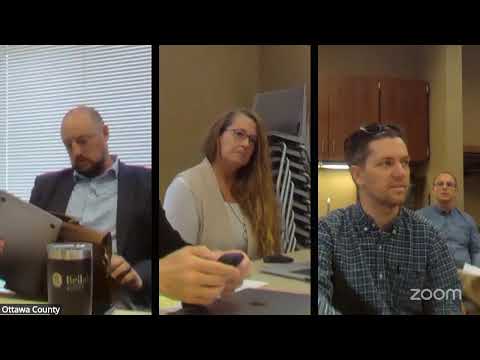
Housing commission votes to proceed with public survey and debates bylaw changes for larger, more diverse board
Loading...
Summary
Commissioners approved distributing a two‑week public survey to inform a February facilitated planning session and discussed proposed bylaw changes including board size and term lengths, balancing broader representation against operational agility.
At the meeting the Ottawa County Housing Commission approved staff plans to launch a public survey and use results to guide a facilitated strategic‑planning session in February.
Joe Pierce, identified in the meeting as leading strategic efforts for the Department of Strategic Impact, described a short survey designed to gather perspectives from residents, municipal planners, nonprofits and builders. "We're looking at doing a survey that we would launch next week...the survey would be open for 2 weeks," he said, and staff said they will share a preview link with commissioners for quick feedback.
Commissioners emphasized outreach: staff plan to send the survey directly to a contact list of roughly 300 stakeholders and to post it on county social media to reach residents. Staff also said they will combine ZIP‑level download data from the small‑footprint plans with survey responses to identify geographic pockets of demand.
A separate discussion under new business addressed proposed bylaw revisions that would change the commission’s size and term lengths. One commissioner cautioned that a 19‑member commission could be unwieldy and suggested a smaller voting board supported by volunteer subcommittees. "My concern would be a 19 member board in a meeting like this...It'd be a bit unwieldy," a commissioner said. Other commissioners argued a larger board could widen representation and include banking and nonprofit housing expertise.
Commissioners asked for a two‑week period of exchanges among themselves and staff to craft a recommended structure and said they would circulate suggested edits. Staff committed to collecting written input from commissioners and to convene a work group to refine a recommended structure to present to the county board of commissioners.
Administrative items: staff said the annual review of bylaws and conflict‑of‑interest forms will be emailed after the meeting, and the commission set its next regular meeting for February 5 at 10 a.m. (location to be confirmed). The commission did not enact bylaw changes at the meeting; the conversation will continue as staff and commissioners collect survey data and written input.
Public comments during the meeting touched on governance and implementation questions. A Grand Haven resident recommended keeping the existing housing authority in a 'hibernation' state so that it remains available to meet statutory requirements in the future. Another public commenter urged broader representation and asked about typical lot sizes for the small‑footprint designs; a speaker representing Save A Homes raised infrastructure barriers, noting local rules can require additional wells or septic systems that raise development costs.
Next steps: commissioners and staff will finalize the survey for launch early next week, collect survey responses for two weeks, hold a facilitated session in February to identify priorities, and reconvene in late February to review a concise strategic plan draft.