
Iroquois County hears proposal for 398 MW 2 Road Solar project; residents press drainage, notice and buffer concerns
Get AI-powered insights, summaries, and transcripts
Subscribe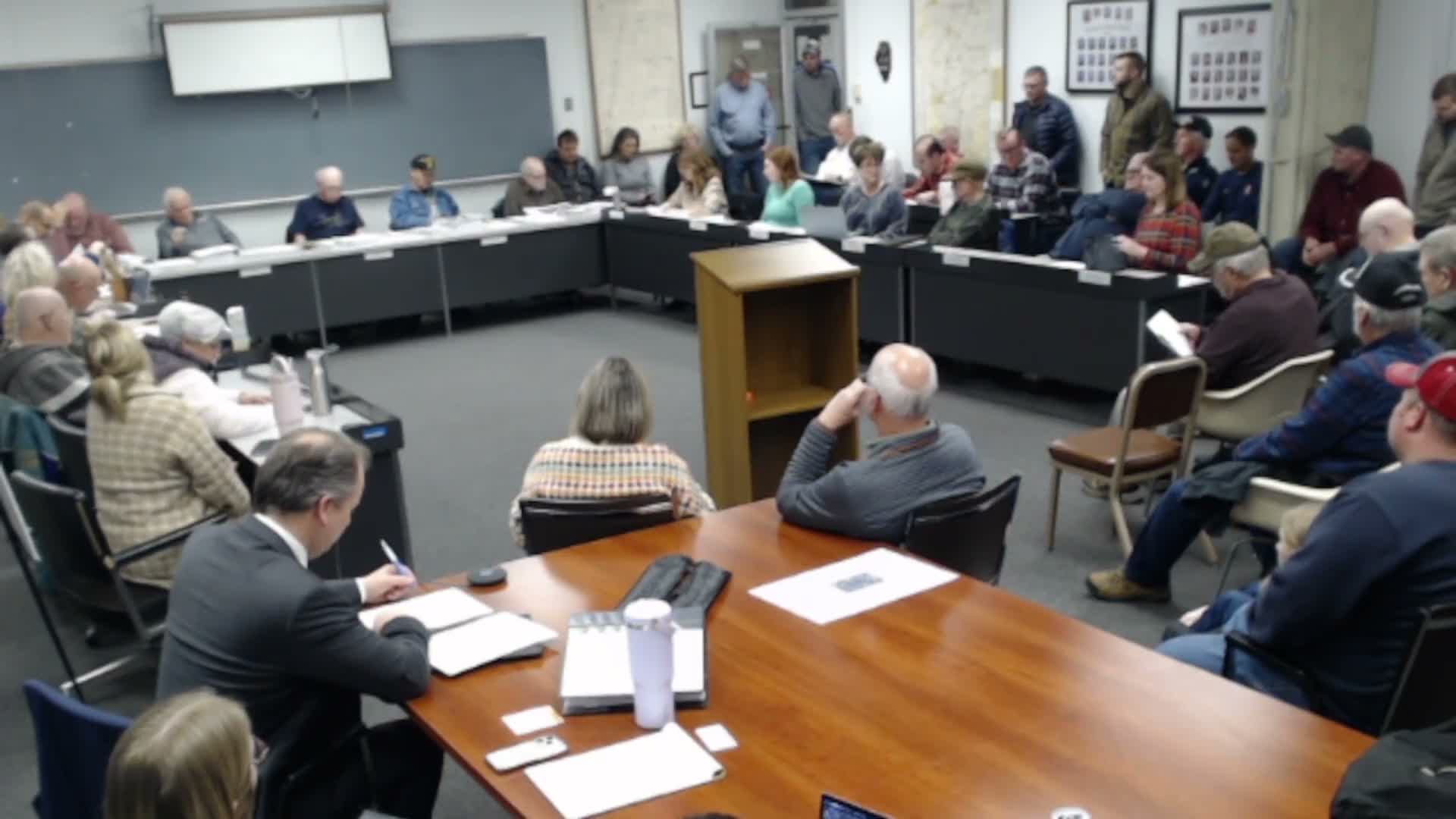
Summary
At a Jan. 6 public hearing the Iroquois County Zoning Board of Appeals heard the developer of 2 Road Solar LLC describe a 398 MW, 4,468.25-acre project and its mitigation plans; neighbors questioned drain-tile protection, outreach and vegetation; the board combined three related agenda items for a single hearing and recessed without deciding the permit or variances.
The Iroquois County Zoning Board of Appeals opened a public hearing on Jan. 6, 2026, to consider 2 Road Solar LLC'9s application for a conditional-use permit and two variances to build a 398-megawatt commercial solar energy facility sited on 4,468.25 acres in Lorton and Pigeon Grove townships. Counsel for the applicant said the project would be developed by Ranger Power and is structured so that roughly 3,000 acres would be fenced and used for solar generation.
"The project will produce enough clean, renewable energy to power approximately 90,000 Illinois homes," the applicant'9s presenter said, and the company told the board it expects construction to begin in late 2027 with commercial operation around 2029. Counsel David Stryker described Ranger Power as a long-term owner and operator that prepared the application to align with Iroquois County'9s commercial solar ordinance adopted in May 2025.
The developer asked that three related agenda items—the conditional-use permit and two variance requests—be heard together for efficiency; the board approved that motion at the start of the hearing. The developer also requested a variance to allow an aerial drain-tile survey to be completed in 2026 rather than before permit approval, saying the surveyor could not accommodate the earlier schedule but that the company intended to provide the results as a condition of approval.
Company representatives described multiple mitigation measures and protections in the application and exhibits: a vegetative buffer and permanent native ground cover beneath panels; a posted decommissioning fund; an Agricultural Mitigation Agreement with the Illinois Department of Agriculture covering restoration and drain-tile repairs; a noise study (exhibit J) and a glare study (exhibit I) that were submitted to the record; and a property-value report (exhibit R) that the developer said found no negative trend for adjacent property values. The presenter said Ranger would voluntarily double the state setback from 150 feet to 300 feet on nonparticipating parcels and would maintain that buffer.
Residents raised several concerns during a public question-and-answer period. Krista Steiner, who identified herself and asked that her name be recorded, said her land appeared on permit maps but that she had not been contacted and that receipt of the hearing notice was the first she heard of the project. The developer and the facilitator said only parcels with executed agreements would host infrastructure and that adjacent landowner notice is required by state statute, but Steiner said the notice did not resolve her concern.
On drainage and extreme weather, residents asked who would be liable if panels were damaged by tornadoes and spread debris onto neighboring land. The presenter said the panels are weather-tested, that Ranger'9s other Illinois projects have withstood severe weather, and that the company carries insurance and would be responsible for cleanup if an extraordinary event occurred.
Other public questions addressed batteries (the developer said there will be no utility-scale battery storage on the site), panel sourcing (the presenter said vendors are not yet selected but that domestic suppliers are prioritized), panel end-of-life handling (replacement and recycling or resale), and how vegetative buffers and perimeter trees would be planted and maintained (the company said it would be responsible for maintenance and replanting as needed and that the vegetative management plan will be part of the building-permit review).
The developer cited an Anderson Economic Group tax analysis that it said forecasted approximately $881,600,000 in new tax revenue over the project'9s lifetime and provided line-item numbers for county, township, school and fire department allocations; some attendees questioned the figures and formatting in the record. The developer said construction would generate hundreds of temporary jobs and that long-term operations typically yield roughly 8—to—10 permanent positions for a project of this size.
No final vote on the conditional-use permit or variances was taken at the Jan. 6 session. After roughly an hour of presentation and public questioning the board recessed until approximately 7:15 p.m. and indicated it would take the evidence into deliberation and later make recommendations to the county board.