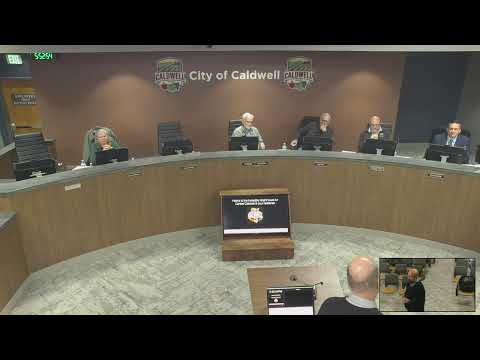
Envision Central Caldwell plan sets long-range vision for riverfront, parks and downtown catalysts
Loading...
Summary
Consultant Roger Brooks presented a 10-initiative Envision Central Caldwell plan to the Urban Renewal Agency proposing an Indian Creek Promenade, a whitewater sports corridor, a 700-space parking garage with a conference center, and district-specific neighborhood investments aimed at attracting hotels, office space and tourism.
Roger Brooks, a consultant with Destination Developments, presented the Envision Central Caldwell master plan to the Caldwell Urban Renewal Agency, laying out 10 initiatives intended to reshape about 1,500–1,600 acres of central Caldwell, including riverfront corridors, fairgrounds and downtown.
Brooks said the planning process included extensive outreach — “we have met with nearly 400 people in Caldwell” — and was designed to move the city from a general comprehensive plan toward concrete, implementable projects. The plan groups the area into three districts — Garden (primarily residential), Plaza (downtown core) and Stockyard (agricultural/light industrial) — and prioritizes projects that Brooks described as catalysts for private investment.
Top priorities in Brooks’ presentation were the Indian Creek Promenade and a public parking structure adjacent to City Hall. The promenade is proposed as a 12-foot mixed-use trail with separate bike and pedestrian lanes, trailhead parking, small restrooms and bridges at street crossings; Brooks said it is likely to be delivered in pieces over five to seven years and will depend on easements, grants and phased funding. He described the parking facility as a roughly 700–720-space public garage tied to a proposed 70,000 sq ft conference center (a retrofit on the old City Hall/fire station footprint) and nearby hotels; Brooks estimated the garage as a multiyear public‑private partnership and said a feasibility study should determine the final scale and funding mix.
The plan also highlights a proposed Whitewater Park and sports complex along the Boise River, with boat ramps, viewing towers, pump tracks and tournament-grade fields, which Brooks argued could attract out-of-town visitors and tournament business. He noted that certain recreation and wetland-related components are competitive for state and federal grants.
Brooks listed programmatic tools to spur development: clearer wayfinding signage, an expanded urban renewal district to capture project-area increment, targeted street redesigns (notably 5th Street and Chicago Street), community gardens and parklets in the Garden District, and a zoning overlay for downtown intended to favor locally owned businesses. He repeatedly stressed the need for a railroad “quiet zone” (he estimated ~$400,000 in safety improvements) as a precondition for hotel and office investment along the rail corridor.
Brooks asked the Agency to fund or authorize a financial feasibility study (he cited a $50k estimate for an economic/URA analysis), and to consider hiring a dedicated implementation staff member or contractor to recruit hotel and conference center partners. He framed the plan as a vision document that would inform future discrete investments rather than an immediate package of construction contracts.
The Agency did not take formal action during the presentation; Brooks requested follow-up materials and proposed a focused URA retreat to review costs and phasing. The consultant said he would return to work with the Agency and staff on next steps.