
Efficiency Vermont proposes $1.75M annual pre‑weatherization home‑repair fund to reduce deferrals
Get AI-powered insights, summaries, and transcripts
Subscribe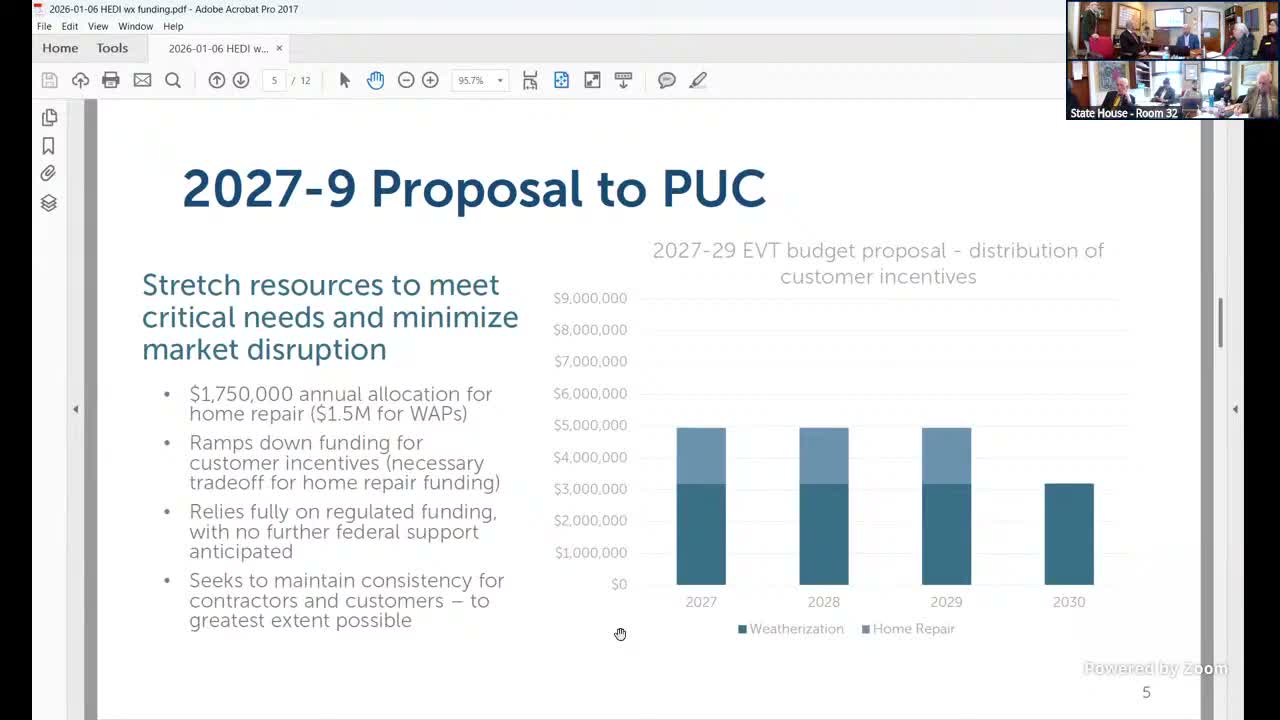
Summary
Efficiency Vermont told the committee it plans to include $1,750,000 a year in its demand‑resource plan for a pre‑weatherization home‑repair program to pay for roof, foundation and hazard remediation that currently delays weatherization for low‑income households.
During the committee's weatherization briefing, Efficiency Vermont described a proposed pre‑weatherization "home repair" program intended to fix issues that prevent weatherization work (leaky roofs, mold, vermiculite/asbestos, faulty wiring) and reduce deferrals for low‑ and moderate‑income households.
Peter, speaking for Efficiency Vermont, said the agency would include a proposal in its demand‑resource plan to allocate $1,750,000 per year for the pre‑weatherization home‑repair program. He said about $1.5 million of that package would be directed to the Weatherization Assistance Program (WAP) low‑income component and the remainder would support moderate‑income needs. "That 1.5 of that would go to the weatherization assistance program to fund the low income component," Peter told the committee.
Peter and other presenters explained that some homes must receive basic repairs before weatherization crews can safely and effectively work. They framed the home‑repair component as a housing initiative that, combined with weatherization, can improve living conditions and make later energy upgrades more cost‑effective. Presenters said limited ARPA funds have been used to support initial home‑repair pilots but cautioned those ARPA dollars are finite and will not last indefinitely.
Committee members asked whether the proposed funding would be available immediately and how it interfaces with existing ARPA, IIJA and WAP funding; Efficiency Vermont said the proposal would begin if approved by the PUC through its DRP process and that some ARPA funds are being braided into short‑term support while longer‑term sources are pursued. No formal decision was taken at the briefing; presenters said more detailed accounting and implementation plans would be supplied to the committee and to the Department of Public Service and PUC as the DRP advances.