Preliminary FY26–27 outlook: MMSD projects tight margins, flags state‑aid and federal risks
Loading...
Summary
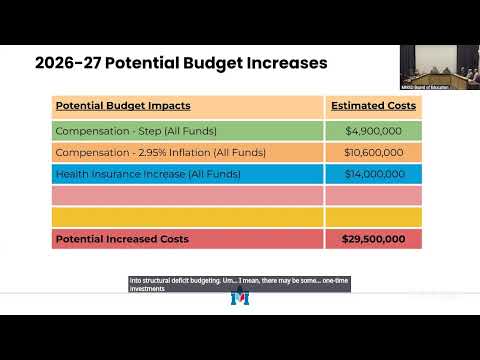
District finance staff presented an early FY26–27 budget outlook showing roughly $30 million in new base revenue but similar projected cost pressures (steps, COLA, health insurance). Staff warned of a potential $7 million decline in state aid and the need to prioritize programs to produce a balanced operating budget.
District finance staff opened the FY26–27 budget discussion at the Jan. 12 operations work group, presenting preliminary revenue assumptions and major risk factors that could make balancing next year’s operating budget difficult without program prioritization.
Bob Solner recapped the district’s starting position — a fund balance of about $100.7 million and approximately $30 million in new base revenue assumptions for 2026–27 (including voter‑approved referendum revenues and other changes). He said staff are modeling CPI at about 2.95% for salary adjustments and warned that ongoing cost drivers — step increases, cost‑of‑living adjustments and likely higher health‑insurance costs — could total roughly $29–30 million in recurring pressures.
Solner highlighted two material downside risks: a projected $7 million decline in state aid under current assumptions (which the district would need to replace with property‑tax revenue, expense reductions or fund‑balance use), and uncertainty around federal funding streams that currently support staffing. Board members noted that special‑education reimbursement shortfalls already require sizable general‑fund support; staff said the 25–26 budget includes roughly $62 million from the general fund to cover IEP costs not otherwise reimbursed.
Board members asked for program‑level evaluations and prioritization to inform choices if revenue does not keep pace with recurring costs. Staff said a recruitment/retention plan and the district’s strategic framework (MMSD Excellence Together) will guide allocation decisions and that the budget process will continue through the spring and summer with periodic updates.
What happens next: staff will refine revenue and expenditure projections over the next months, provide more granular program and cost data to the board, and incorporate policy direction about priorities and any compression/retention remedies into the FY26–27 budget process.