
Garden City Council remands large multifamily design review over height and traffic questions
Get AI-powered insights, summaries, and transcripts
Subscribe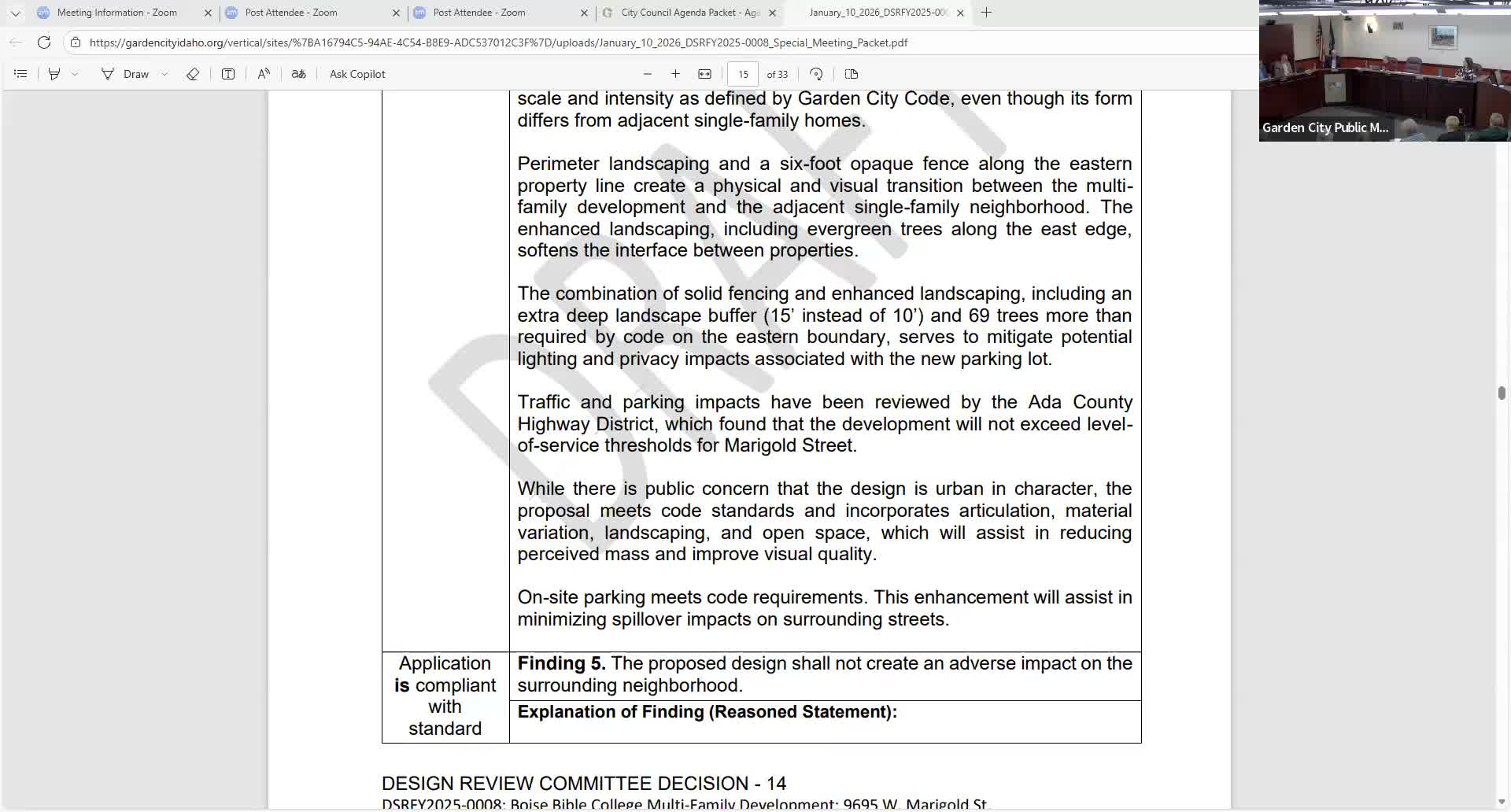
Summary
Garden City Council voted 2–1 to remand DSR FY2025-0008, a proposed multifamily development adjacent to Marigold Street and Glenwood, asking staff and consultants to return with a redesign no taller than three stories and additional traffic information for the council’s January 26 decision session.
Garden City Council on [date of this meeting] voted 2–1 to remand a contested design‑review application for a large multifamily development (DSR FY2025‑0008) back to city planning staff for redesign and additional review.
Council President Page opened deliberations by noting the public hearing had closed on December 30 and reminding the council that decisions must be based on the written and oral record. Page said the staff draft contained eight required conclusions of law and that the council would vote on each finding individually.
Council members split most sharply over findings tied to neighborhood compatibility and traffic. Council member Jorgensen urged a remand, arguing the project’s four‑story height “exceeds scale and intensity” for the surrounding single‑family quadrant and raising concerns that nationally derived ITE trip rates can undercount real‑world trips, particularly during event surges. He asked staff to obtain additional traffic verification requested on page 14 of the packet and to allow previously referenced observational counts to be validated.
Legal counsel warned members against relying on outside research not in the official record, saying, “If you do a Google search, that’s gonna be a mistrial,” and reiterated that the council was acting in a quasi‑judicial capacity and must base findings on the record before it.
Council member Rasmussen repeatedly emphasized that the application meets current R‑3 code requirements and that professional analyses in the record — including the applicant’s traffic study by Kimley Horn and agency review by Ada County Highway District (ACHD) — do not show the development will push Marigold Street beyond adopted level‑of‑service thresholds. Staff summarized traffic figures in the record: existing PM peak hour traffic of roughly 391 trips, an expected project addition of about 92 PM peak trips for a projected total near 483 trips, and ACHD’s policy threshold of about 530 PM trips for this residential collector classification.
On compatibility, Page and Jorgensen cited public testimony and exhibits showing that building heights in the local quadrant are overwhelmingly one and two stories; they said a four‑story building would be visually incongruent despite the applicant’s generous setbacks and landscaping. Staff and Rasmussen countered that the proposal complies with R‑3 zoning and that the design includes mitigation measures: enhanced perimeter landscaping, deep setbacks (examples cited in the record include 32‑foot front setbacks and 88–152‑foot eastern setbacks for buildings), added tree buffers, screened trash enclosures, and architectural articulation.
After deliberation on all eight findings, the council adopted most findings but concluded by majority that Finding 4 (compatibility in scale and intensity) was not met as drawn. Council President Page moved to remand DSR FY2025‑0008 to the planning department for a redesign consistent with the council’s record and to preserve the original application date; the motion was seconded and the roll‑call vote was 2–1 in favor (affirmative responses recorded as Council member Jorgensen and Council member Page; opposition recorded as Council member Espison). The council asked staff to prepare a reasoned decision for the council’s next scheduled session on January 26, 2026.
Council instructions on remand were intentionally focused: the council asked for a resubmittal no taller than three stories while continuing to require compliance with applicable code standards for parking, landscaping and setbacks (staff noted those code elements could change as the applicant adjusts massing and layout). Council members discussed, but did not set, a fixed density cap; instead they left density outcomes to the redesign process so long as the submittal remains within code and the remand keeps the applicant’s original filing date intact.
Staff and several council members cited specific conditions and technical items that must be addressed on remand, including ACHD permits and any traffic‑related improvements the agency requires, resolution of sewer capacity questions, compliance with Drainage District Number 2 requirements for the proposed canal tiling (the record references an 18‑inch tile and an engineering letter from David Evans & Associates asserting preserved hydraulic function), and continued coordination with design review consultants.
The remand preserves the applicant’s procedural rights under the current code while directing staff to work with the applicant and return with a revised design and an updated decision document on January 26. The council adjourned after the vote.
What’s next: Staff will draft the remand decision and advise on whether the remand constitutes a final decision subject to reconsideration procedures; counsel said he will provide guidance on those procedural questions at the January 26 meeting. The applicant may revise the project’s massing, setbacks, and landscape plan to respond to the council’s height and compatibility concerns and to the technical items requested by staff and agencies.