Board tables High Valley subdivision appeal after hours of public testimony on water, roads and fire risk
Loading...
Summary
After roughly three hours of testimony from applicants, supporters and more than two dozen neighbors citing water shortages, road safety, EMS response and wildfire risks, the board closed the public hearing for SUB 25‑018 (Tripod View) and continued deliberations to Feb. 9 at 1:30 p.m.
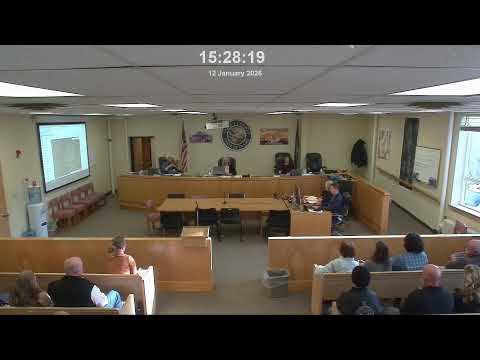
Valley County commissioners on Jan. 12 heard extensive testimony in an appeal of the Planning & Zoning Commission’s denial of a proposed 12‑lot subdivision (SUB 25‑018, “Tripod View”) in High Valley and tabled the matter for decision to Feb. 9 at 1:30 p.m.
Staff outlined the application: 46 acres with 12 lots (1.8–6.2 acres), individual wells and septic systems, access via a new private road to Drybuck Road, and that the P&Z denial resulted from a tie vote following concerns about water supply, fire response and road impacts. The applicant’s attorney, Abby Jermaine, said the subdivision meets code and argued the P&Z decision did not identify specific standards that were not met as required by Idaho Code 67‑65‑19.
The applicant and his wife, Steve and Jonna Emerson, described plans to live on and ranch much of the property and to sell the 12 lots to fund ranch improvements. Jermaine said a wildland‑urban interface fire protection plan was submitted and that the developers intend to include firewise building materials and other mitigation in CC&Rs and deed restrictions. “These are not concerns that will be applicable only to this new application,” Jermaine said, contending that water variability in High Valley is a regional water‑table issue and that prior subdivisions were approved under similar circumstances.
Opponents from High Valley gave lengthy testimony focused on water, road safety and emergency access. Tom Love, who authored a public letter in opposition, said his “biggest concern is the public safety,” and others described wells that produce a gallon or less per minute, roads that are impassable in winter and long EMS response times. John Green asked who would be liable if a new well caused an existing neighbor’s well to go dry, and multiple speakers urged the board to require more definitive water testing and mitigation before approval.
A property owner, Saul Monreal, said a planned road alignment encroaches about 15 feet on his Parcel F and asked the board to withhold approval until easement and boundary issues are resolved. Several ranching community members cited evacuation and cattle‑movement logistics on the narrow road as a public‑safety concern.
After public testimony and a brief rebuttal from the applicant’s attorney, the board closed the public hearing and—citing the complexity of water, fire and road issues—continued the matter to a date‑certain: Feb. 9 at 1:30 p.m., with public testimony closed. Commissioners asked staff to return with any additional information relevant to deliberations.
What happens next: The board will reconvene the item on Feb. 9 for deliberation and decision. Parties and staff may provide supplemental materials (e.g., water studies, easement clarifications, draft CC&Rs or deed restrictions) for the board’s review before that meeting.