
Council advances Isla Carroll rezoning on first reading over objections about equestrian character
Get AI-powered insights, summaries, and transcripts
Subscribe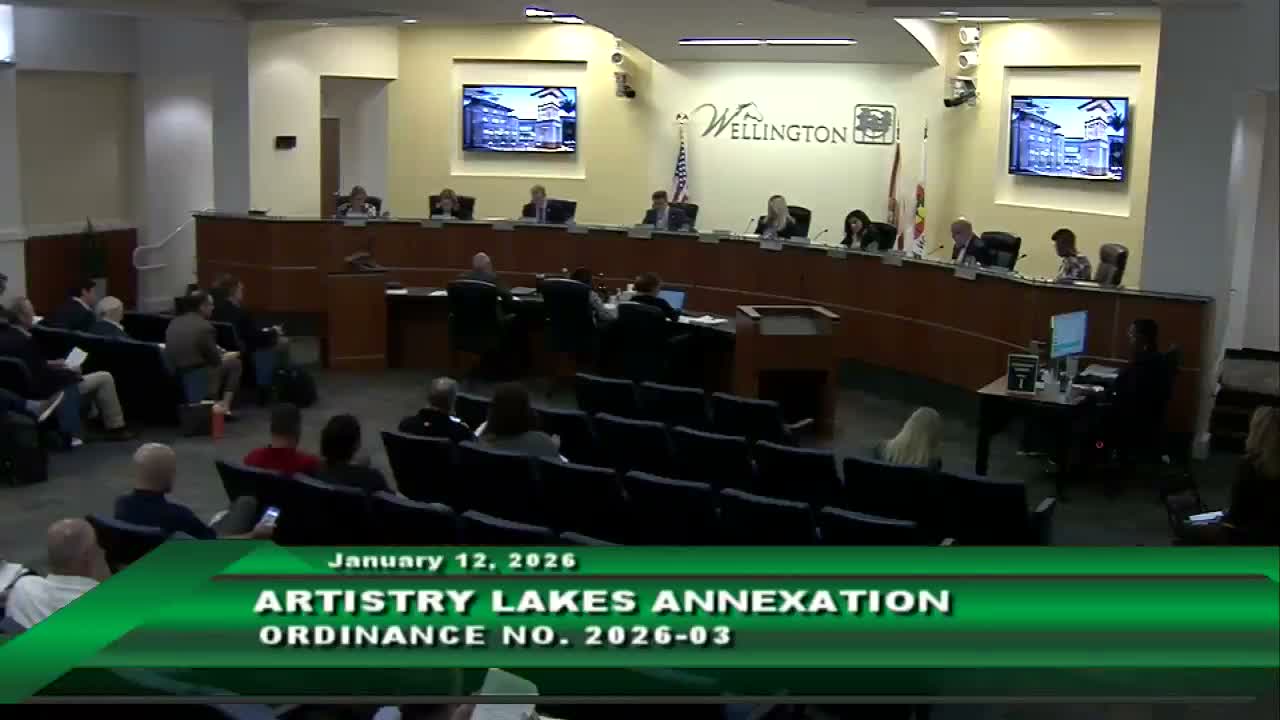
Summary
On first reading Jan. 12 the Wellington Village Council voted 3–2 to advance a rezoning that would convert the 79.17‑acre Isla Carroll property to a planned unit development (PUD) with a polo‑centered plan and 40 dwelling lots; supporters pointed to a 45‑year agreement with the U.S. Polo Association to preserve the field, while opponents said the plan fails the equestrian‑preserve standard in code section 6.8.0.8.
WELLINGTON, Fla. — The Wellington Village Council on Monday advanced a controversial rezoning request for the Isla Carroll property after a lengthy quasi‑judicial hearing that drew dozens of speakers for and against the plan.
The council voted 3–2 to approve first reading of the rezoning petition (rezoning petition number 2025‑4‑REZ) for Isla Carroll Polo and Residences, which would rezone roughly 79.17 acres from equestrian residential to a planned unit development under the Equestrian Overlay Zoning District and adopt a master plan that shows 40 residential lots, a 31.32‑acre equestrian and club amenity pod and a deed‑restricted polo field maintained by the United States Polo Association (USPA).
Why it matters: Supporters — including the applicant team led by developer Frank McCourt and Discovery Land Company — said the project locks in a maintained polo field adjacent to the National Polo Center under a USPA agreement they described as a 45‑year minimum term with 10‑year renewal options. Opponents said the proposal does not preserve the large‑lot, horse‑centered lifestyle intended by the equestrian overlay and argued that most residents in the proposed community would lack stalls or barns, meaning the plan fails the LDR’s internal‑equestrian‑amenity requirement (section 6.8.0.8).
What the applicant proposed: Neil Schiller, representing the applicant, said the plan provides about 60 percent open space, preserves and programs the existing east polo field, and binds the property with a restrictive covenant intended to keep the field as equestrian open space in perpetuity unless a unanimous vote of the council removes it. "We play by the rules," said Frank McCourt, who identified himself as the property owner and project partner. "This is a project that we are extremely proud of." Stuart Armstrong, USPA chairman, told the council Wellington has lost dozens of polo fields in recent decades and said preserving high‑quality fields is essential to keeping the sport in town: "Since Isla Carroll was first developed in 1995, Wellington has lost approximately 23 polo fields," he said.
Conditions and community commitments: The applicant said the USPA will program and maintain the field under a long‑term agreement and that the restrictive covenant will require unanimous council consent to amend — a higher bar than ordinary deed restrictions, they said. Applicant materials provided specific program numbers for the club: a membership cap of roughly 325 members (including 40 residents), 149 dedicated paved parking spaces on site, additional grass parking and trailer parking, and a plan for shared parking agreements with the National Polo Center for larger events. The applicant also committed to a traffic mitigation package that includes design work and a proportionate‑share contribution toward a roundabout at Lake Worth Road and 120th Avenue South (applicant’s stated share was 2.82 percent of an estimated $4.2 million project, subject to final engineering).
Opposition and board recommendations: More than 40 members of the public spoke. Opponents — including longtime equestrian residents and members of advisory boards — argued the site lacks on‑site stables, paddocks and overnight horse boarding and said the master plan relies on a third party (USPA) and private memberships rather than creating a resident‑centered equestrian community. The Planning and Zoning Board and the Equestrian Preserve Committee both recommended denial; staff recommended approval of first reading.
Council action and next steps: Councilmembers debated whether the proposal meets the change‑in‑conditions standard for rezoning and whether the plan’s equestrian amenities qualify as "internal focus" under section 6.8.0.8 of the land‑development regulations. The council voted 3–2 to advance the rezoning on first reading; the ordinance and the master‑plan approvals will return for a required second reading where final conditions, deed‑restriction language and the master‑plan resolution must be adopted before conclusive approvals are given.
What’s next: If the council approves second reading and the master plan, the restrictive covenant and conditions of approval will be recorded and the applicant will proceed to final master‑plan certification and site plan steps required by the code. If the council votes against second reading, the rezoning would fail. The council scheduled a follow‑up hearing for February to consider master‑plan conditions.