
Flagstaff art commission discusses AI disclosure, originality and a proposed committee for guidance
Get AI-powered insights, summaries, and transcripts
Subscribe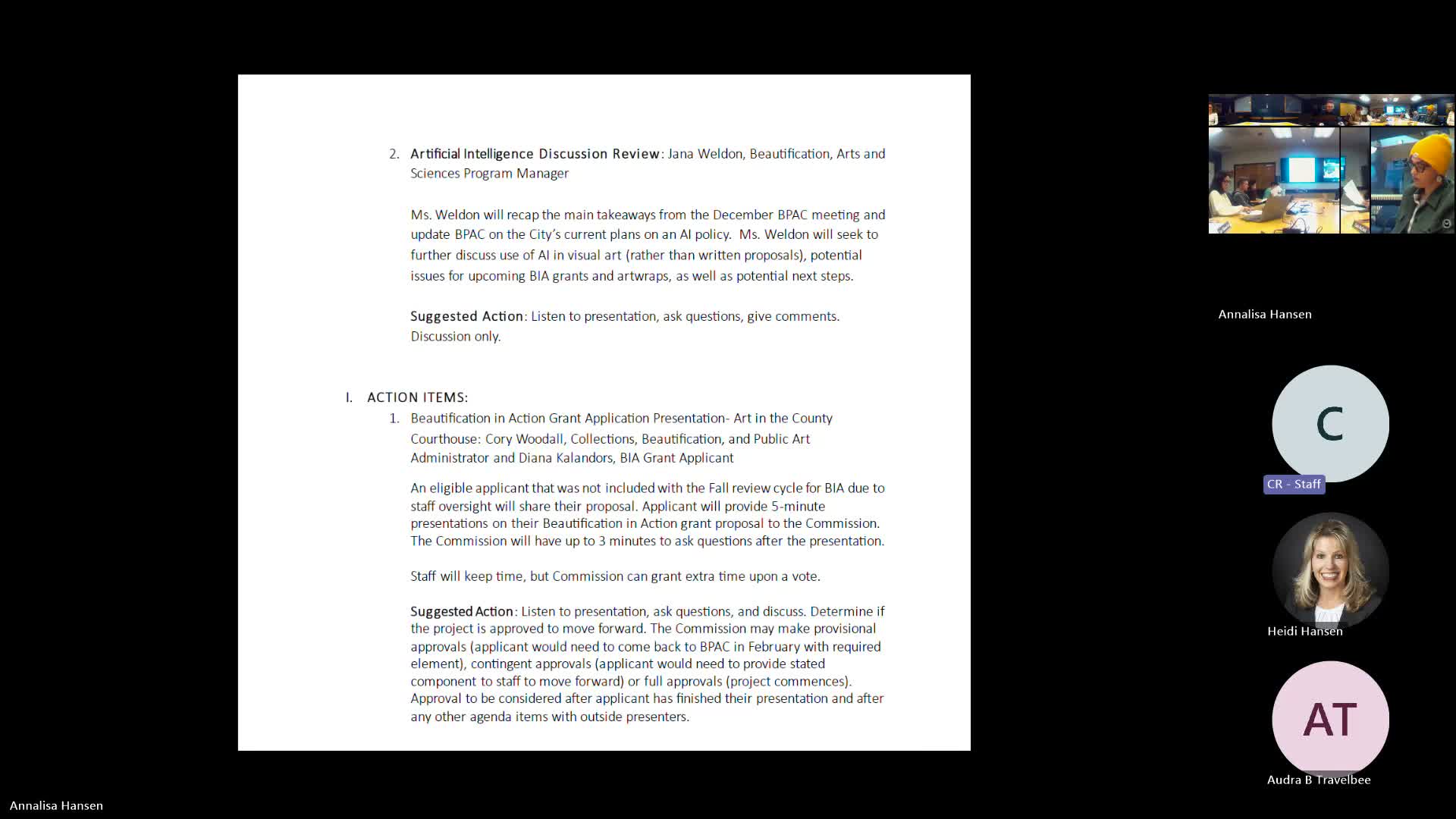
Summary
Commissioners and guests spent the bulk of the Jan. 12 meeting debating whether and how to regulate AI use in public-art submissions—disclosure, selection‑panel guidance, education for artists, copyright questions and the possibility of forming a small advisory committee were all raised.
Commissioners spent an extended portion of their Jan. 12 meeting discussing how the city should handle artificial intelligence in public‑art submissions, with participants urging education, legal review and clearer selection criteria rather than an immediate blanket ban.
Staff framed the issue as distinct from a citywide AI policy: the IT‑led group is focused on internal staff use, while the commission needs guidance on evaluating art submissions, disclosure and selection‑panel practice. "We're probably not going to like put a big thumb on—it's more focused around the visual versus the proposal," the chair said when summarizing staff intent around guidelines rather than an immediate policy.
Speakers voiced a range of views. One presenter summarized current legal thinking: "Under current law, content produced entirely by AI immediately enters the public domain. No creator copyright." Commissioners and staff noted that the situation is more complex if artists use AI as a tool that incorporates third‑party materials, and they urged input from the city attorney before finalizing rules.
Several commissioners argued disclosure should be required. "I've been having conversations with both artists and tech folks ... one thing that there was consensus on was that the use of AI should be disclosed," the chair said, describing outreach to local partners including NAU's AI Hub. Commissioners discussed alternatives: require disclosure only to staff, require disclosure to selection panels, or include specific rubric items that parse "original idea" from technical reproduction.
Practical suggestions included forming a small advisory committee (1–2 commissioners plus staff and external partners such as NAU or the Arizona Commission on the Arts), running focused artist outreach and crafting rubrics that separate technical durability, local cultural considerations and originality. Commissioners also noted risks: bias in AI training data, the possibility of "hallucination" or factual errors from automated checks, and differences in how digital pieces and painted works are evaluated.
No formal policy was adopted. The commission asked staff to pursue legal guidance, continue outreach to artists and peer organizations, and return with options for an advisory committee or draft guidelines for future meetings.