
Flagstaff airport requests roughly $1.3M to shore up ARFF staffing, proposes merger with fire department
Get AI-powered insights, summaries, and transcripts
Subscribe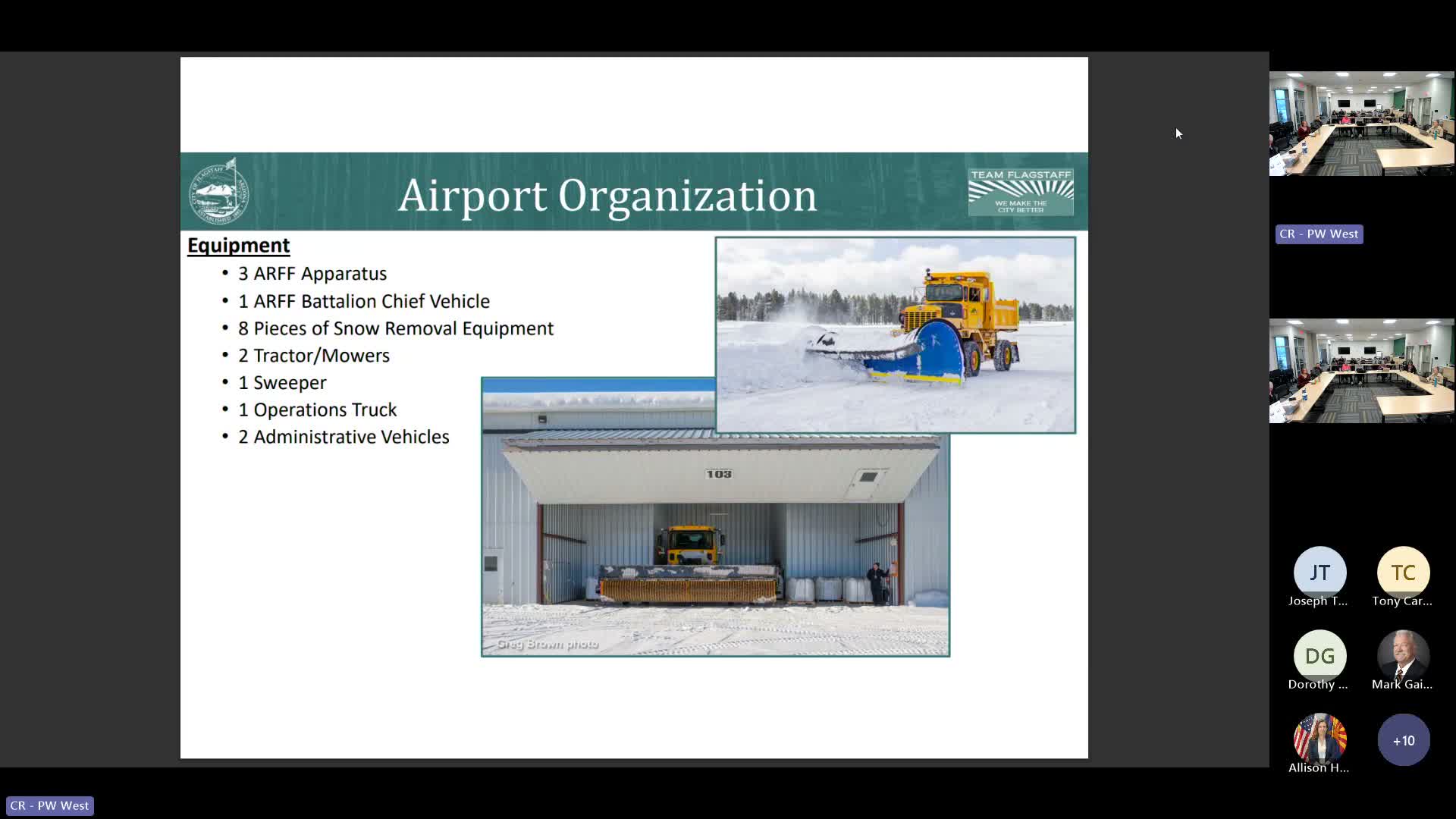
Summary
Airport staff told a city advisory panel they lack ARFF bench depth and face federal staffing/training mandates; presenters asked the committee to consider about $1.29 million for ARFF improvements and about $657,000 for law‑enforcement support to raise on‑site readiness and reduce multi‑agency strain.
Flagstaff Airport officials told an advisory committee that aircraft rescue and firefighting (ARFF) staffing and split operational roles create safety risks and undermine preparedness, and they asked the city to consider a near‑term funding request of about $1.29 million to address ARFF shortfalls.
The request, presented by Brian Goll, director of the Flagstaff Airport, and Tim Skinner, ARFF battalion chief and airport operations manager, would fund additional ARFF engineers, training and reclasses intended to provide bench depth, improve response capability and align airport ARFF staff with the Flagstaff Fire Department pay and structure. Brian Goll said the airport moved from ARFF index A to index B after the introduction of larger regional jets, and that regulatory and operational demands have increased staffing minimums and training obligations.
Why it matters: presenters said the airport often operates at minimum staffing (two personnel on two trucks, one per truck), leaving only two ARFF responders on an aircraft incident until mutual‑aid resources arrive. Tim Skinner said the Federal Aviation Administration‑mandated response time requires a first truck to apply agent within three minutes and a second within four minutes; he and Goll said geography and mutual‑aid travel times often make that standard difficult to meet from the airport alone. “Seven minutes can feel like a very long time,” Goll said during the committee hearing.
What the presenters asked for: Goll outlined a set of near‑term costs tied directly to ARFF readiness. He attributed a $522,000 shortfall to recently added ARFF services and cited an additional $772,000 needed for training, reclassifications and bench depth; he presented the combined ARFF ask as about $1.29 million for the first year. He also described a law‑enforcement funding gap of roughly $350,000 and a proposed police‑aid program (startup and first‑year costs) of about $307,000, together presented as roughly $657,000 for the first year.
Regulatory and safety context: Tim Skinner detailed the specialized training ARFF personnel must complete (structural firefighter qualifications, recurrent training, an annual live‑fire burn and FAA‑required training at certified facilities). Skinner and Goll argued that ARFF staff currently perform both emergency response and extensive airport‑operations duties (snow removal, airfield inspection, wildlife control), creating operational conflicts that increase fatigue and attrition. Skinner said the unit has experienced “a state of hiring” with high turnover and that those losses impose substantial replacement costs and training timelines.
Alternatives and next steps: presenters said they favor moving ARFF into the Flagstaff Fire Department organizationally to centralize fire suppression and ARFF under a single structure, but they said funding remains the principal obstacle. Deputy Chief Mark Wilson confirmed the ARFF request could be implemented on a faster timeline than larger fire‑department facility additions and said the two funding tracks are related but not mutually exclusive.
Committee reaction and timeline: Committee members raised questions about the cost breakdown, response times, and whether airport operations duties could be shifted to other city departments. Staff noted some revenue and development strategies are under way (a tech park and private hangar opportunities) but stressed FAA limitations on on‑field non‑aeronautical development and that revenue gains would take years to materialize. The advisory committee set follow‑up topics and asked staff to provide detailed spreadsheets backing the cost estimates; no formal vote was taken at the meeting.