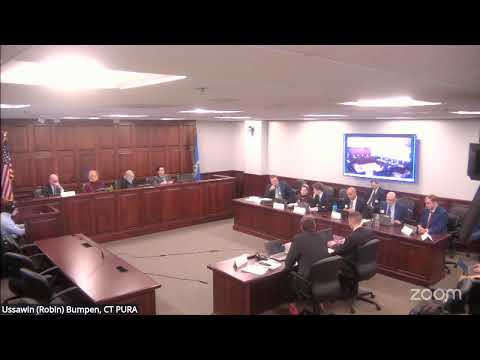
United Illuminating challenges 'ROE' penalties and inflation rulings in PURA evidentiary hearing
Loading...
Summary
At PURA, UI argued the final rate decision produced unjust and unreasonable rates, contesting ROE penalties tied to DERMS and the water-heater program and asking for clearer rules on inflation and O&M adjustments; UI presented a witness panel to support factual assertions and to describe financial impacts.
United Illuminating told the Public Utilities Regulatory Authority that the authority’s final decision in the company’s 2024 rate case produced rates UI considers "not just and reasonable," pointing to ROE (return-on-equity) penalties tied to DERMS and the water-heater rental program, differences in allowed inflation/O&M adjustments, and new inclusions such as East Shore remediation.
UI’s vice president for electric operations, Chuck Euse, described DERMS (distribution energy resource management system) as a centralized operational control system proposed in UI’s 2022 filing that UI characterized as a multiyear, "nice to have" investment rather than an immediate necessity. Euse recounted learning from other jurisdictions—including a conversation with Hawaiian Electric—that high distributed energy resource penetration can, in some instances, be managed without DERMS: "I walked away from that... understanding that DERMS was not a necessity to achieve very high penetrations." UI argued the draft decision’s sudden imposition of an ROE penalty for not including DERMS in the capital plan differed from prior regulatory treatment and created financial pressure because prior cases denied UI parts of its requested capital budget, constraining the company’s ability to include forward-looking investments.
On the water-heater rental program, UI said it began winding down the program after a multi-step regulatory exchange with PURA; the company reported the program served roughly 10,000 customers near the wind-down and that ownership of remaining water heaters transferred to customers effective Nov. 8, 2025. UI’s program manager said the company interpreted motion rulings and compliance steps as directing a phase-out, and that an existing disallowance (about $1.7M referenced in testimony) already limits ratepayer impact. During redirect, UI told commissioners that lifting the ROE penalty associated with the water-heater program would not harm customers because a disallowance for replaced water heaters already exists.
UI also pressed PURA for consistent rules on inflation and known-and-measurable O&M adjustments. Company witnesses pointed to prior Connecticut dockets where inflationary adjustments were accepted and asked for clarity about evidence requirements if the agency’s evidentiary standard has changed. UI described a common third-party approach (a generic inflation rate or index) and contrasted that with a line-by-line vendor-by-vendor showing, which UI said would be impractical and commercially sensitive. Commissioners asked about the role of the Handy-Whitman index and how it has been applied to storm-cost thresholds and other adjustments; UI argued that past application of Handy-Whitman had shifted costs between major and minor storm buckets and complicated its budget forecasts.
UI reiterated that its alternative resolution proposal was materially similar to the final decision’s top-line rate increase (UI described its alternative around $63 million vs. the final decision slightly north of $65 million) but said the inclusion of ROE penalties and added obligations (East Shore remediation) materially changed whether the resulting rates are reasonable.
What happens next: Commissioners asked detailed questions and sought clarifying filings; PURA has not issued a new ruling at this hearing. UI and interveners reserved rights to cross-examine further and to brief legal arguments where appropriate. The evidentiary record was reopened for the two administratively noticed items (the mayoral letter and a compliance filing); parties signaled they will rely on continued testimony, mediation outcomes and post-hearing briefs to resolve legal and factual disputes.