Get Full Government Meeting Transcripts, Videos, & Alerts Forever!
Get email alerts on the State Legislation topic
No spam. Unsubscribe anytime.
Spokane County commissioners oppose bill forcing county planning to adopt city standards, back aquifer measure and track housing and waste-to-energy bills
Summary
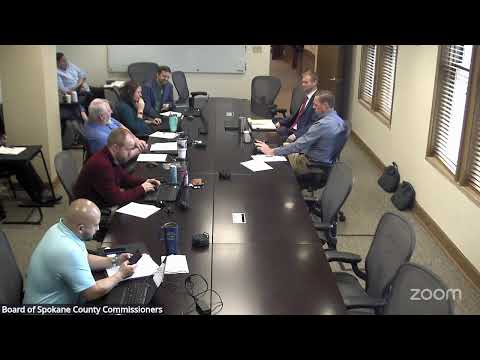
At a Jan. 13 briefing, Spokane County officials signaled opposition to House Bill 2201 — which they said would require counties to adopt adjacent city development standards in UGAs — pledged support for an aquifer recharge measure (6016) and put several housing and waste-to-energy bills on their watch list.
Spokane County commissioners on Tuesday signaled formal opposition to House Bill 2201, a proposal that county staff and local planners described as forcing counties to apply neighboring cities’ development standards inside urban growth areas (UGAs).
County lobbyist Mike Burgess told the board the 2026 legislative session had just begun and that staff would circulate a bill list next week. Scott, county staff who reviewed the text, described the measure as problematic: “The first 1, 22 0 1, city and county development regs and UGA is is a, a really bad bill,” he said, adding that it would force counties “to plan for UGA's using the development standards of the adjacent municipality” regardless of annexation commitments.
Why it matters: Commissioners said the proposal threatens local control and could create inconsistent standards across Spokane County’s many cities. One commissioner summarized the concern as the bill “fly[ing] in the face of the Growth Management Act,” and commissioners asked staff to identify sponsors and gather more background from Thurston County colleagues where the bill originated.
County staff and commissioners also discussed two related measures. Scott recommended support for a companion aquifer bill (referred to by staff as 6016), saying it preserves flexibility to move UGA boundaries while preventing net increases to critical recharge areas. The board expressed support for tracking and backing that bill.
On housing policy, staff flagged House Bill 6026, which would require jurisdictions above 30,000 population to allow residential development in certain commercial zones. Commissioners welcomed the goal of locating housing near existing infrastructure but asked staff to track exclusions, transit access and critical-area protections before taking a position. “You really need to look at where this commercial area is, how it’s served,” one commissioner said, urging a review of transit and local planning context.
Waste-to-energy: The board generally placed a bill exempting waste-to-energy facilities from Climate Commitment Act compliance in the “pro” column but asked staff for more analysis of the bill text and strategy to coordinate with city partners. Burgess noted sponsors on the House and Senate versions and cautioned that broad public sign-in patterns and cross-state sponsorship often influence a bill’s prospects.
Next steps: Commissioners asked staff to prepare sign-on letters and testimony where appropriate, to monitor committee hearings (the policy cutoff is Feb. 4) and to return with sponsor information or suggested amendments. The board also asked staff to report back on HB 6026 and the waste-to-energy bill after upcoming hearings.
Attribution: Quotes and paraphrases in this article come from statements made during the Jan. 13, 2026 Spokane County Board of County Commissioners briefing; primary on-the-record sources cited in the transcript include Mike Burgess (county lobbyist) and Scott (county staff who presented the bills).
The commissioners will revisit these matters as bills move through committee; no formal county legislative actions or votes were recorded at the Jan. 13 briefing.