
Spokane seeks phased relief for waste‑to‑energy costs under Climate Commitment Act
Get AI-powered insights, summaries, and transcripts
Subscribe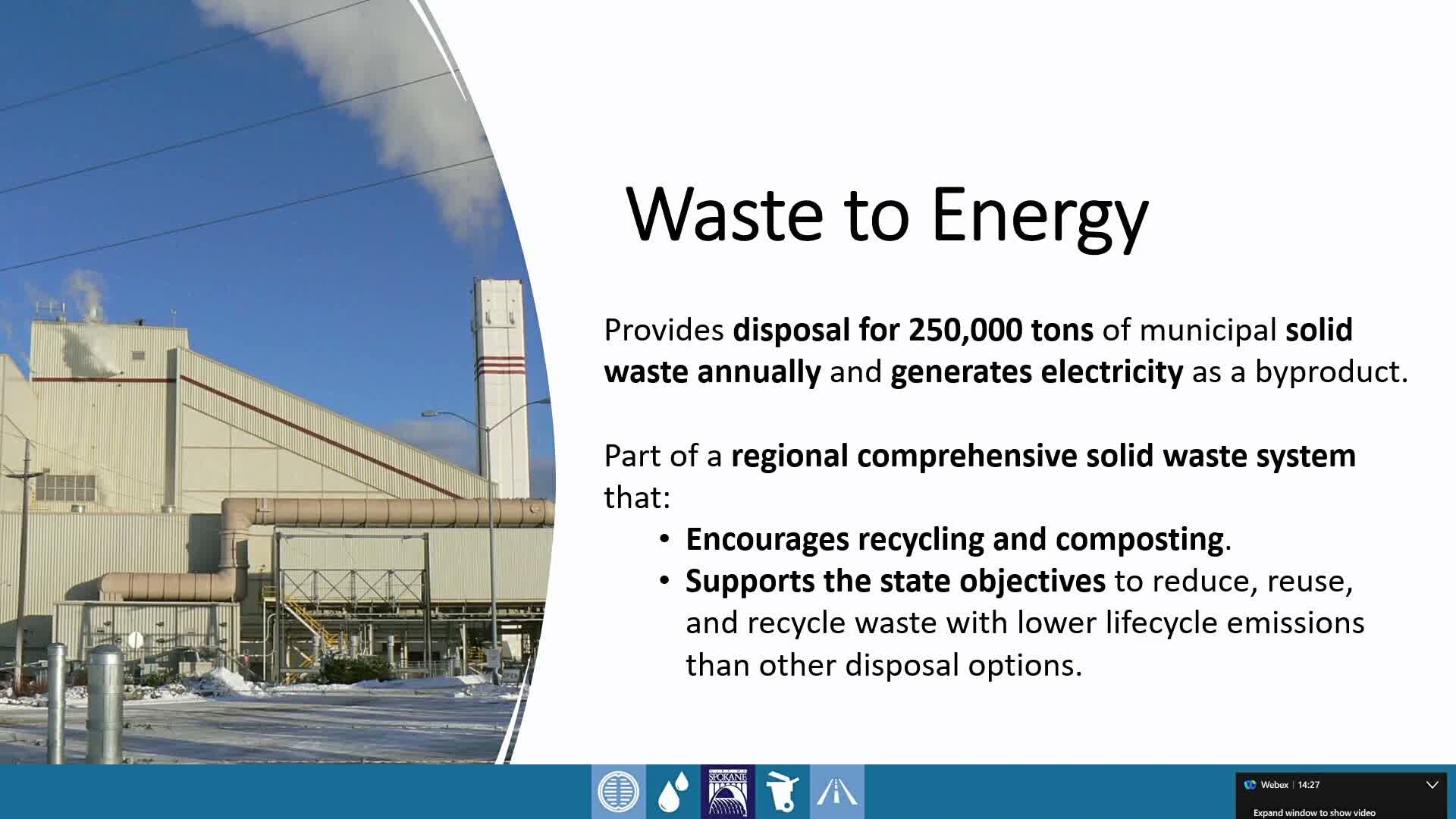
Summary
Public Works Director Marlene Feist told the committee a bill dropped at the start of the legislative session would give Spokane a phased compliance schedule for its waste‑to‑energy plant; without relief the city estimates up to $8 million annually for carbon credits and says the change would affect regional customers and about 75 plant jobs.
Public Works Director Marlene Feist told the Public Infrastructure and Environmental Sustainability Committee on Jan. 12 that the city has proposed legislation to create a phased compliance schedule for Spokane’s waste‑to‑energy facility under the state’s Climate Commitment Act.
Feist said Spokane’s regional solid‑waste system processes about 250,000 tons of municipal solid waste and currently faces a rule framework that treats disposal technologies differently. “Annual cost to Spokane would be estimated at up to $8,000,000 per year for purchase of credits,” she said, adding that the program’s auction markets have generated roughly $2,000,000,000 in sales since 2023.
The bill, dropped the Friday before the session convened, would initially provide no‑cost credits for the city’s facility and then reduce that benefit over subsequent compliance periods so Spokane has time to invest in emission‑reduction measures, Feist said. She described the proposal as a “glide path” with early periods covering a large share of compliance and later periods phasing in responsibility (examples cited in the presentation: roughly 97% coverage in an early period, then 94% in a later period).
Feist said the Climate Commitment Act, enacted in 2021, currently leaves waste‑to‑energy as the lone solid‑waste disposal technology in the program after prior legislation removed landfills and moved them to a separate methane regulation. She argued that Spokane’s plant achieves lower life‑cycle emissions than some alternatives and that strict immediate compliance would “penalize good technology.” The city is studying carbon‑capture options: Feist noted a completed feasibility study with Carbon Quest and a second ongoing study with another technology to identify feasible pathways (capture for sequestration, beverage‑grade CO2, sustainable aviation fuel, fertilizer and other end uses).
Council members pressed Feist for specifics on how the glide path would affect residential bills. When asked what a 3% increment equates to for an average user, Feist said the 3% figure referred to increases on the compliance‑cost portion of the total (3% of the compliance cost) and that the final customer impact depends on market prices and other operational cost pressures.
Feist emphasized the regional implications: Spokane’s system serves the city and other jurisdictions (including West Plains cities and the county), and she said the legislation would preserve the city’s ability to invest in diversion and emission‑reduction projects. She also highlighted that the plant supports about 75 family‑wage jobs.
Next steps: Feist said staff would provide the finalized bill text and compliance‑period details to the committee when available. Councilors urged staff to present condensed materials to legislators and committees during the session.
Provenance: Topic introduced SEG 110; discussion closed SEG 233.