
Mesa Public Schools projects 2,400-student drop next year and a $13.7 million operating shortfall
Get AI-powered insights, summaries, and transcripts
Subscribe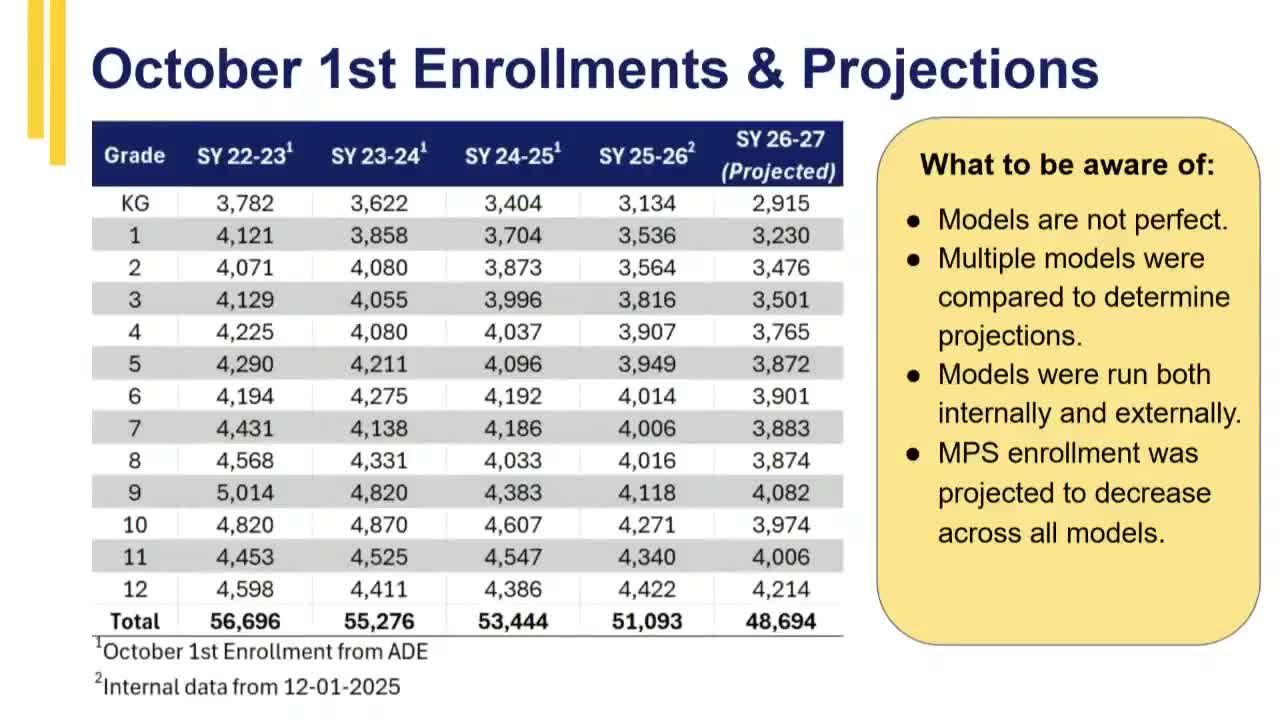
Summary
District demographers told the Mesa Unified School District governing board the district expects a roughly 2,400-student decline for next year and longer-term erosion driven by demographics, charter growth and ESAs; staff translated that forecast into a preliminary FY27 M&O budget gap of about $13.7 million and outlined options to close it.
Mesa Unified School District officials told the governing board on Tuesday that enrollment declines are already large enough to have a measurable effect on next year’s operating budget.
In a study-session presentation, district demographer Glassmeyer said multiple projection models — including a long-range forecast from Applied Economics — put next year’s enrollment about 2,400 students below current levels. Glassmeyer described that as an estimate and emphasized variables such as housing construction, birth rates and cross‑district movement that can change the outlook.
Chief budget presenter John Moore explained how enrollment feeds the state funding formula and the district’s revenue control limit. Using the district’s current base ($403,000,000 cited in the presentation) and the projected student loss, Moore said the calculation implies roughly an $18 million reduction to the district’s M&O (maintenance and operations) revenue next year. He noted the state’s inflation adjustment (presented at roughly 2–2.8 percent) will offset part of that loss (about $7.6 million in Moore’s estimate), leaving a preliminary projected operating deficit of about $13.7 million for FY27.
Moore said the district is already aligning staffing and school budgets to the enrollment projections and plans to finalize M&O numbers in March before shifting attention to capital planning. Suggested deficit-mitigation measures included organizational redesign that the board previously approved, adjustments to stipend and teacher allocation formulas tied to enrollment, and targeted department budget changes.
Board members pressed staff for more granular information on where students are leaving (by school and grade) and for parent-focused research to understand motivations. Glassmeyer said district and state data show concentrated losses at transitional grades (seventh and ninth) and said the district has commissioned West Group Research to survey parents of students who left after eighth and ninth grades; staff expect that survey report in February or March.
The presentation also addressed alternative options families use when they leave the district. Glassmeyer reported 36 charter schools serving area students (15 within one mile of district boundaries) and a recent increase in Education Savings Account (ESA) participation since universal rollout in 2022–23. She said roughly half of charter enrollees the district discussed do not reside inside Mesa Public Schools boundaries and that a portion of ESA growth represented privately enrolled students newly eligible for ESA funding.
Why it matters: enrollment is the primary multiplier in Arizona school funding; even modest long‑term declines change how many schools the district can staff and maintain. The board asked staff to keep them updated through January–March budgeting steps and to return with school-level breakdowns and the West Group parent survey results when available.
What’s next: staff said they will finalize M&O planning in March and present detailed budget implications and proposed cuts or reallocations before formal budget adoption in June.