Arch Cape forum reviews incorporation study, weighing taxes, services and local control
Loading...
Summary
Echo Northwest presented Arcadia–Arch Cape–Falcon Cove Beach incorporation options, projecting budgets, required services and revenue scenarios. The steering committee will gather public input through October and aims to recommend whether to place incorporation on the ballot in November.
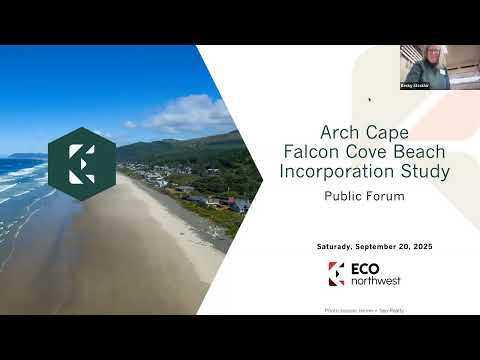
Arch Cape residents and consultants gathered at a community forum where Becky Stuckler, project director at Echo Northwest, presented preliminary findings from an incorporation study that models potential city services, revenues and startup costs.
The study mapped four subareas (Arcadia Beach, Arch Cape, Falcon Cove Beach and neighboring areas), modeled short- and long-term budgets (years 1, 3 and 10) and outlined service options ranging from a bare‑bones municipal operation to more expansive city services. Stuckler said the study’s scenarios show how different combinations of a permanent property tax, transient lodging tax, franchise fees and grants would cover operating expenses and that the steering committee will use community feedback to craft a recommendation.
Why it matters: forming a city would shift some decision‑making (land use, zoning, local ordinances) from Clatsop County to locally elected city councilors, change which local taxes apply to residents, and create new ongoing budget obligations for services such as police, planning and road maintenance.
Major points from the presentation
• Taxes that would disappear or change: Stuckler explained two Clatsop County unincorporated‑area levies (for rural law enforcement and rural roads) currently appear on local property tax statements — roughly $1.73 per $1,000 of assessed value in the presenter’s estimate — and those levies would no longer apply if areas incorporated. That offset factors into scenarios for a new city’s permanent tax rate.
• Sample budget and permanent tax example: For a low‑end, year‑1 operating budget in the study near $1.1 million, the team estimated a required permanent property tax rate just under $1.93 per $1,000 of assessed value combined with other revenues. As an illustration, Stuckler said a house assessed at $500,000 would face roughly a $1,000 annual city tax under that scenario.
• State shared revenue and timing: Stuckler noted state shared revenues are typically not available in year 1 (a property tax must have been assessed the prior year) and generally only flow to cities that provide several major services (police, fire, land use, transportation). She said the study models state shared revenue starting after year 1 where eligibility conditions are met.
• Transient lodging tax: The presentation flagged that lodging tax revenue can be significant in seasonal communities but is constrained by statute. “Seventy percent of those revenues according to state statute have to be spent on tourism promotion,” Stuckler said; the remaining 30% can go to a community’s general fund. The team’s lodging‑tax estimates used peer‑city averages and Tillamook County short‑term rental data and are subject to revision as better local data become available.
• Public safety and other high costs: Stuckler said policing is the largest ongoing cost in many scenarios. Clatsop County would continue to respond to major crimes and serious crashes, but a new city could contract for part‑time or limited local police coverage — an approach some small cities use to provide more frequent patrols without funding a full department.
• Planning and capital needs: Required long‑range planning (comprehensive plan, urban growth boundary, zoning) is an early, material cost: the team cited quotes of roughly $100,000 for first‑year contract planning services and estimated comprehensive plan updates can run in the $400,000–$500,000 range spread over multiple years. Capital projects (bridges, major roadwork) are not included in the study’s operations and maintenance budgets and would typically be financed separately (bonds, grants).
• Special districts and subarea options: By default, special districts wholly inside a new city are typically absorbed (assets, liabilities and service obligations transfer to the city), but the ballot description can explicitly preserve particular districts. Steering‑committee procedures discussed at the forum allow subareas such as Falcon Cove Beach to withdraw from consideration before the committee’s final recommendation.
Public questions and community concerns
Residents pressed the consultants on data and assumptions: how lodging tax revenue was estimated, whether ambulance/EMT services would be covered by the new city, and whether creating a city is the only way to influence local land‑use decisions. Stuckler said ambulance and 9‑1‑1 funding would remain county responsibilities and that several estimates rely on peer communities and county data that can be updated.
Some Falcon Cove Beach residents said they prefer the current, low‑infrastructure character (no streetlights, gravel roads) and worried about being included without adequate local consent. Steering‑committee members and consultants responded that subareas may be handled independently and that the steering committee will reflect community feedback in its November recommendation.
Quotes
“Nothing in this incorporation study binds the future city councilors to any specific future,” Stuckler said, adding that only the permanent tax rate would appear on an incorporation ballot and be binding if voters approve it. Bob, a community club leader, summarized local motivations: control, returning tax dollars to local infrastructure and preserving institutional knowledge.
Next steps
The steering committee will continue community outreach through September–October, collect written comments and host small‑group discussions in the adjacent community room. The committee intends to bring recommendations on whether and how to pursue incorporation to the community (and possibly the ballot) in November; the study report and supporting materials are posted online and will be updated as better local data become available.
No formal motions or votes occurred at the forum.