
Guam hearing spotlights plan to adopt UN trade customs system to modernize ports and recover lost revenue
Get AI-powered insights, summaries, and transcripts
Subscribe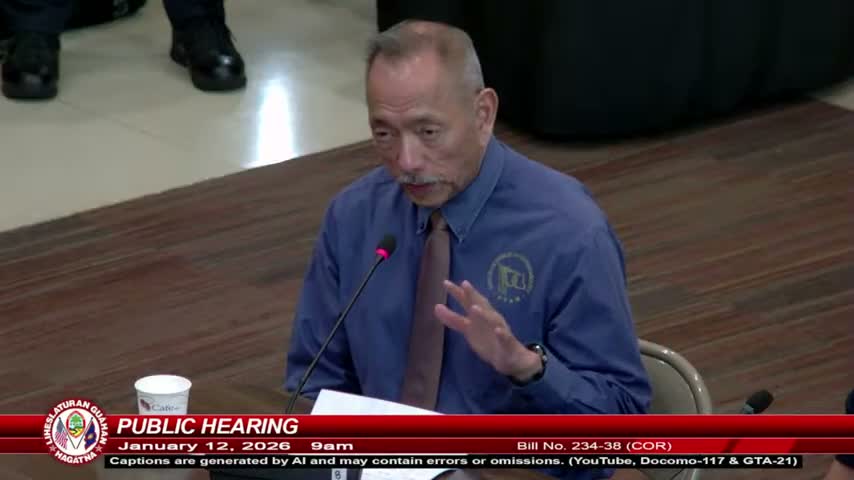
Summary
Agency witnesses urged passage of Bill 234-38 to adopt UNCTAD's ASYCUDA customs-management platform, citing improved revenue capture, public-health screening and border security; estimated upfront cost is roughly $2 million, with a 24'2-month implementation timeline and an annual maintenance estimate of about $150,000. No committee vote was taken.
A legislative hearing on Bill 234-38 opened with the public auditor and agency leaders urging the Guam Legislature to authorize adoption of the United Nations Conference on Trade and Development's automated customs system, ASYCUDA, to replace Guam's largely paper-based customs operations.
Enciatus Masi, director of the Guam Customs and Quarantine Agency, testified the measure would give CQA clear authority to implement ASYCUDA, enter necessary intergovernmental agreements with UNCTAD and modernize customs processes. "This bill positions Guam for the future," Masi said, urging the legislature to pass the measure and noting the system is used in more than 100 countries.
John Rick Mendiola, customs officer supervisor, described the operational strain of manual entry, saying customs still processes documentation attached to roughly 900 sea containers and 200 tons of air freight weekly. "We still do it" by hand, Mendiola said, and he told senators that automation would improve risk assessment, fraud detection and the government's ability to reconcile revenue.
Matthew Santos, deputy director of the Bureau of Statistics and Plans, traced the multi-year technical engagement with UNCTAD and said the project stalled previously because of financing and procurement barriers. Santos said ASYCUDA was the only financially viable solution identified in market research and that earlier federal and grant support (a TAP grant and DOI engagement) established Phase 1 deliverables.
Technical implementation details presented by Michael Ford of the Office of Technology (OTEC) emphasized infrastructure needs: API integration with Guam's payment systems, higher-bandwidth links at several CQA sites, multifactor authentication, on-site IT staffing and backup/replication. Ford said OTEC recommends cloud hosting only if data can be stored within U.S. jurisdiction; otherwise, on-site hosting was recommended to meet local governance concerns.
Tom Nadeau of the Division of Environmental Health, speaking for the Department of Public Health and Social Services, said ASYCUDA would allow health regulators to electronically screen imports for unapproved drugs, adulterated foods and other threats, moving DEH from reactive inspections to risk-based screening.
Witnesses and outside stakeholders offered cost and timeline estimates during committee questioning: Santos said a realistic implementation after contract award would be 24'36 months; CQA estimated an upfront implementation cost in the neighborhood of $2,000,000, with an ongoing maintenance estimate of about $150,000 per year. Witnesses also cited a contingency estimate of roughly $327,000 for additional upfront costs.
Multiple witnesses and senators referenced revenue shortfalls tied to manual processes. Testimony included a range of estimates: the hearing cited prior audit examples that suggested daily bills-of-lading totals in the millions and noted that Guam may currently be missing between $60 million and $110 million a year in border-related taxes and fees because of delayed declarations and limited audit trails. Witnesses pointed to Palau's deployment of ASYCUDA, where officials reported revenue increases in the low- to mid-20-percent range in initial quarters.
Committee members pressed on procurement logistics, data ownership and cross-platform communication with U.S. Customs and Border Protection systems such as ACE. Witnesses said data governance and legal arrangements would be part of the project planning and insisted the government of Guam would own customs data while working to ensure secure cross-platform modules where needed.
The hearing also reviewed agency budget execution: Clarice Briggs, the agency fiscal ASO, reported unaudited FY25 general-fund lapses in the neighborhood of $2.9 million and special-fund lapses around $1.8 million, and she and senators said procurement delays were a primary cause of unused encumbrances.
Several senators expressed bipartisan urgency to advance the bill and move Guam out of a decades-old manual process; at the close of the hearing the committee left the record open for 10 business days for additional testimony and provided instructions for submitting written comments. The chair indicated the item will likely return in a future session (possible March hearing); no committee vote or formal action occurred at this hearing.
Next steps: the public record remains open for additional testimony for 10 business days; witnesses said implementation planning, data-governance agreements and procurement arrangements would follow passage and that detailed cost and schedule milestones would be refined as the contract negotiations progress.