
Ways & Means committee hears briefing on Vermont corporate income tax, Act 148 changes and revenue outlook
Get AI-powered insights, summaries, and transcripts
Subscribe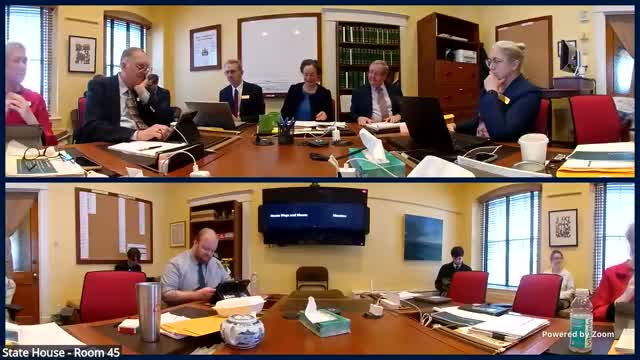
Summary
Legislative staff briefed the Ways & Means Committee on who is taxed under Vermont's corporate income tax, how the state apportions income (single sales factor and unitary combined reporting), recent Act 148 changes and the tax's volatility for the general fund.
Legislative staff and the Joint Fiscal Office briefed the Ways & Means Committee on January 15 on how Vermont defines and taxes corporations, recent law changes under Act 148 of 2022, and what the changes mean for state revenue forecasts.
The briefing, led by an attorney from the Legislative Council identified in the session as Kirby and by Patrick Churchill of the Joint Fiscal Office, covered three groups that can be subject to Vermont corporate income tax: C corporations, entities (such as some LLCs) that elect to be taxed as C corporations, and nonprofit organizations when they have unrelated business income. "If it's subject to income tax as a corporation under federal law, we consider it, subject to taxation," Kirby said, summarizing Vermont's reliance on the federal classification.
Why it matters: Vermont ties its corporate tax base to the federal definition of taxable income and now uses a single sales factor to apportion multistate firms'sales into Vermont. That combination means that corporations with sales into Vermont can pull an entire unitary corporate group into Vermont taxation, even if most activity occurs elsewhere. Churchill described unitary combined reporting as treating affiliated companies as a single taxpayer for apportionment and said the state uses the sales-to-Vermont share of group sales to determine the portion of net income apportioned to Vermont.
Staff reviewed key changes adopted in Act 148 (2022), which the briefing listed as a package of five items: repeal of the 80/20 rule that had excluded certain overseas sales from apportionment, the shift to a single sales factor (sales into Vermont only), adoption of the Finnegan approach to unitary inclusion, repeal of the throwback rule, and a scheduled minimum corporate tax. The briefing said these changes were intended as a modernization that aimed to be roughly revenue neutral while addressing avoidance and increasing consistency across taxpayers.
Churchill walked lawmakers through three hypothetical apportionment examples to illustrate the single-sales-factor approach: a firm with no sales to Vermont would have zero apportioned Vermont income; a firm selling only into Vermont would have all its net income apportioned to Vermont; and a firm splitting sales evenly would have roughly half its taxable income apportioned. He noted many corporate tax returns report zero or negative taxable income and so pay by the minimum-tax schedule rather than under the marginal brackets.
On revenue, Churchill said the July forecast presented corporate income tax revenue for fiscal year 2026 at roughly $240 million (as presented in the briefing) and observed that corporate collections are volatile; he reported that collections in the first six months of FY26 were about $25 million below the July consensus, partly because some large taxpayers opted to take refunds in cash rather than carry them forward. He said corporate income taxes currently account for about 10% of forecasted general fund revenue and remain the state's second-largest source of tax revenue after personal income tax.
Committee members pressed staff for further data'how many filers fall into each bracket, the distribution of taxpayers paying minimum tax versus the top marginal rate, and better historical detail on the effects of the 2022 law changes. Churchill said some of the detailed corporate return data are confidential and not publicly available; he offered to provide aggregate counts and historical tables that do not disclose taxpayer-identifiable information.
The committee requested follow-up materials on counts of corporate income tax filers by bracket and updated revenue forecasts. Churchill said he would provide updated numbers and related issue briefs and that staff would continue the work at the next meeting.
The hearing concluded with a reminder of additional presentations scheduled the following day.