Get Full Government Meeting Transcripts, Videos, & Alerts Forever!
Get email alerts on the Emergency Declaration topic
No spam. Unsubscribe anytime.
Ventura County board ratifies sheriffs emergency proclamation after December storms; officials estimate $14M in public damage
Summary
The Ventura County Board of Supervisors on Jan. 6 ratified a sheriffs proclamation of local emergency tied to severe Dec. 24 storms after hearing reports that estimated about $14 million in public damage and outlined immediate emergency repairs and timelines for roads, sewer and a collapsed storm channel.
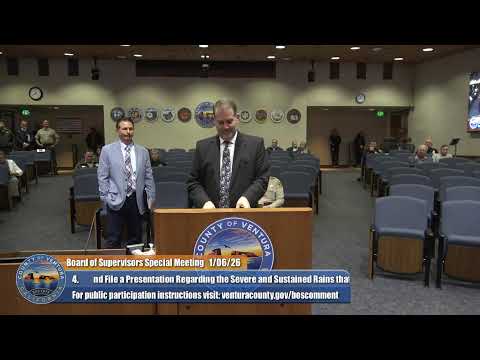
The Ventura County Board of Supervisors unanimously approved staff recommendations on Jan. 6 to receive a briefing on December storm impacts and ratify the Ventura County sheriff's Jan. 2 proclamation of local emergency.
Sheriff Fryhoff told the board the county had sustained "estimates are $14,000,000 in damage that we sustained as a county," and urged residents to avoid waterways and heed evacuation orders. Patrick Maynard, director of emergency services, told the board that the sheriff signed the proclamation Jan. 2 and that state law requires the board to ratify it within seven days to preserve eligibility for reimbursement.
The ratification sets the county up to pursue state disaster assistance if federal help is not available. "We will likely not be receiving any assistance from FEMA just based on the magnitude of this," Maynard said, noting FEMA requires roughly $74,000,000 in statewide damage to trigger assistance and that Ventura County had not reached that threshold. Maynard said the California Disaster Assistance Act could cover 75% of eligible expenses, leaving the county responsible for 25%.
Public Works Agency Director Greg Strackelouse provided a technical briefing on infrastructure impacts and emergency repairs. "In the Ventura area alone, we've received 16.3 inches," he said, and reported 43 identified cleanup or repair locations and about $13,800,000 in public-works cleanup and repair costs so far. Strackelouse described emergency stabilization work on multiple sites.
Among the most urgent repairs: - Old Telegraph Road (Supervisor Longs district): crews placed heavy rock to protect an eroded foundation and established a 3-ton weight restriction with eastbound traffic only. - Reeves Road: emergency measures protected a slope next to utilities; public-works staff said a contractor will start under an emergency contract next Monday and the initial contract will likely take about 2to3 weeks to restore access. - Water Works District 1 sewer main break: an exposed 8-inch gravity sewer line failed and crews estimate about 48,000 gallons spilled into the arroyo; a temporary pipeline was installed while a deeper, permanent replacement is designed. - Barlow Barranca: a roughly 220-foot section of a 12-foot-deep stormwater conveyance failed and threatened private property; crews hired a contractor and installed rock-filled baskets to construct about 120 feet of temporary protection.
Board members pressed staff on the distinction between public and private damage, permitting limits on work in streambeds and options for long-term resilience. Jeff Palmer and watershed staff said many creeks and rivers are on private property and that the county is limited in where it can spend public funds; they identified the U.S. Army Corps of Engineers, NRCS programs (including the Emergency Watershed Protection Program) and state funding as partners for larger projects.
Anita Balan, who spoke for public-works operations, said the Reeves Road contractor will begin work next Monday, with a short contract to reopen the road: "We'll have them start work starting Monday... it'll probably take 2 to 3 weeks to at least get that road back in shape." Watershed engineers said the Barlow repair will require design work and easement/property conversations, and they are aiming to complete a permanent fix before next winter.
The board's formal action was to approve staff recommendations on Item 4 and ratify the sheriff's proclamation; Supervisor Parvin moved the motion and Supervisor Grohl seconded it. The motion passed unanimously.
Next steps include field inspections with state teams to document damage for reimbursement, continued emergency repairs under delegated authority, and follow-up work to develop resilient rebuild plans that state and federal partners would need to fund. County officials cautioned that reimbursement eligibility will depend on incident-period definitions and documentation for each damaged site.