Florida announces historic Citizens rate cuts, officials cite tort reforms and market returns
Loading...
Summary
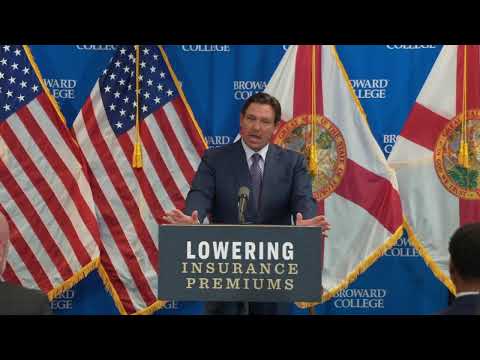
Governor Ron DeSantis and Insurance Commissioner Michael Jaworski announced statewide average reductions to Citizens Property Insurance of 8.7% and multiple private- and auto-insurer filings for rate decreases, which officials tied to 2022–23 tort reforms and increased carrier participation.
TALLAHASSEE — Governor Ron DeSantis announced on Jan. 15 that Citizens Property Insurance customers will see historic statewide rate reductions as regulators and insurers reflect an improving market.
"The statewide average will be 8.7% reduction," DeSantis said, adding that more than 150,000 policyholders will see their premiums fall by more than 10%. He gave county-level figures, saying Miami-Dade customers would see an average reduction near 14%, Broward 14.1% (about 27,000 homes) and Palm Beach about 11.9%. In Monroe County, DeSantis said homes with full coverage would see about an 11.3% decrease and that wind-only policies would not increase at renewal.
Insurance Office officials and the governor attributed the changes to a package of legal and regulatory reforms enacted in 2022 and 2023 that aimed to reduce litigation-related costs in the state’s markets. "The announcements the governor made today are entirely related to the tort reform measures that were enacted in 2022 and 2023," Michael Jaworski, the Insurance Office official who spoke at the event, said. Jaworski added that his office had returned $40,000,000 to policyholders in 2025 in cases where insurers had underpaid and that the Citizens filing was reviewed to ensure the reductions were "actuarially sound."
Officials also cited private-market moves: DeSantis said 17 new carriers entered Florida, and many insurers filed for rate decreases in recent months. Examples cited at the briefing included Peninsula Property’s roughly 8.2% filing, Security First’s average 8% decrease for about 62,000 homes, and Universal Property & Casualty’s 5.1% reduction for a quoted block of policies. DeSantis said Progressive planned a refund of $1,000,000,000 and that major auto insurers and others had submitted average reductions.
Officials emphasized the timing of those changes: private-market decreases take effect at each policyholder’s next renewal date; Citizens reductions were expected to appear primarily in spring renewals. "If your next renewal is coming up, you'll get it in January. If it's not till April, then it would likely wait until April," DeSantis said.
The governor noted the state's history of concentrated litigation in a small number of counties during the prior crisis and framed the depopulation of Citizens — from about 1.3 million policies at the peak to under 400,000 now — as a stability improvement for the residual market. He also cited falls in surplus-lines pricing (business surplus lines down about 33%, residential surplus lines down about 15%) as further market signals.
Jaworski said his office had "hunted through every single piece" of the Citizens rate filing to identify reductions that could be made on an actuarially sound basis and that Citizens would remain well-capitalized after the changes.
What happens next: regulators will finalize filings and reductions will appear at policy renewals. Officials warned that not every market entrant will write in every county, and high-risk areas may still have limited private options. DeSantis said he expects the positive momentum to continue barring major external shocks or reversal of the tort reforms by the Legislature.