
CPUC staff outlines RMAR filing schedule, recast/backcast rules and methods to show mitigation effectiveness at public workshop
Get AI-powered insights, summaries, and transcripts
Subscribe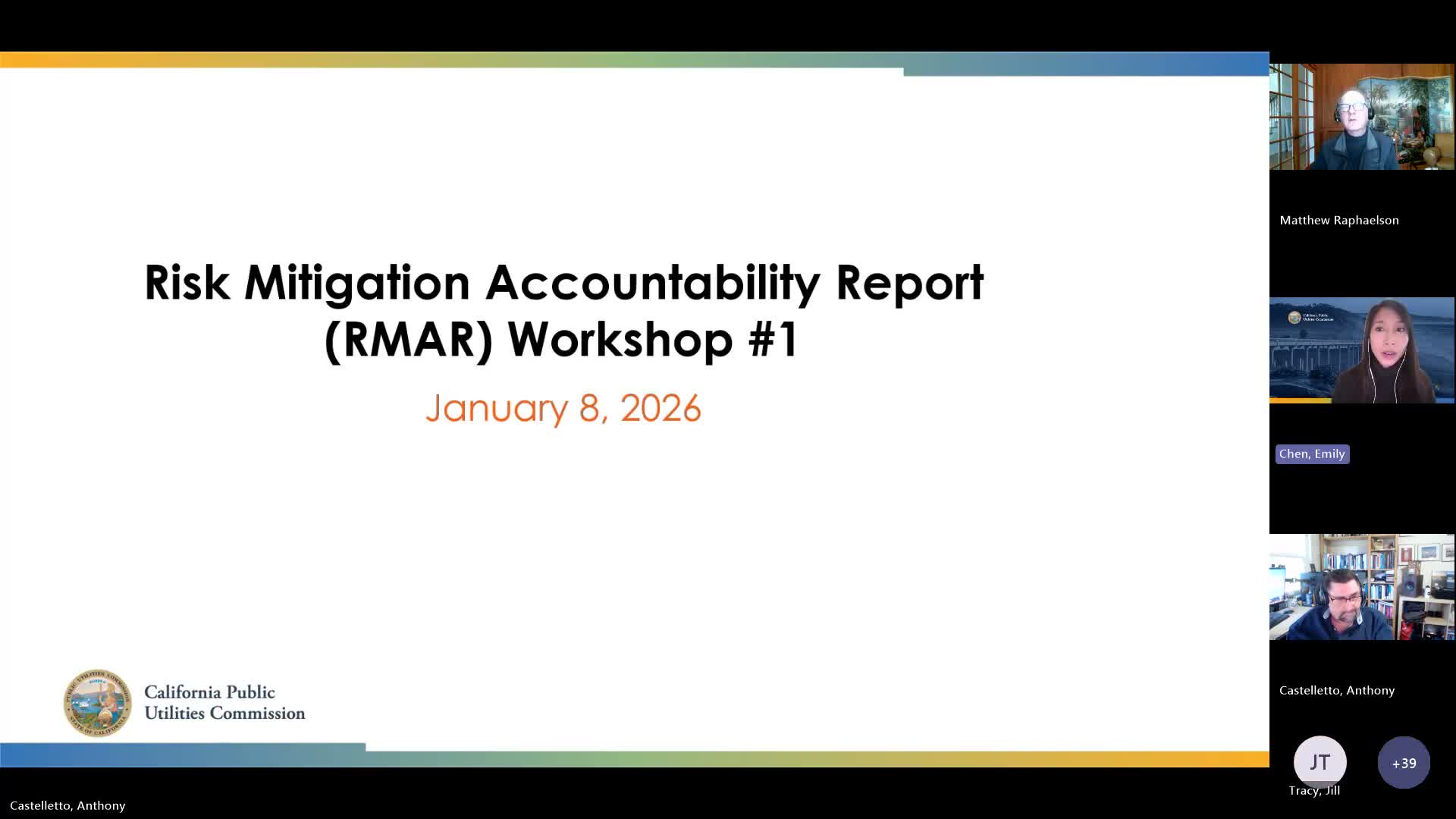
Summary
At a CPUC Safety Policy Division workshop, staff presented RMAR staff proposal number 2, recommended filing schedules tied to GRC cycles, described recast/backcast methods to preserve apples‑to‑apples comparisons, and asked parties for comments on thresholds, data tables and how utilities should demonstrate mitigation effectiveness. SPD will post a revised proposal and redline on Jan. 15; party proposals due Feb. 9.
The California Public Utilities Commission’s Safety Policy Division (SPD) hosted a workshop to review staff proposal number 2 for the Risk Mitigation Accountability Report (RMAR) framework and to solicit party comments on filing schedules, change‑control rules and methods to show whether observed risk reductions are attributable to mitigation actions.
SPD regulatory analyst Emily opened the session, introduced co‑presenters including Tony Castoletto and Matthew Raffelson (Level 4), and said the meeting was recorded. Emily said the workshop would address timing and cadence of RMAR filings, requirements for plan and reporting phases, procedures for change control including recast and backcast, and which RMAR tables should be required. She emphasized that no formal commission decisions would be taken at the workshop.
Why it matters: SPD is proposing standardized, table‑based RMAR filings so risk information is comparable across investor‑owned utilities and GRC cycles. Staff framed RMAR as a consolidated statement of risk with a plan phase (forecasts adopted in a GRC) and a reporting phase (annual RMARs that report outcomes, results and projections). The filing schedule staff proposed would require the first plan‑phase RMAR tables six months after a GRC decision and annual reporting due April 30 following the test year, aligned with the RSAR calendar for comments and division review.
Key staff proposals and clarifications
- Filing timing: SPD recommended two RMAR filing schedules — a plan‑phase submission six months after a GRC decision and annual complete RMAR submissions following the RSAR calendar (annual RMARs due April 30; intervener comments July 21; CPUC division review Oct. 31). SPD showed example first‑filing dates tied to each IOU’s GRC cycle and invited alternative schedules in party comments.
- Tables and format: Staff said all RMAR tables should be required except the tail‑risk table (optional). SPD also recommended adding a stock (snapshot) companion to an existing flow (change‑over‑time) table to show mitigation benefits versus forecasted values.
- Recast, backcast and replan: SPD defined recast (apply original models/data to a current year) and backcast (apply current models to the original forecast) as backward‑looking methods intended to preserve apples‑to‑apples comparisons. Replans would be rare and require strict regulatory approval; SPD recommended bridging tables and narratives where full versioning is impractical.
- Demonstrating mitigation effectiveness: SPD and Level 4 explained that showing the absence of an adverse event does not, by itself, prove mitigation effectiveness. Matthew Raffelson described a mix of methods — outcome/results analysis, input analysis for rare events, trend analysis, tests and controls, and hypothesis testing — and said utilities should provide a methodology and supporting datasets demonstrating confidence that observed results were due to mitigation rather than exogenous factors.
What participants asked and offered
Utility representatives and intervenors raised practical concerns about timing, data burden and methodology. Brian (Edison) asked about sequencing when GRC decisions and filings do not align; SPD said parties may propose alternative schedules during the discussion period and in opening comments. Several IOU speakers (including PG&E and SCE representatives) warned that an April 30 RMAR deadline could overlap other filings and be burdensome; some urged the RMAR due date be tied to RSAR/RSAR extensions or moved later to allow additional analysis.
Participants also raised questions about long‑lived mitigations (for example, undergrounding or pipeline replacement with multi‑decade lifetime). Matthew said RMAR reporting will continue until a mitigation is used and useful and that staff expects at least one post‑completion report year before projecting remaining asset life benefits for benefit‑cost calculations rather than tracking dozens of annual RMARs.
On change‑control triggers and thresholds (for when a recast or backcast is required), utilities and intervenors cautioned against hard numeric thresholds (for example, an arbitrary 10% change). Some recommended statistically grounded triggers (e.g., deviations measured in standard deviations, persistent breaches) or leaving the decision to utilities with transparent disclosure and recast/backcast when they adopt new models.
Direct quote: At one point during the presentation, when a participant asked a substantive question mid‑slide, Matthew told the participant, "This is not your meeting," and SPD redirected participants to use the chat or the scheduled Q&A so the presentation could continue and all questions could be addressed in the designated discussion period.
Next steps and deadlines
SPD said it will revise RMAR staff proposal number 2 to incorporate certain changes, and "share this, and the red line version and the post workshop questions on January 15." Party proposals on utility accountability are due February 9; SPD said there will be additional workshops on utility accountability and one or more draft resolutions in the future. The workshop recording will be posted to YouTube in a few days.
The workshop closed with SPD asking parties to submit written opening comments and any remaining questions to the service list; SPD will compile and circulate post‑workshop answers and the redline proposal.